Talk to Special Deluxe like its author wrote you back.
Get the ideas that fit your life — not generic summaries.
- Chat with the book
- Audiobook-style main ideas
- Adapts to your life and goals
- Helps you take action
What it argues
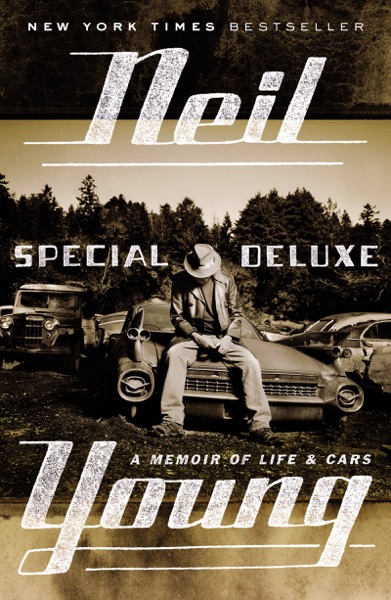
Special Deluxe is Neil Young's second memoir — a follow-up to Waging Heavy Peace (2012) — and it is organized around a peculiar structural conceit: Young uses each car he has owned over his lifetime as a chapter marker, and each vehicle serves as a portal to the memories of that period. The cars range from an early beater he drove as a teenager in Canada to the LincVolt, his obsessive project to convert a 1959 Lincoln Continental to run on alternative fuel. The vehicle structure is both endearing and slightly absurd, which seems to be part of the point.
The memoir does not follow conventional chronological autobiography. Young circles back to the same periods — the Buffalo Springfield years, his early solo career, the CSNY collaborations, the decades of experimentation — from different angles, never quite settling on a definitive account of anything. This can frustrate readers looking for a standard rock autobiography with narrative drive. But it accurately reflects how Young thinks and writes: associatively, digressively, interested in feeling and image over fact and sequence.
What it gets right
- 1.
Young uses each car as a memory container — the objects we obsess over often organize our emotional history more faithfully than chronological narrative.
- 2.
The LincVolt project — converting a 1959 Lincoln to alternative fuel — reflects Young's belief that love for beautiful old things and environmental concern are not in tension.
- 3.
Young's creative method across all fields is to follow instinct at the expense of completion. He abandons projects not out of indifference but because the impulse has moved on.
What it covers
Who wrote it
Neil Young is a Canadian-American musician, singer-songwriter, and filmmaker whose career spans more than six decades. He rose to prominence with the folk-rock group Buffalo Springfield in the 1960s and has since released more than forty studio albums as a solo artist and as part of Crosby, Stills, Nash and Young. He was inducted into the Rock and Roll Hall of Fame twice — as a solo artist and as a member of Buffalo Springfield — and is widely regarded as one of the most influential guitarists and songwriters in rock history. He is also a longtime environmental advocate and the creator of the Neil Young Archives project.
