Talk to Special Deluxe like its author wrote you back.
Get the ideas that fit your life — not generic summaries.
- Chat with the book
- Audiobook-style main ideas
- Adapts to your life and goals
- Helps you take action
Special Deluxe, in detail
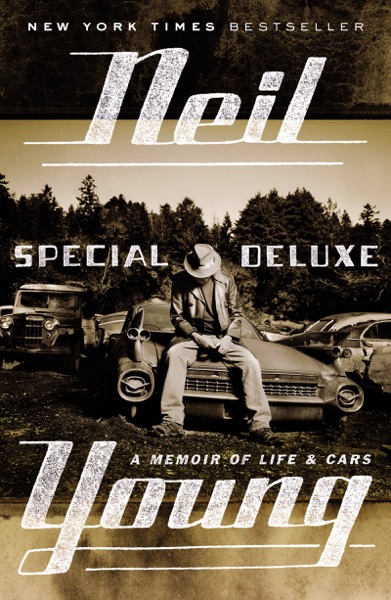
Special Deluxe is Neil Young's second memoir — a follow-up to Waging Heavy Peace (2012) — and it is organized around a peculiar structural conceit: Young uses each car he has owned over his lifetime as a chapter marker, and each vehicle serves as a portal to the memories of that period. The cars range from an early beater he drove as a teenager in Canada to the LincVolt, his obsessive project to convert a 1959 Lincoln Continental to run on alternative fuel. The vehicle structure is both endearing and slightly absurd, which seems to be part of the point.
The memoir does not follow conventional chronological autobiography. Young circles back to the same periods — the Buffalo Springfield years, his early solo career, the CSNY collaborations, the decades of experimentation — from different angles, never quite settling on a definitive account of anything. This can frustrate readers looking for a standard rock autobiography with narrative drive. But it accurately reflects how Young thinks and writes: associatively, digressively, interested in feeling and image over fact and sequence.
The environmental thread is more prominent here than in Waging Heavy Peace. Young became increasingly focused on fuel emissions and alternative energy, and the LincVolt project — which ended in the car catching fire in a warehouse — takes up considerable space in the later chapters. Young treats it not as a failure but as a proof of concept interrupted. His passion for this project, and for the Neil Young Archives digital project that runs in parallel through the book, reveals a person constitutionally unable to finish things in a way that other people find satisfying.
Special Deluxe is not the best way into Neil Young's life and work — that is probably Shakey, the authorized biography by Jimmy McDonough. But for readers already invested in Young, it offers something different: the rambling, inconsistent, frequently beautiful thinking of a person who has spent decades following instinct over coherence. The writing has passages of genuine clarity alongside passages that are puzzling, and the car metaphor occasionally sheds unexpected light on something that more conventional prose would not.
The big ideas
- 1.
Young uses each car as a memory container — the objects we obsess over often organize our emotional history more faithfully than chronological narrative.
- 2.
The LincVolt project — converting a 1959 Lincoln to alternative fuel — reflects Young's belief that love for beautiful old things and environmental concern are not in tension.
- 3.
Young's creative method across all fields is to follow instinct at the expense of completion. He abandons projects not out of indifference but because the impulse has moved on.
