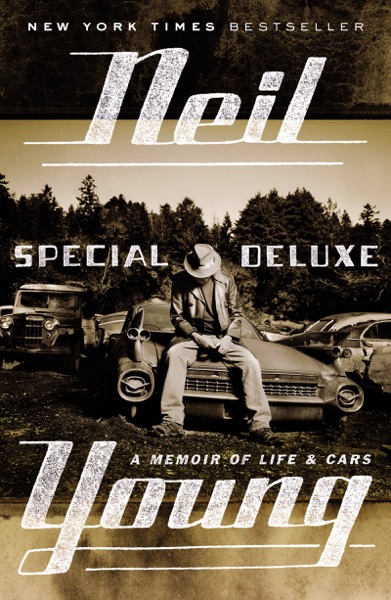
Special Deluxe by Neil Young is a 2014 memoir book about memory, music, environmentalism. Young uses each car as a memory container — the objects we obsess over often organize our emotional history more faithfully than chronological narrative.
Summary
Special Deluxe is Neil Young's second memoir — a follow-up to Waging Heavy Peace (2012) — and it is organized around a peculiar structural conceit: Young uses each car he has owned over his lifetime as a chapter marker, and each vehicle serves as a portal to the memories of that period. The cars range from an early beater he drove as a teenager in Canada to the LincVolt, his obsessive project to convert a 1959 Lincoln Continental to run on alternative fuel. The vehicle structure is both endearing and slightly absurd, which seems to be part of the point.
The memoir does not follow conventional chronological autobiography. Young circles back to the same periods — the Buffalo Springfield years, his early solo career, the CSNY collaborations, the decades of experimentation — from different angles, never quite settling on a definitive account of anything. This can frustrate readers looking for a standard rock autobiography with narrative drive. But it accurately reflects how Young thinks and writes: associatively, digressively, interested in feeling and image over fact and sequence.
The environmental thread is more prominent here than in Waging Heavy Peace. Young became increasingly focused on fuel emissions and alternative energy, and the LincVolt project — which ended in the car catching fire in a warehouse — takes up considerable space in the later chapters. Young treats it not as a failure but as a proof of concept interrupted. His passion for this project, and for the Neil Young Archives digital project that runs in parallel through the book, reveals a person constitutionally unable to finish things in a way that other people find satisfying.
Special Deluxe is not the best way into Neil Young's life and work — that is probably Shakey, the authorized biography by Jimmy McDonough. But for readers already invested in Young, it offers something different: the rambling, inconsistent, frequently beautiful thinking of a person who has spent decades following instinct over coherence. The writing has passages of genuine clarity alongside passages that are puzzling, and the car metaphor occasionally sheds unexpected light on something that more conventional prose would not.
Talk to Special Deluxe like its author wrote you back.
Get the ideas that fit your life — not generic summaries.
- Chat with the book
- Audiobook-style main ideas
- Adapts to your life and goals
- Helps you take action
Key takeaways
- 1.
Young uses each car as a memory container — the objects we obsess over often organize our emotional history more faithfully than chronological narrative.
- 2.
The LincVolt project — converting a 1959 Lincoln to alternative fuel — reflects Young's belief that love for beautiful old things and environmental concern are not in tension.
- 3.
Young's creative method across all fields is to follow instinct at the expense of completion. He abandons projects not out of indifference but because the impulse has moved on.
- 4.
The memoir reflects a larger truth about how musicians remember their careers: not as a story with clear arcs but as a series of emotional states with different sonic backdrops.
- 5.
Young treats his environmental work as continuous with his music: both are expressions of feeling rather than calculated positions, and the advocacy is as instinct-driven as the songwriting.
- 6.
Special Deluxe is a companion to Waging Heavy Peace rather than a sequel — both books circle the same preoccupations rather than advancing a narrative.
- 7.
The book is most valuable as a portrait of an artist in old age still fully engaged with process: the Archives project, the LincVolt, the writing itself are all expressions of the same restless energy.
Discussion questions
Use these on your own, with a book club, or as chat starters in Superbook. Book club version, ready to copy or print →
- 1.
Young uses cars as memory anchors. What objects serve that function in your own life — things that, when you see or think about them, reliably bring back a specific period or feeling?
- 2.
The memoir resists chronological narrative. Is that a reflection of how memory actually works, or does it feel like an evasion of the harder task of making sense of a life?
- 3.
Young's environmental advocacy is emotional rather than policy-driven. Is that a more or less persuasive form of advocacy than data-driven argument?
- 4.
The LincVolt burned in a warehouse before Young could demonstrate what it could do. How do you think about the value of a project that fails at the demonstration stage?
- 5.
Young has been criticized for inconsistency — championing environmental causes while running diesel-hungry touring infrastructure. Does he address that tension honestly?
- 6.
Both Young memoirs avoid the standard rock autobiography format — the chronological rise, the crisis, the redemption arc. What does that refusal suggest about how he wants to be understood?
- 7.
The book was written in a period when Young was also building the Neil Young Archives — a massive project to organize and release his recorded output. How does archival work relate to memory and to identity?
- 8.
Young writes without a collaborator or ghostwriter, and the voice is very much his own — associative, sometimes cryptic. Does that authenticity outweigh the loss in readability?
- 9.
Special Deluxe is dedicated to his car, which he acknowledges is an odd thing to do. What does that joke say about what the memoir is actually doing?
- 10.
Which version of Neil Young — the musician, the environmental advocate, the tinkerer, the memoirist — comes through most clearly in this book?
- 11.
Young's relationship to completion seems constitutionally conflicted: he returns to things, abandons things, and returns again. Is that a creative temperament or a personality trait, and is there a difference?
Themes
Frequently asked questions
-
Do I need to read Waging Heavy Peace first?
No, though they overlap in theme and temperament. Special Deluxe stands alone. Readers who enjoy one tend to enjoy the other, but neither provides the kind of biographical foundation that most readers expect from a memoir.
-
How long is Special Deluxe?
Around 300 pages with photographs, about four to five hours to read. The prose is not dense; the meandering quality makes it feel longer in places.
-
Is Special Deluxe actually about cars?
Cars are the organizing device, but the book is really about memory, music, environmentalism, and creative process. The car metaphor is playful — Young is aware of the absurdity — and it works intermittently rather than consistently.
-
What is the LincVolt?
A 1959 Lincoln Continental that Young had converted to run on ethanol and biodiesel in a series-hybrid configuration. The project was intended as a demonstration that beautiful American cars could be retrofitted for cleaner fuel. The car caught fire in a warehouse in 2010. Young continued the project afterward.
-
Is this book for non-Neil Young fans?
Probably not. Without existing investment in Young's music, the associative structure and the lack of conventional narrative make the book harder to engage with. Fans of rock memoir as a genre but not specifically Young fans may find it frustrating.