Science · Book club
Spillover book club questions
Here are 12 book club questions for Spillover by David Quammen, ordered to open easily and end somewhere worth arguing about. Copy them, print them, or bring them up one at a time.
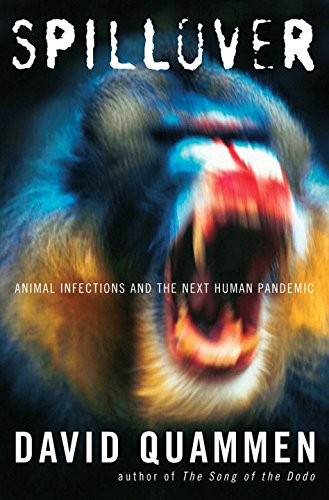
Spillover is David Quammen's exhaustive investigation into zoonotic disease — illness that jumps from animals to humans — and the ecological and evolutionary logic behind why such spillover events happen.
David Quammen · 2012 · 8h 45m
Full summary and key takeaways →The 12 questions
- 1.
Quammen argues that pandemic risk is structural — driven by habitat destruction and population density — rather than random. Does that framing change how you think about pandemic preparedness policy?
- 2.
The bat chapters make a strong case that specific ecological features of bats make them uniquely dangerous reservoir hosts. Were you aware of this before reading? What surprised you most?
- 3.
Quammen spent years in the field for this book. What does primary fieldwork add to science journalism that secondary synthesis can't provide?
- 4.
How do you read Spillover differently knowing about COVID-19? Does its prescience make it more or less useful as a guide to understanding the present?
- 5.
The book traces HIV to a single spillover event, probably a single hunter. How do you hold together that contingency — one moment — with the structural forces that made the pandemic possible?
- 6.
Quammen treats the Next Big One as a near-certainty. Does that certainty change anything about how you think individual people should respond versus how governments should respond?
- 7.
The reservoir host problem — finding where a virus hides between outbreaks — has never been solved for Ebola. What does that say about the limits of epidemiological knowledge?
- 8.
Quammen writes about scientists who spend careers studying viruses in bats in remote forests. What draws people to that kind of work?
- 9.
Which spillover event in the book did you find most alarming? Which was least surprising?
- 10.
The book was published in 2012. If Quammen were revising it today, what new cases would he add and how do you think his argument would change?
- 11.
Habitat destruction is the structural driver Quammen emphasizes. But that destruction is driven by poverty and development pressure in the same regions where reservoir species live. How do you weigh that tradeoff?
- 12.
Spillover is dense and long. What would you have cut, and what does the length give you that a shorter book couldn't?
How to run the discussion
- Pick six to eight, not all of them. An hour of real discussion covers fewer questions than anyone expects, and racing the list is what makes a book club feel like homework.
- Open with what people noticed, not what they concluded. Asking for a verdict first hardens opinions before anyone has heard each other.
- Let the disagreement run. The questions below that split a room are the ones worth the time; the ones everyone answers the same way can be skipped.
- Ask the quiet person a specific question. A direct, narrow question is far easier to answer than an open invitation to contribute.
Themes worth steering toward
If the conversation stalls, these are the threads that usually restart it.
Common questions
What are good book club questions for Spillover?
Here are 12 book club questions for Spillover by David Quammen, ordered to open easily and end somewhere worth arguing about. The strongest openers ask what each reader noticed rather than what they concluded, and the discussion usually turns on zoonotic disease, ecology, epidemics.
How long should a book club discussion of Spillover last?
Most groups run 60 to 90 minutes of actual discussion. That is roughly six to eight questions, not all of them, so pick the ones that suit your group rather than working down the list in order.
What are the main themes in Spillover?
Zoonotic disease, Ecology, Epidemics, Evolution, Public health. Those are the threads most likely to divide a room, which makes them the useful places to steer a discussion that has gone quiet.
Picking the next one? See books like Spillover or questions for other book club picks.
