Business · Book club
Sprint book club questions
Here are 12 book club questions for Sprint by Jake Knapp, John Zeratsky, and Braden Kowitz, ordered to open easily and end somewhere worth arguing about. Copy them, print them, or bring them up one at a time.
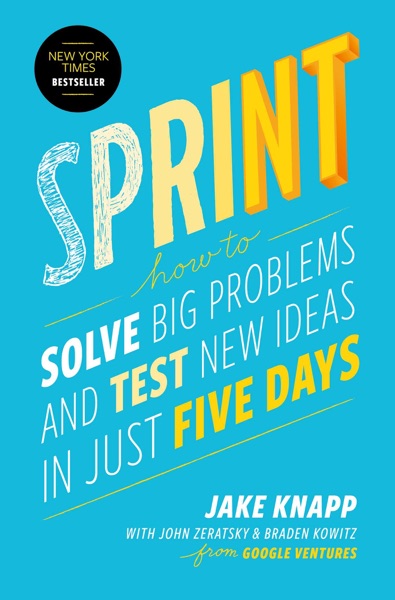
Sprint is the account of the design sprint methodology developed at Google Ventures — a five-day process for answering critical business questions through rapid prototyping and real user testing.
Jake Knapp, John Zeratsky, and Braden Kowitz · 2016 · 4h 45m
Full summary and key takeaways →The 12 questions
- 1.
The book argues a five-day sprint can answer questions that take months by conventional methods. What is it about the sprint structure that produces this compression — and why don't most organizations work this way by default?
- 2.
The 'no phones or laptops in the sprint room' rule is one most teams find hardest to follow. What is it protecting against — and do you think the rule is essential or can it be adjusted?
- 3.
The book requires a named Decider who makes final calls. What happens in organizations or teams where authority is unclear, diffuse, or contested — and is the sprint methodology feasible there?
- 4.
Individual sketching before group discussion is central to the sprint's ideation method. Have you seen this work — or fail — in your own experience of group problem-solving?
- 5.
The sprint produces a validated answer to one focused question. What questions is it not suited to answer — and how do you decide what deserves a sprint versus a different approach?
- 6.
Five users in a Friday test session are described as sufficient to identify meaningful patterns. Does this number feel right to you — and when would you want more?
- 7.
The prototype built on Thursday is explicitly not a real product — it's a facade designed to test one thing. What are the risks of that kind of testing, and when might fake prototypes mislead you?
- 8.
The book was written by Google Ventures partners, and many of the examples are technology startups. Does the methodology translate to very different contexts — hardware, services, government, education?
- 9.
Sprints constrain the problem to what can be answered in a week. What happens to the questions that are genuinely too complex for a sprint — and is there a risk that sprints are biased toward questions that can be simplified?
- 10.
If you've been through a design sprint, how did the reality compare to the book's account? What worked, what didn't?
- 11.
The sprint replaces most meetings with structured independent work. What would have to change about your organization's culture for this to be accepted — and is culture the main obstacle?
- 12.
Rapid prototyping and user testing in five days requires a certain kind of risk tolerance. How do you think about the balance between speed and thoroughness in your own work?
How to run the discussion
- Pick six to eight, not all of them. An hour of real discussion covers fewer questions than anyone expects, and racing the list is what makes a book club feel like homework.
- Open with what people noticed, not what they concluded. Asking for a verdict first hardens opinions before anyone has heard each other.
- Let the disagreement run. The questions below that split a room are the ones worth the time; the ones everyone answers the same way can be skipped.
- Ask the quiet person a specific question. A direct, narrow question is far easier to answer than an open invitation to contribute.
Themes worth steering toward
If the conversation stalls, these are the threads that usually restart it.
Common questions
What are good book club questions for Sprint?
Here are 12 book club questions for Sprint by Jake Knapp, John Zeratsky, and Braden Kowitz, ordered to open easily and end somewhere worth arguing about. The strongest openers ask what each reader noticed rather than what they concluded, and the discussion usually turns on product design, rapid prototyping, team decision-making.
How long should a book club discussion of Sprint last?
Most groups run 60 to 90 minutes of actual discussion. That is roughly six to eight questions, not all of them, so pick the ones that suit your group rather than working down the list in order.
What are the main themes in Sprint?
Product design, Rapid prototyping, Team decision-making, Testing and validation, Innovation process. Those are the threads most likely to divide a room, which makes them the useful places to steer a discussion that has gone quiet.
Picking the next one? See books like Sprint or questions for other book club picks.
