Fantasy · Book club
Stardust book club questions
Here are 11 book club questions for Stardust by Neil Gaiman, ordered to open easily and end somewhere worth arguing about. Copy them, print them, or bring them up one at a time.
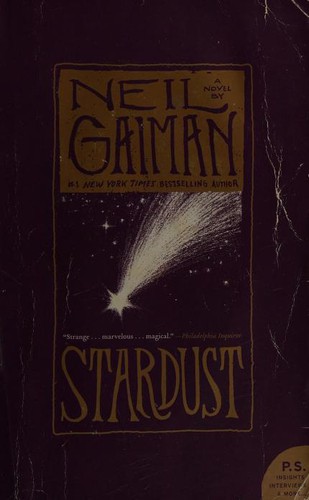
Stardust begins with a simple bargain: young Tristran Thorn promises a girl he fancies that he will bring her a fallen star, and to find it he must cross the wall at the edge of his English village into Faerie.
Neil Gaiman · 1999 · 4h 0m
Full summary and key takeaways →The 11 questions
- 1.
Tristran's promise to Victoria drives the entire plot, but Victoria herself is barely a character. Is she meant to be a placeholder, or is that kind of unexamined longing part of the story's argument?
- 2.
Yvaine arrives in the story as a victim of circumstance and leaves as an agent of her own fate. At what point does the shift happen, and what makes it convincing?
- 3.
The witch-queen is the most vivid antagonist, and the novel gives her real interiority. Does she get what she deserves, or is the ending too neat for her?
- 4.
Gaiman frames this as an old-fashioned fairy tale, complete with the narrator's gentle asides. Does that framing add to the story or hold it at a comfortable distance?
- 5.
The wall between the village and Faerie stands for something — but what, exactly? What does each side represent, and is the divide ever really resolved?
- 6.
Stardust is a love story, but the love develops slowly and almost reluctantly. Is that pacing realistic, or is it a convenient way to delay the emotional payoff?
- 7.
The princes' succession plot runs parallel to the main story but never quite merges with it. Does it add texture or dilute the focus?
- 8.
Compared to American Gods, Stardust is quieter and more intimate. Which version of Gaiman do you prefer, and what does the choice say about what you want from fantasy?
- 9.
The novel was published with Charles Vess's illustrations and later adapted into a film. How much do you think the story relies on visual atmosphere, and does it survive without pictures?
- 10.
The ending is unusually happy for a fairy tale — at least on the surface. What has been lost that the ending doesn't quite name?
- 11.
Tristran and Yvaine both have hidden origins that shape the plot. Is the revelation of origins satisfying, or does it feel like a convenient gift?
How to run the discussion
- Pick six to eight, not all of them. An hour of real discussion covers fewer questions than anyone expects, and racing the list is what makes a book club feel like homework.
- Open with what people noticed, not what they concluded. Asking for a verdict first hardens opinions before anyone has heard each other.
- Let the disagreement run. The questions below that split a room are the ones worth the time; the ones everyone answers the same way can be skipped.
- Ask the quiet person a specific question. A direct, narrow question is far easier to answer than an open invitation to contribute.
Themes worth steering toward
If the conversation stalls, these are the threads that usually restart it.
Common questions
What are good book club questions for Stardust?
Here are 11 book club questions for Stardust by Neil Gaiman, ordered to open easily and end somewhere worth arguing about. The strongest openers ask what each reader noticed rather than what they concluded, and the discussion usually turns on fairy tale logic, identity and transformation, love and sacrifice.
How long should a book club discussion of Stardust last?
Most groups run 60 to 90 minutes of actual discussion. That is roughly six to eight questions, not all of them, so pick the ones that suit your group rather than working down the list in order.
What are the main themes in Stardust?
Fairy tale logic, Identity and transformation, Love and sacrifice, The price of magic, Coming of age. Those are the threads most likely to divide a room, which makes them the useful places to steer a discussion that has gone quiet.
Picking the next one? See books like Stardust or questions for other book club picks.
