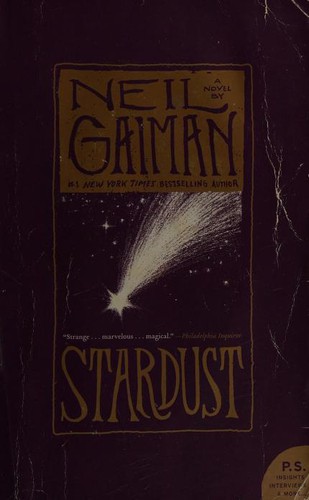
Stardust by Neil Gaiman is a 1999 fantasy book about fairy tale logic, identity and transformation, love and sacrifice. The journey changes the traveler in ways the traveler cannot predict before setting out — Tristran arrives at the wall one person and returns another, without the change ever feeling forced.
Summary
Stardust begins with a simple bargain: young Tristran Thorn promises a girl he fancies that he will bring her a fallen star, and to find it he must cross the wall at the edge of his English village into Faerie. What he finds on the other side is not a rock but a young woman named Yvaine, and the journey home turns out to be very different from the journey out. Gaiman is working in the mode of nineteenth-century fairy tale — Dunsany, MacDonald, William Morris — but the sensibility is contemporary and his voice is warm rather than cold.
The book is less concerned with plot mechanics than with the texture of a particular kind of magic: the kind that has rules even when it doesn't announce them, the kind that carries a cost even when the bill is deferred. Tristran starts as an earnest, slightly foolish young man who doesn't know who he is, and that ignorance turns out to be structural to the story. Meanwhile Yvaine is stranded in a world she didn't ask to enter, and the antagonists — a witch-queen, feuding princes — pursue their own agendas with an amoral competence that feels genuinely dangerous.
What distinguishes Stardust from much of the fantasy written at the same time is restraint. It is a short book that says what it means to say and stops. Gaiman's prose has the cadence of someone telling a story by a fire, with an occasional aside that reminds you the narrator knows more than he's letting on. The romance is earnest without being saccharine, and the ending earns its warmth. The novel was published alongside illustrations by Charles Vess in its original edition, though the trade paperback stands well on its own.
Readers who want vast world-building, multiple POVs, and a complex magic system will find Stardust too small and too lean. Readers who like their fantasy the way Angela Carter or Ursula K. Le Guin wrote it — the fairy tale as a vehicle for emotional and moral investigation — will find it nearly perfect. It is also one of Gaiman's most accessible books, a good entry point before American Gods or the Sandman comics.
Talk to Stardust like its author wrote you back.
Get the ideas that fit your life — not generic summaries.
- Chat with the book
- Audiobook-style main ideas
- Adapts to your life and goals
- Helps you take action
Key takeaways
- 1.
The journey changes the traveler in ways the traveler cannot predict before setting out — Tristran arrives at the wall one person and returns another, without the change ever feeling forced.
- 2.
Gaiman's Faerie operates on the logic of old tales: deals bind, true names matter, and innocence is not the same as safety.
- 3.
The novel treats love not as something that happens to people but as something they grow into through ordeal and attention.
- 4.
The antagonists are genuinely menacing precisely because they want plausible things — power, immortality, a throne — and pursue them with competence and without guilt.
- 5.
Identity in the book is always partly unknown to the person who holds it; the self is something you discover, not something you construct.
- 6.
Gaiman uses the narrator's voice as a structural element — the occasional aside reminds you that you're hearing a story, which gives the more brutal moments a strange comfort.
- 7.
The magic in Stardust has moral weight without moral instruction. It doesn't teach lessons; it simply shows that the universe has structure and that ignoring it has consequences.
Discussion questions
Use these on your own, with a book club, or as chat starters in Superbook. Book club version, ready to copy or print →
- 1.
Tristran's promise to Victoria drives the entire plot, but Victoria herself is barely a character. Is she meant to be a placeholder, or is that kind of unexamined longing part of the story's argument?
- 2.
Yvaine arrives in the story as a victim of circumstance and leaves as an agent of her own fate. At what point does the shift happen, and what makes it convincing?
- 3.
The witch-queen is the most vivid antagonist, and the novel gives her real interiority. Does she get what she deserves, or is the ending too neat for her?
- 4.
Gaiman frames this as an old-fashioned fairy tale, complete with the narrator's gentle asides. Does that framing add to the story or hold it at a comfortable distance?
- 5.
The wall between the village and Faerie stands for something — but what, exactly? What does each side represent, and is the divide ever really resolved?
- 6.
Stardust is a love story, but the love develops slowly and almost reluctantly. Is that pacing realistic, or is it a convenient way to delay the emotional payoff?
- 7.
The princes' succession plot runs parallel to the main story but never quite merges with it. Does it add texture or dilute the focus?
- 8.
Compared to American Gods, Stardust is quieter and more intimate. Which version of Gaiman do you prefer, and what does the choice say about what you want from fantasy?
- 9.
The novel was published with Charles Vess's illustrations and later adapted into a film. How much do you think the story relies on visual atmosphere, and does it survive without pictures?
- 10.
The ending is unusually happy for a fairy tale — at least on the surface. What has been lost that the ending doesn't quite name?
- 11.
Tristran and Yvaine both have hidden origins that shape the plot. Is the revelation of origins satisfying, or does it feel like a convenient gift?
Themes
Frequently asked questions
-
Is Stardust worth reading as an adult?
Yes, and it reads faster and more warmly than most of Gaiman's longer work. It's a fairy tale written for adults who remember what made fairy tales feel necessary when they were young. If you're expecting the scope of American Gods, adjust expectations downward — this is a shorter, more intimate book, and that's a virtue.
-
How does the Stardust novel compare to the 2007 film?
The film expands the story significantly, adds action sequences, and has a broader comic tone. The novel is quieter, more melancholic, and the romance develops more slowly. Both are good in different ways; the film is a better popcorn experience, the novel is a better meditation.
-
Is Stardust suitable for younger readers?
It contains some violence and brief sexual content, so it's best suited for older teens and adults. It's not dark in the way Coraline is — the tone is warmer — but it's written for grown readers, not children.
-
What is Stardust actually about, without spoilers?
A young man crosses into a magical land to retrieve a fallen star, and discovers that what he thought he wanted and who he thought he was are both wrong. It's about love, identity, and what it costs to grow up.
-
Who shouldn't read Stardust?
Readers who want extensive world-building, hard magic systems, or a sprawling cast. This is a small, elegant book that favors atmosphere over mechanics and emotional truth over plot complexity.