Health · Book club
Starting Strength book club questions
Here are 12 book club questions for Starting Strength by Mark Rippetoe, ordered to open easily and end somewhere worth arguing about. Copy them, print them, or bring them up one at a time.
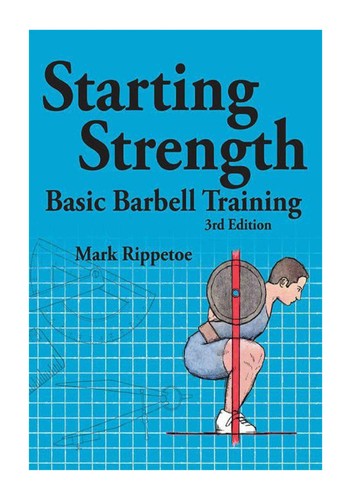
Starting Strength is Mark Rippetoe's comprehensive manual for barbell training, built around the argument that strength — the ability to produce force against external resistance — is the foundational physical quality from which most other fitness attributes benefit.
Mark Rippetoe · 2005 · 8h 0m
Full summary and key takeaways →The 12 questions
- 1.
Rippetoe argues that strength is the foundational fitness quality. How does that claim fit with what your own physical goals have been — have you prioritized strength, endurance, appearance, or something else?
- 2.
The barbell squat is the center of his program. Have you learned to squat? What was the experience of receiving coaching on a technically complex movement like the squat?
- 3.
Linear Progression sounds almost too simple — add five pounds every session. What does the existence of such a simple effective approach suggest about why people overcomplicate training?
- 4.
Rippetoe is dismissive of machine training and high-rep workouts. Have you experienced both? Do his criticisms match your experience?
- 5.
He argues women should train the same way as men with the same movements. Does the fitness industry's gender differentiation in training advice reflect biological reality or marketing?
- 6.
The book is written with unusual confidence and dismissiveness toward alternatives. Does strong, opinionated writing make you more or less likely to trust the advice?
- 7.
Technical detail is pervasive in the book — more biomechanics than most fitness readers expect. Did that depth increase your confidence in the prescriptions or make them less accessible?
- 8.
Rippetoe argues that most people quit training before they have genuinely exhausted novice gains. What does 'novice' mean in his framework, and how do most people misjudge where they are?
- 9.
The book treats getting strong as a fundamentally moral and practical good for all humans. Is that a position you share, or does it feel too prescriptive about what physical development means?
- 10.
He covers the nutritional requirements for strength training — eat more than you think you need, prioritize protein. Is adequate nutrition the most commonly overlooked component of training results?
- 11.
Starting Strength has influenced a generation of strength coaches and athletes. What is it about the book that produced such lasting impact in a field full of competing programs?
- 12.
If you were to start a barbell training program today, what would be the primary obstacle — equipment access, technique learning, time, or something else?
How to run the discussion
- Pick six to eight, not all of them. An hour of real discussion covers fewer questions than anyone expects, and racing the list is what makes a book club feel like homework.
- Open with what people noticed, not what they concluded. Asking for a verdict first hardens opinions before anyone has heard each other.
- Let the disagreement run. The questions below that split a room are the ones worth the time; the ones everyone answers the same way can be skipped.
- Ask the quiet person a specific question. A direct, narrow question is far easier to answer than an open invitation to contribute.
Themes worth steering toward
If the conversation stalls, these are the threads that usually restart it.
Common questions
What are good book club questions for Starting Strength?
Here are 12 book club questions for Starting Strength by Mark Rippetoe, ordered to open easily and end somewhere worth arguing about. The strongest openers ask what each reader noticed rather than what they concluded, and the discussion usually turns on strength training, barbell training, movement mechanics.
How long should a book club discussion of Starting Strength last?
Most groups run 60 to 90 minutes of actual discussion. That is roughly six to eight questions, not all of them, so pick the ones that suit your group rather than working down the list in order.
What are the main themes in Starting Strength?
Strength training, Barbell training, Movement mechanics, Progressive overload, Physical development. Those are the threads most likely to divide a room, which makes them the useful places to steer a discussion that has gone quiet.
Picking the next one? See books like Starting Strength or questions for other book club picks.
