Philosophy · Book club
Stillness Is the Key book club questions
Here are 12 book club questions for Stillness Is the Key by Ryan Holiday, ordered to open easily and end somewhere worth arguing about. Copy them, print them, or bring them up one at a time.
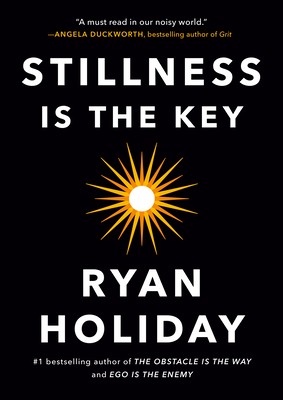
Ryan Holiday's central argument is deceptively simple: the ability to be still — to quiet the mind, resist distraction, and act from a place of clarity rather than reaction — is not a passive virtue but an active competitive advantage.
Ryan Holiday · 2019 · 5h 0m
Full summary and key takeaways →The 12 questions
- 1.
Holiday says stillness is an active skill, not a passive state. What would it look like in your own work or relationships to act from stillness rather than from reaction?
- 2.
The book opens with Kennedy during the Cuban Missile Crisis. Think of a moment when you made a decision too quickly. What would slowing down have changed?
- 3.
Holiday argues that information overload is now the primary enemy of clear thinking. How do you manage your own inputs? Is what you're consuming earning its place?
- 4.
Which of the three arenas — mind, soul, body — is the biggest source of noise in your life right now? What's one thing you'd change first?
- 5.
The book makes a case for journaling as serious self-examination. Do you journal? If not, what's the honest reason — and does Holiday's framing make it more or less appealing?
- 6.
Holiday writes that ambition without contentment produces suffering. Is there an area of your life where the gap between what you have and what you want is making you worse rather than better?
- 7.
He draws on Marcus Aurelius, a sitting emperor who still wrote privately about his failures. What does that kind of self-accounting look like in your own life?
- 8.
The soul section argues that deep commitments — to people, to craft, to something beyond achievement — are what protect against internal turbulence. What are yours?
- 9.
Holiday doesn't tell you to quit social media, but the implication is there. Where in your daily life are you trading depth for stimulation, and is the trade worth it?
- 10.
The book is the third in a trilogy. If you've read The Obstacle Is the Way or Ego Is the Enemy, how does Stillness change or extend those arguments for you?
- 11.
Holiday profiles figures who reached extraordinary external success and remained internally stable. Who in your own life comes closest to that combination? What do they do differently?
- 12.
The body section is the shortest. Holiday's prescription — sleep, exercise, walking — is unglamorous. Why do you think it's so hard to do the obvious things consistently?
How to run the discussion
- Pick six to eight, not all of them. An hour of real discussion covers fewer questions than anyone expects, and racing the list is what makes a book club feel like homework.
- Open with what people noticed, not what they concluded. Asking for a verdict first hardens opinions before anyone has heard each other.
- Let the disagreement run. The questions below that split a room are the ones worth the time; the ones everyone answers the same way can be skipped.
- Ask the quiet person a specific question. A direct, narrow question is far easier to answer than an open invitation to contribute.
Themes worth steering toward
If the conversation stalls, these are the threads that usually restart it.
Common questions
What are good book club questions for Stillness Is the Key?
Here are 12 book club questions for Stillness Is the Key by Ryan Holiday, ordered to open easily and end somewhere worth arguing about. The strongest openers ask what each reader noticed rather than what they concluded, and the discussion usually turns on stillness, mindfulness, stoicism.
How long should a book club discussion of Stillness Is the Key last?
Most groups run 60 to 90 minutes of actual discussion. That is roughly six to eight questions, not all of them, so pick the ones that suit your group rather than working down the list in order.
What are the main themes in Stillness Is the Key?
Stillness, Mindfulness, Stoicism, Self-mastery, Inner peace. Those are the threads most likely to divide a room, which makes them the useful places to steer a discussion that has gone quiet.
Picking the next one? See books like Stillness Is the Key or questions for other book club picks.
