Economics · Book club
Stocks for the Long Run book club questions
Here are 12 book club questions for Stocks for the Long Run by Jeremy J. Siegel, ordered to open easily and end somewhere worth arguing about. Copy them, print them, or bring them up one at a time.
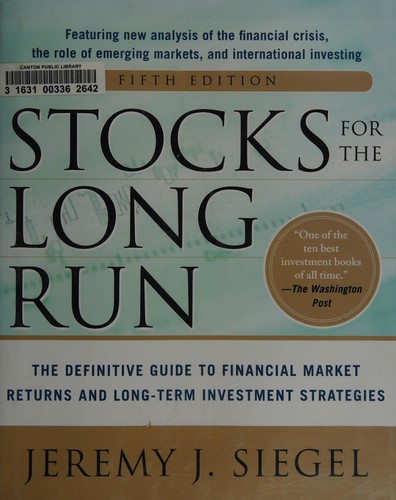
Stocks for the Long Run is Jeremy Siegel's comprehensive empirical case for equities as the dominant long-term asset class.
Jeremy J. Siegel · 1994 · 8h 0m
Full summary and key takeaways →The 12 questions
- 1.
Siegel's data covers nearly 200 years of US market history. How much weight do you give historical returns when thinking about your own investment future?
- 2.
The US may be a survivorship bias case — the country that happened to dominate the global economy. How does that possibility affect how you use Siegel's data?
- 3.
The book argues that long-horizon investors face less real risk in equities than in bonds. Does that argument change how you think about your own asset allocation?
- 4.
Siegel defines risk primarily as real purchasing power loss over time, not short-term volatility. Do you agree with that definition? How do you define risk for your own portfolio?
- 5.
The stock market has lost 30 to 50 percent of its value several times in the past century and always recovered. How confident are you that you would hold equities through a 40 percent decline rather than selling?
- 6.
Siegel's constant — a 6.5 to 7 percent real return on equities — has held for 200 years. Do you believe it will hold for the next 50? What would have to change for it not to?
- 7.
The book was first published in 1994, before the dot-com bubble and the 2008 financial crisis. Did those events change the core thesis, or were they well within the range of historical volatility the book describes?
- 8.
Inflation erodes bonds but equities provide a hedge. How are you personally thinking about inflation risk in your current portfolio?
- 9.
Siegel covers sector investing and argues that some sectors (e.g. energy, healthcare) have historically outperformed. How do you think about sector tilts in a largely passive portfolio?
- 10.
The book makes a case for a high equity allocation relative to conventional wisdom. If you increased your stock allocation by 10 percentage points, what would that mean for your sleep at night?
- 11.
International diversification is one of Siegel's recommendations in later editions. How much of your equity exposure is currently outside your home country?
- 12.
Siegel is an academic economist making an empirical case. How do you weigh his statistical arguments against your own emotional reactions to market moves?
How to run the discussion
- Pick six to eight, not all of them. An hour of real discussion covers fewer questions than anyone expects, and racing the list is what makes a book club feel like homework.
- Open with what people noticed, not what they concluded. Asking for a verdict first hardens opinions before anyone has heard each other.
- Let the disagreement run. The questions below that split a room are the ones worth the time; the ones everyone answers the same way can be skipped.
- Ask the quiet person a specific question. A direct, narrow question is far easier to answer than an open invitation to contribute.
Themes worth steering toward
If the conversation stalls, these are the threads that usually restart it.
Common questions
What are good book club questions for Stocks for the Long Run?
Here are 12 book club questions for Stocks for the Long Run by Jeremy J. Siegel, ordered to open easily and end somewhere worth arguing about. The strongest openers ask what each reader noticed rather than what they concluded, and the discussion usually turns on stock market history, long-term investing, asset allocation.
How long should a book club discussion of Stocks for the Long Run last?
Most groups run 60 to 90 minutes of actual discussion. That is roughly six to eight questions, not all of them, so pick the ones that suit your group rather than working down the list in order.
What are the main themes in Stocks for the Long Run?
Stock market history, Long-term investing, Asset allocation, Market returns, Risk and return. Those are the threads most likely to divide a room, which makes them the useful places to steer a discussion that has gone quiet.
Picking the next one? See books like Stocks for the Long Run or questions for other book club picks.
