Short stories · Book club
Stories of Your Life and Others book club questions
Here are 12 book club questions for Stories of Your Life and Others by Ted Chiang, ordered to open easily and end somewhere worth arguing about. Copy them, print them, or bring them up one at a time.
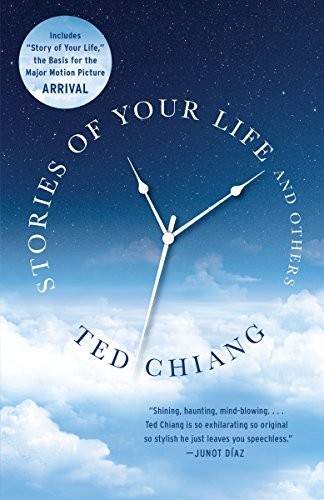
Eight stories, all of them rigorously thought-out, many of them devastating.
Ted Chiang · 2002 · 5h 45m
Full summary and key takeaways →The 12 questions
- 1.
In Story of Your Life, Louise knows her daughter will die and chooses to have her anyway. Does this seem like a meaningful choice if her future is already determined? Does the novel treat it as one?
- 2.
Chiang's story uses two-column parallel narration — present scenes with the aliens interwoven with future scenes with her daughter. How did that structure affect your experience of the grief at the center of the story?
- 3.
Hell Is the Absence of God portrays a God who is clearly real but whose behavior seems ethically indefensible. Whose side do you think Chiang is on — or does he refuse to take one?
- 4.
In Understand, the enhanced protagonist ends up more isolated the smarter he becomes. Is the story a warning about the limits of intelligence, or is it making a different point?
- 5.
Tower of Babylon takes the Babel story literally and follows a man who climbs the actual tower. What does it mean that the story ends where it begins? Is that a consolation or something else?
- 6.
Division by Zero is about a mathematician whose life falls apart when she disproves the consistency of mathematics. Can you articulate why that discovery would be psychologically destructive, rather than just professionally interesting?
- 7.
Chiang rarely writes protagonists you can unambiguously root for. Did you find that frustrating or did it serve the stories?
- 8.
The collection was published in 2002 but feels in many ways ahead of its time — the questions it asks about AI, enhancement, and language feel more current now. Which story felt most urgent on a first read?
- 9.
Story of Your Life uses the concept of variational principles in physics as a metaphor for non-linear time perception. Did that analogy clarify something for you, or did it stay opaque?
- 10.
Chiang has said he's not interested in stories about technology per se, but in stories about ideas that happen to involve technology. After reading the collection, do you find that distinction useful?
- 11.
Which story in the collection did you find most emotionally affecting, and why? Is there a pattern in which ideas produce the strongest feelings?
- 12.
Story of Your Life is now widely known through the film Arrival. If you saw the film first, how did reading the original story change or confirm your understanding of what the story is actually about?
How to run the discussion
- Pick six to eight, not all of them. An hour of real discussion covers fewer questions than anyone expects, and racing the list is what makes a book club feel like homework.
- Open with what people noticed, not what they concluded. Asking for a verdict first hardens opinions before anyone has heard each other.
- Let the disagreement run. The questions below that split a room are the ones worth the time; the ones everyone answers the same way can be skipped.
- Ask the quiet person a specific question. A direct, narrow question is far easier to answer than an open invitation to contribute.
Themes worth steering toward
If the conversation stalls, these are the threads that usually restart it.
Common questions
What are good book club questions for Stories of Your Life and Others?
Here are 12 book club questions for Stories of Your Life and Others by Ted Chiang, ordered to open easily and end somewhere worth arguing about. The strongest openers ask what each reader noticed rather than what they concluded, and the discussion usually turns on language and perception, free will and determinism, science and humanity.
How long should a book club discussion of Stories of Your Life and Others last?
Most groups run 60 to 90 minutes of actual discussion. That is roughly six to eight questions, not all of them, so pick the ones that suit your group rather than working down the list in order.
What are the main themes in Stories of Your Life and Others?
Language and perception, Free will and determinism, Science and humanity, Grief and memory, Identity transformation. Those are the threads most likely to divide a room, which makes them the useful places to steer a discussion that has gone quiet.
Picking the next one? See books like Stories of Your Life and Others or questions for other book club picks.
