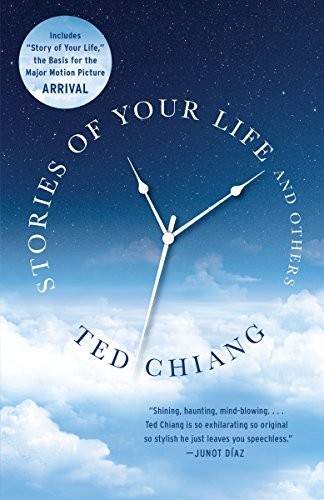
Stories of Your Life and Others by Ted Chiang is a 2002 short stories book about language and perception, free will and determinism, science and humanity. Story of Your Life uses the Sapir-Whorf hypothesis — the idea that language shapes thought — to ask what it would mean to experience time non-sequentially. The answer turns out to be about love and grief, not just linguistics.
Summary
Eight stories, all of them rigorously thought-out, many of them devastating. Ted Chiang takes a premise — a woman learns an alien language that restructures how she perceives time; a man undergoes surgery to correct a cognitive bias toward beauty; a medieval scholar confronts what biblical literalism would actually require — and develops it with the care of a proof and the feeling of a poem. The title story, "Story of Your Life," became the 2016 film Arrival, but the collection is much broader than that single piece.
What distinguishes Chiang from most science fiction writers is his refusal to let the intellectual premise and the emotional content run in separate lanes. "Story of Your Life" is simultaneously a rigorous exploration of linguistic relativity and Sapir-Whorf and a mother's meditation on grief and inevitability. "Hell Is the Absence of God" is a theologically precise thought experiment about a world where divine intervention is literal and visible, and also a story about a man who cannot make himself love the God who killed his wife. The ideas do not explain the feelings; the feelings don't resolve the ideas. That combination is rare.
Chiang is meticulous and slow by design — he publishes very little, revises extensively, and treats each story as its own philosophical problem. The prose is clean and unshowy, which makes the emotional sucker punches land harder. "Tower of Babylon" imagines what Babylonian cosmology would actually look like from the inside; "Division by Zero" traces the psychological unraveling of a mathematician who disproves the consistency of mathematics. Neither is a comfortable read.
Readers who like their speculative fiction to earn its concepts and pay them off emotionally will find this collection exceptional. Those who want genre pacing — fast, propulsive, action-driven — will find Chiang's deliberate approach an adjustment. The difficulty isn't linguistic; it's that he asks you to sit inside ideas that are genuinely destabilizing, and he doesn't let you off by resolving them into comfort.
Talk to Stories of Your Life and Others like its author wrote you back.
Get the ideas that fit your life — not generic summaries.
- Chat with the book
- Audiobook-style main ideas
- Adapts to your life and goals
- Helps you take action
Key takeaways
- 1.
Story of Your Life uses the Sapir-Whorf hypothesis — the idea that language shapes thought — to ask what it would mean to experience time non-sequentially. The answer turns out to be about love and grief, not just linguistics.
- 2.
Chiang's thought experiments are closed systems: he grants one change to the world and follows it rigorously wherever it leads, including to conclusions that are morally irresolvable.
- 3.
Hell Is the Absence of God is a story about theodicy — the problem of how a benevolent God can permit suffering — set in a world where the problem is completely literal and still unresolvable.
- 4.
Understand takes the premise of extreme cognitive enhancement and asks what it would mean to be so intelligent you could no longer relate to ordinary human experience. The ending refuses to celebrate its protagonist.
- 5.
Division by Zero is among the most precise literary treatments of mathematical despair: a woman who disproves the consistency of mathematics finds her sense of self dissolving alongside the discipline she built her life on.
- 6.
Each story in the collection is essentially a philosophical question, but the emotional architecture is primary — Chiang builds the feeling first and uses the idea to make it strange.
- 7.
Chiang is interested in free will not as abstract debate but as lived experience: what would it actually feel like to know your future was fixed? The collection returns to this question across multiple stories.
- 8.
The collection's consistent achievement is making the reader feel the weight of ideas that are usually kept at intellectual distance — mathematical proof, linguistic determinism, theological paradox — as personal and mortal concerns.
Discussion questions
Use these on your own, with a book club, or as chat starters in Superbook. Book club version, ready to copy or print →
- 1.
In Story of Your Life, Louise knows her daughter will die and chooses to have her anyway. Does this seem like a meaningful choice if her future is already determined? Does the novel treat it as one?
- 2.
Chiang's story uses two-column parallel narration — present scenes with the aliens interwoven with future scenes with her daughter. How did that structure affect your experience of the grief at the center of the story?
- 3.
Hell Is the Absence of God portrays a God who is clearly real but whose behavior seems ethically indefensible. Whose side do you think Chiang is on — or does he refuse to take one?
- 4.
In Understand, the enhanced protagonist ends up more isolated the smarter he becomes. Is the story a warning about the limits of intelligence, or is it making a different point?
- 5.
Tower of Babylon takes the Babel story literally and follows a man who climbs the actual tower. What does it mean that the story ends where it begins? Is that a consolation or something else?
- 6.
Division by Zero is about a mathematician whose life falls apart when she disproves the consistency of mathematics. Can you articulate why that discovery would be psychologically destructive, rather than just professionally interesting?
- 7.
Chiang rarely writes protagonists you can unambiguously root for. Did you find that frustrating or did it serve the stories?
- 8.
The collection was published in 2002 but feels in many ways ahead of its time — the questions it asks about AI, enhancement, and language feel more current now. Which story felt most urgent on a first read?
- 9.
Story of Your Life uses the concept of variational principles in physics as a metaphor for non-linear time perception. Did that analogy clarify something for you, or did it stay opaque?
- 10.
Chiang has said he's not interested in stories about technology per se, but in stories about ideas that happen to involve technology. After reading the collection, do you find that distinction useful?
- 11.
Which story in the collection did you find most emotionally affecting, and why? Is there a pattern in which ideas produce the strongest feelings?
- 12.
Story of Your Life is now widely known through the film Arrival. If you saw the film first, how did reading the original story change or confirm your understanding of what the story is actually about?
Themes
Frequently asked questions
-
Is Stories of Your Life and Others worth reading even if I saw the film Arrival?
Very much so. The film is an excellent adaptation but it changes the story's emotional architecture significantly. The original is more interior, more focused on linguistics, and the grief at its center hits differently in prose. The other seven stories in the collection also have no film equivalent.
-
Is the collection difficult to read?
The prose is clean and accessible. The difficulty is conceptual: Chiang asks you to sit inside ideas — variational calculus, mathematical logic, theistic ethics — and feel their weight. Some readers find the deliberate pace and lack of genre propulsion a challenge.
-
What is the best story in the collection?
Story of Your Life and Hell Is the Absence of God are the most cited, but Tower of Babylon, Division by Zero, and Understand each have strong advocates. The collection is unusually consistent — there is no obvious weak entry.
-
Who might not enjoy this collection?
Readers wanting fast plots, action, or comfortable resolutions will struggle. Chiang's stories move slowly, demand intellectual engagement, and often refuse moral closure. If genre science fiction is your usual comfort zone, this is a different species of the form.
-
How does this compare to Chiang's second collection, Exhalation?
Exhalation (2019) is arguably more technically ambitious; this collection is many readers' preferred starting point because its emotional range is wider. Reading both is the obvious recommendation.