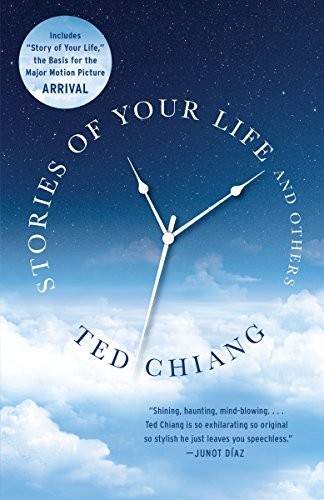
Talk to Stories of Your Life and Others like its author wrote you back.
Get the ideas that fit your life — not generic summaries.
- Chat with the book
- Audiobook-style main ideas
- Adapts to your life and goals
- Helps you take action
What it argues
Eight stories, all of them rigorously thought-out, many of them devastating. Ted Chiang takes a premise — a woman learns an alien language that restructures how she perceives time; a man undergoes surgery to correct a cognitive bias toward beauty; a medieval scholar confronts what biblical literalism would actually require — and develops it with the care of a proof and the feeling of a poem. The title story, "Story of Your Life," became the 2016 film Arrival, but the collection is much broader than that single piece.
What distinguishes Chiang from most science fiction writers is his refusal to let the intellectual premise and the emotional content run in separate lanes. "Story of Your Life" is simultaneously a rigorous exploration of linguistic relativity and Sapir-Whorf and a mother's meditation on grief and inevitability. "Hell Is the Absence of God" is a theologically precise thought experiment about a world where divine intervention is literal and visible, and also a story about a man who cannot make himself love the God who killed his wife. The ideas do not explain the feelings; the feelings don't resolve the ideas. That combination is rare.
What it gets right
- 1.
Story of Your Life uses the Sapir-Whorf hypothesis — the idea that language shapes thought — to ask what it would mean to experience time non-sequentially. The answer turns out to be about love and grief, not just linguistics.
- 2.
Chiang's thought experiments are closed systems: he grants one change to the world and follows it rigorously wherever it leads, including to conclusions that are morally irresolvable.
- 3.
Hell Is the Absence of God is a story about theodicy — the problem of how a benevolent God can permit suffering — set in a world where the problem is completely literal and still unresolvable.
What it covers
Who wrote it
Ted Chiang is an American science fiction writer whose small, extraordinarily precise output has earned him four Hugo Awards, four Nebula Awards, and four Locus Awards. Born in 1967, he has published two collections: Stories of Your Life and Others (2002) and Exhalation (2019). He works as a technical writer in the software industry and publishes rarely, revising extensively before release. The story Story of Your Life was adapted into the 2016 film Arrival directed by Denis Villeneuve. He is widely considered the most literarily serious short fiction writer currently working in science fiction.
