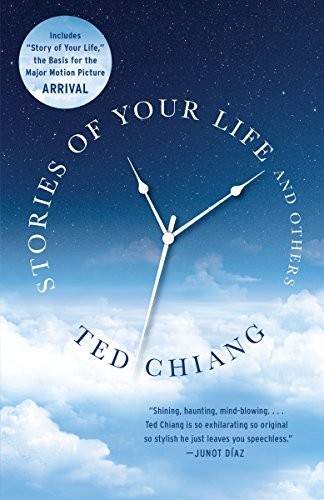
Talk to Stories of Your Life and Others like its author wrote you back.
Get the ideas that fit your life — not generic summaries.
- Chat with the book
- Audiobook-style main ideas
- Adapts to your life and goals
- Helps you take action
Stories of Your Life and Others, in detail
Eight stories, all of them rigorously thought-out, many of them devastating. Ted Chiang takes a premise — a woman learns an alien language that restructures how she perceives time; a man undergoes surgery to correct a cognitive bias toward beauty; a medieval scholar confronts what biblical literalism would actually require — and develops it with the care of a proof and the feeling of a poem. The title story, "Story of Your Life," became the 2016 film Arrival, but the collection is much broader than that single piece.
What distinguishes Chiang from most science fiction writers is his refusal to let the intellectual premise and the emotional content run in separate lanes. "Story of Your Life" is simultaneously a rigorous exploration of linguistic relativity and Sapir-Whorf and a mother's meditation on grief and inevitability. "Hell Is the Absence of God" is a theologically precise thought experiment about a world where divine intervention is literal and visible, and also a story about a man who cannot make himself love the God who killed his wife. The ideas do not explain the feelings; the feelings don't resolve the ideas. That combination is rare.
Chiang is meticulous and slow by design — he publishes very little, revises extensively, and treats each story as its own philosophical problem. The prose is clean and unshowy, which makes the emotional sucker punches land harder. "Tower of Babylon" imagines what Babylonian cosmology would actually look like from the inside; "Division by Zero" traces the psychological unraveling of a mathematician who disproves the consistency of mathematics. Neither is a comfortable read.
Readers who like their speculative fiction to earn its concepts and pay them off emotionally will find this collection exceptional. Those who want genre pacing — fast, propulsive, action-driven — will find Chiang's deliberate approach an adjustment. The difficulty isn't linguistic; it's that he asks you to sit inside ideas that are genuinely destabilizing, and he doesn't let you off by resolving them into comfort.
The big ideas
- 1.
Story of Your Life uses the Sapir-Whorf hypothesis — the idea that language shapes thought — to ask what it would mean to experience time non-sequentially. The answer turns out to be about love and grief, not just linguistics.
- 2.
Chiang's thought experiments are closed systems: he grants one change to the world and follows it rigorously wherever it leads, including to conclusions that are morally irresolvable.
- 3.
Hell Is the Absence of God is a story about theodicy — the problem of how a benevolent God can permit suffering — set in a world where the problem is completely literal and still unresolvable.
