History · Book club
Strategies of Containment: A Critical Appraisal of American National Security Policy During the Cold War book club questions
Here are 12 book club questions for Strategies of Containment: A Critical Appraisal of American National Security Policy During the Cold War by John Lewis Gaddis, ordered to open easily and end somewhere worth arguing about. Copy them, print them, or bring them up one at a time.
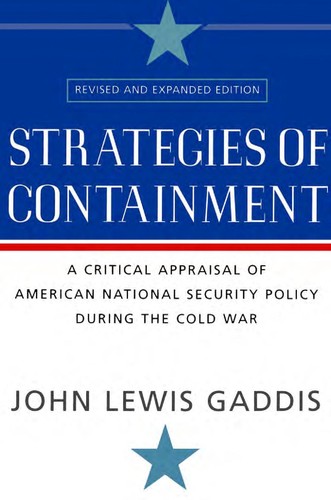
Strategies of Containment is John Lewis Gaddis's systematic analysis of how American national security policy evolved across successive administrations from Truman through Reagan.
John Lewis Gaddis · 1982 · 7h 15m
Full summary and key takeaways →The 12 questions
- 1.
Gaddis distinguishes symmetrical from asymmetrical containment. Which approach do you find more persuasive as grand strategy, and what are the costs of each?
- 2.
Kennan's original containment vision was largely abandoned in implementation. What does that suggest about the relationship between strategic thinkers and the bureaucracies that execute policy?
- 3.
NSC-68 argued that the United States had to match Soviet pressure everywhere or signal weakness. How does Gaddis assess that logic, and do you find his critique convincing?
- 4.
The Vietnam War is treated as a product of doctrinal overextension rather than a unique political failure. Does that framing change how you think about accountability for the war?
- 5.
Eisenhower's New Look strategy accepted the risk of nuclear escalation in exchange for reduced conventional spending. How do you evaluate that tradeoff in retrospect?
- 6.
Gaddis updated the book after the Soviet collapse. How does knowing how the Cold War ended change the criteria by which you would evaluate the various strategies he describes?
- 7.
The book argues that domestic politics constrained strategy at least as much as the international environment. Can you think of contemporary parallels to that dynamic?
- 8.
Gaddis treats Kennan as the book's intellectual hero while acknowledging that his advice was mostly not followed. What does that say about the relationship between strategic wisdom and political influence?
- 9.
How does reading a systematic account of strategy formation change your understanding of how foreign policy decisions are actually made?
- 10.
Grand strategy as Gaddis defines it requires long time horizons and consistency across administrations. What institutional mechanisms, if any, make that possible in a democratic system?
- 11.
The resource-commitment problem Gaddis identifies seems to recur across different strategic environments. Is it structural to democratic foreign policy, or is it a correctable failure?
- 12.
Which of the administrations Gaddis covers do you think had the most coherent strategy, and which the least?
How to run the discussion
- Pick six to eight, not all of them. An hour of real discussion covers fewer questions than anyone expects, and racing the list is what makes a book club feel like homework.
- Open with what people noticed, not what they concluded. Asking for a verdict first hardens opinions before anyone has heard each other.
- Let the disagreement run. The questions below that split a room are the ones worth the time; the ones everyone answers the same way can be skipped.
- Ask the quiet person a specific question. A direct, narrow question is far easier to answer than an open invitation to contribute.
Themes worth steering toward
If the conversation stalls, these are the threads that usually restart it.
Common questions
What are good book club questions for Strategies of Containment: A Critical Appraisal of American National Security Policy During the Cold War?
Here are 12 book club questions for Strategies of Containment: A Critical Appraisal of American National Security Policy During the Cold War by John Lewis Gaddis, ordered to open easily and end somewhere worth arguing about. The strongest openers ask what each reader noticed rather than what they concluded, and the discussion usually turns on cold war strategy, containment, national security.
How long should a book club discussion of Strategies of Containment: A Critical Appraisal of American National Security Policy During the Cold War last?
Most groups run 60 to 90 minutes of actual discussion. That is roughly six to eight questions, not all of them, so pick the ones that suit your group rather than working down the list in order.
What are the main themes in Strategies of Containment: A Critical Appraisal of American National Security Policy During the Cold War?
Cold War strategy, Containment, National security, Grand strategy, American foreign policy. Those are the threads most likely to divide a room, which makes them the useful places to steer a discussion that has gone quiet.
Picking the next one? See books like Strategies of Containment: A Critical Appraisal of American National Security Policy During the Cold War or questions for other book club picks.
