Business · Book club
Superbosses book club questions
Here are 12 book club questions for Superbosses by Sydney Finkelstein, ordered to open easily and end somewhere worth arguing about. Copy them, print them, or bring them up one at a time.
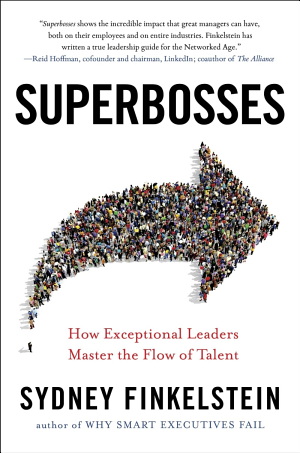
Superbosses is Sydney Finkelstein's study of a specific type of leader — one whose primary legacy is not what they built but who they developed.
Sydney Finkelstein · 2016 · 5h 0m
Full summary and key takeaways →The 12 questions
- 1.
Have you ever had a superboss — someone who developed you in ways that shaped your career significantly? What did they do that most managers don't?
- 2.
Finkelstein's three types — Glorious Bastards, Nurturers, Iconoclasts — all develop great talent. Which type do you most resemble, and where does that type create blind spots?
- 3.
The book argues that superbosses are not threatened by talented people — they seek them out. Where in your own management does insecurity shape who you hire or promote?
- 4.
Stretch assignments are the primary tool superbosses use. Think of someone on your team. What assignment would be genuinely beyond their current capability but would develop them significantly?
- 5.
Superbosses provide intense personal attention to promising people. What would you have to stop doing or delegate to create that kind of time with your best people?
- 6.
Finkelstein acknowledges superbosses can be hard to work for. Where is the line between productive intensity and burnout-creating pressure, and how do you know when you've crossed it?
- 7.
The regenerative networks superbosses create last for decades. Who are the people you've developed who remain connected to you and each other? What would strengthen those networks?
- 8.
Superbosses hire for raw ability rather than credentials. What does that look like in practice in your current hiring process? What would you have to change to do it?
- 9.
Many of Finkelstein's subjects are famous for their intensity and demanding standards. Can someone develop superboss-level talent without those characteristics?
- 10.
The book focuses on individual leaders. Can a whole organization develop superboss characteristics — or is it always person-dependent?
- 11.
Think of someone you've managed who went on to do extraordinary things. How much credit do you take for that, and how much of it was their own drive?
- 12.
If your goal were explicitly to develop three people in the next year who would become leaders of their own teams or organizations, what would you do differently starting tomorrow?
How to run the discussion
- Pick six to eight, not all of them. An hour of real discussion covers fewer questions than anyone expects, and racing the list is what makes a book club feel like homework.
- Open with what people noticed, not what they concluded. Asking for a verdict first hardens opinions before anyone has heard each other.
- Let the disagreement run. The questions below that split a room are the ones worth the time; the ones everyone answers the same way can be skipped.
- Ask the quiet person a specific question. A direct, narrow question is far easier to answer than an open invitation to contribute.
Themes worth steering toward
If the conversation stalls, these are the threads that usually restart it.
Common questions
What are good book club questions for Superbosses?
Here are 12 book club questions for Superbosses by Sydney Finkelstein, ordered to open easily and end somewhere worth arguing about. The strongest openers ask what each reader noticed rather than what they concluded, and the discussion usually turns on leadership, talent development, mentorship.
How long should a book club discussion of Superbosses last?
Most groups run 60 to 90 minutes of actual discussion. That is roughly six to eight questions, not all of them, so pick the ones that suit your group rather than working down the list in order.
What are the main themes in Superbosses?
Leadership, Talent development, Mentorship, Innovation, Organizational culture. Those are the threads most likely to divide a room, which makes them the useful places to steer a discussion that has gone quiet.
Picking the next one? See books like Superbosses or questions for other book club picks.
