Memoir · Book club
Surely You're Joking, Mr. Feynman! book club questions
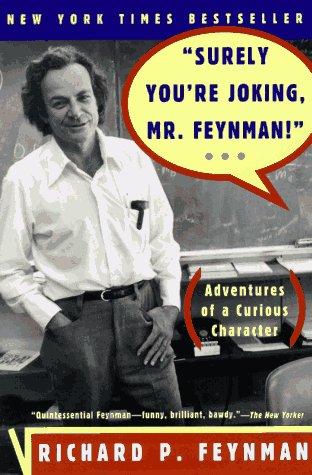
Here are 12 book club questions for Surely You're Joking, Mr. Feynman! by Richard P. Feynman, ordered to open easily and end somewhere worth arguing about. Copy them, print them, or bring them up one at a time.
The 12 questions
- 1.
Feynman's approach to education — always demanding to understand the phenomenon, not just the words — is easy to state but hard to operationalize. What would it look like in practice in a subject you know?
- 2.
Which anecdote did you find most memorable, and what does it reveal about Feynman's character?
- 3.
His treatment of women in several stories is uncomfortable by current standards. How do you read those sections, and does it affect how you evaluate the rest of the book?
- 4.
Feynman claims he often derived results independently rather than reading others' work. Is that a useful learning strategy or a form of intellectual showmanship?
- 5.
The book describes Feynman in Las Vegas, in Brazil, at bars, at strip joints. Does that range of settings expand or diminish your image of what a physicist should be?
- 6.
He was deeply skeptical of credentials and formal authority. Is that skepticism useful in all contexts or only in some?
- 7.
The safe-cracking at Los Alamos was partly a prank but also a genuine security demonstration. What does it reveal about the relationship between playfulness and serious purpose?
- 8.
Feynman describes feeling empty after winning the Nobel Prize, worried he had peaked. Have you experienced anything analogous — achieving a goal that felt hollow?
- 9.
The Brazilian physics education critique has a specific structure: students learn symbols without phenomena. Where do you see that pattern in fields outside physics?
- 10.
Feynman was famous for being able to explain complex ideas simply. Is that a teaching skill that can be learned, or does it require the kind of first-principles understanding he insists on?
- 11.
He describes learning to draw and eventually becoming good enough to sell portraits. What does that late-acquired skill suggest about his theory of learning?
- 12.
How do you distinguish between Feynman's genuine intellectual virtues and the parts of his self-presentation that are performance?
How to run the discussion
- Pick six to eight, not all of them. An hour of real discussion covers fewer questions than anyone expects, and racing the list is what makes a book club feel like homework.
- Open with what people noticed, not what they concluded. Asking for a verdict first hardens opinions before anyone has heard each other.
- Let the disagreement run. The questions below that split a room are the ones worth the time; the ones everyone answers the same way can be skipped.
- Ask the quiet person a specific question. A direct, narrow question is far easier to answer than an open invitation to contribute.
Themes worth steering toward
If the conversation stalls, these are the threads that usually restart it.
Common questions
What are good book club questions for Surely You're Joking, Mr. Feynman!?
Here are 12 book club questions for Surely You're Joking, Mr. Feynman! by Richard P. Feynman, ordered to open easily and end somewhere worth arguing about. The strongest openers ask what each reader noticed rather than what they concluded, and the discussion usually turns on curiosity, physics, problem-solving.
How long should a book club discussion of Surely You're Joking, Mr. Feynman! last?
Most groups run 60 to 90 minutes of actual discussion. That is roughly six to eight questions, not all of them, so pick the ones that suit your group rather than working down the list in order.
What are the main themes in Surely You're Joking, Mr. Feynman!?
Curiosity, Physics, Problem-solving, Nonconformity, Learning. Those are the threads most likely to divide a room, which makes them the useful places to steer a discussion that has gone quiet.
Picking the next one? See books like Surely You're Joking, Mr. Feynman! or questions for other book club picks.
