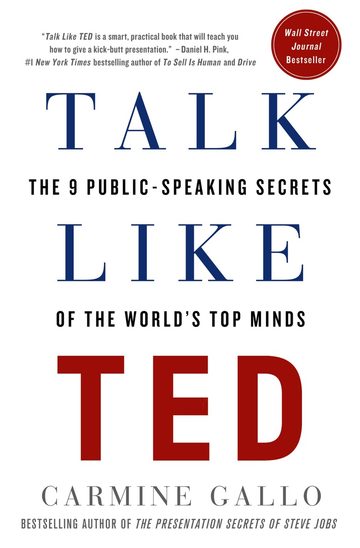
Talk to Talk Like TED: The 9 Public-Speaking Secrets of the World's Top Minds like its author wrote you back.
Get the ideas that fit your life — not generic summaries.
- Chat with the book
- Audiobook-style main ideas
- Adapts to your life and goals
- Helps you take action
Talk Like TED: The 9 Public-Speaking Secrets of the World's Top Minds, in detail
Talk Like TED is Carmine Gallo's analysis of what makes TED Talks compelling, drawn from interviews with more than 500 TED speakers, brain science research, and analysis of the most-watched talks in the archive. Published in 2014, it argues that the best public speakers share nine identifiable techniques and that these techniques can be learned by anyone willing to study and practice them.
Gallo's nine principles organize into three groups: emotional (unleash the master within, master the art of storytelling, have a conversation), novel (teach something new, deliver jaw-dropping moments, lighten up), and memorable (stick to the 18-minute rule, paint a mental picture with multisensory experiences, stay in your lane). Each is illustrated with specific examples from talks by Sir Ken Robinson, Jill Bolte Taylor, Hans Rosling, Simon Sinek, and others, and supported by neuroscience research on attention, memory, and emotion.
The book's most useful observation is that TED's best speakers treat the talk as a conversation rather than a performance — they speak from genuine passion about topics they know deeply, use specific stories and examples rather than abstractions, and aim to give the audience at least one idea worth carrying away. The neuroscience Gallo cites supports the basic claim that emotion and narrative are more effective than data and argument at producing both attention and retention. This is not a controversial finding, and the book makes it accessible without distorting it.
The weaknesses are real. Gallo's nine principles have considerable overlap and are not as crisply distinct as the numbering suggests. The book is longer than it needs to be — the same core advice is illustrated many times. And the premise that you should "talk like TED" is limiting: TED's format and culture reward a particular kind of inspirational, narrative, professional presentation that isn't the only valid model for effective communication. For readers specifically preparing for presentations in professional or academic settings, Talk Like TED offers more practical guidance than most books in its category. For anyone looking for a theory of communication more broadly, the coverage is thin.
The big ideas
- 1.
The best TED speakers speak about topics they are genuinely passionate about — not performed enthusiasm but real engagement with ideas they live with. Audiences detect the difference.
- 2.
Stories activate the brain more fully than data: neuroscience shows that narrative engages sensory and motor cortices in addition to language areas, producing deeper encoding and retention.
- 3.
The 18-minute rule exists because cognitive overload reduces retention. A focused 18-minute talk typically produces more impact than an unfocused 60-minute lecture.
