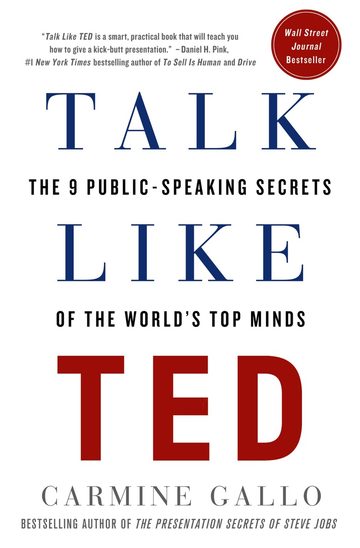
Talk Like TED: The 9 Public-Speaking Secrets of the World's Top Minds by Carmine Gallo is a 2014 self-help book about public speaking, storytelling, communication. The best TED speakers speak about topics they are genuinely passionate about — not performed enthusiasm but real engagement with ideas they live with. Audiences detect the difference.
Summary
Talk Like TED is Carmine Gallo's analysis of what makes TED Talks compelling, drawn from interviews with more than 500 TED speakers, brain science research, and analysis of the most-watched talks in the archive. Published in 2014, it argues that the best public speakers share nine identifiable techniques and that these techniques can be learned by anyone willing to study and practice them.
Gallo's nine principles organize into three groups: emotional (unleash the master within, master the art of storytelling, have a conversation), novel (teach something new, deliver jaw-dropping moments, lighten up), and memorable (stick to the 18-minute rule, paint a mental picture with multisensory experiences, stay in your lane). Each is illustrated with specific examples from talks by Sir Ken Robinson, Jill Bolte Taylor, Hans Rosling, Simon Sinek, and others, and supported by neuroscience research on attention, memory, and emotion.
The book's most useful observation is that TED's best speakers treat the talk as a conversation rather than a performance — they speak from genuine passion about topics they know deeply, use specific stories and examples rather than abstractions, and aim to give the audience at least one idea worth carrying away. The neuroscience Gallo cites supports the basic claim that emotion and narrative are more effective than data and argument at producing both attention and retention. This is not a controversial finding, and the book makes it accessible without distorting it.
The weaknesses are real. Gallo's nine principles have considerable overlap and are not as crisply distinct as the numbering suggests. The book is longer than it needs to be — the same core advice is illustrated many times. And the premise that you should "talk like TED" is limiting: TED's format and culture reward a particular kind of inspirational, narrative, professional presentation that isn't the only valid model for effective communication. For readers specifically preparing for presentations in professional or academic settings, Talk Like TED offers more practical guidance than most books in its category. For anyone looking for a theory of communication more broadly, the coverage is thin.
Talk to Talk Like TED: The 9 Public-Speaking Secrets of the World's Top Minds like its author wrote you back.
Get the ideas that fit your life — not generic summaries.
- Chat with the book
- Audiobook-style main ideas
- Adapts to your life and goals
- Helps you take action
Key takeaways
- 1.
The best TED speakers speak about topics they are genuinely passionate about — not performed enthusiasm but real engagement with ideas they live with. Audiences detect the difference.
- 2.
Stories activate the brain more fully than data: neuroscience shows that narrative engages sensory and motor cortices in addition to language areas, producing deeper encoding and retention.
- 3.
The 18-minute rule exists because cognitive overload reduces retention. A focused 18-minute talk typically produces more impact than an unfocused 60-minute lecture.
- 4.
Every great talk needs one core idea — a single throughline the audience can hold onto. Speakers who try to make ten points usually land none.
- 5.
Jaw-dropping moments — an unexpected statistic, a physical demonstration, a dramatic reveal — serve as memory anchors. Audiences remember what surprised them.
- 6.
Multisensory presentations (video, props, physical demonstration) create more pathways for memory encoding than slides and voice alone.
- 7.
Treat a presentation as a conversation, not a performance. Scripted perfection produces distance; natural expression with genuine warmth produces connection.
- 8.
Specific, personal stories beat abstract arguments in almost every communication context. The more specific the story, the more universal it tends to feel.
Discussion questions
Use these on your own, with a book club, or as chat starters in Superbook. Book club version, ready to copy or print →
- 1.
Gallo argues that passion is not something you can fake effectively. Think about a presentation you found genuinely compelling. Was the speaker's passion visible, and how did it change your reception of the content?
- 2.
The 18-minute rule is based on cognitive load research. Do you find shorter presentations more or less satisfying than longer ones? What's the right length for the kinds of communication you do?
- 3.
The book says every talk needs a single throughline — one idea the audience should leave with. Think about the last presentation you gave. What was your throughline? Did you have one?
- 4.
Stories beat data at producing retention. But some contexts — academic, legal, medical — demand data and distrust narrative. How do you navigate that tension?
- 5.
Jaw-dropping moments are designed to create memory anchors. Is that a form of manipulation, or is it just skilled communication? Where does technique end and authenticity begin?
- 6.
Gallo studies TED Talks specifically. What does that format reward that other communication contexts don't? What kinds of speakers or ideas might be systematically underrepresented in the TED canon?
- 7.
The advice to 'be conversational' sounds simple but is hard to execute when you're nervous. What specific techniques have you found actually reduce performance anxiety?
- 8.
The book is built around professional presentation skills. Does any of the advice transfer to everyday conversation, writing, or one-on-one communication?
- 9.
Gallo says speakers should 'stay in their lane' — talk about what they know from genuine experience. In practice, many people are asked to present on topics outside their depth. What do you do in that situation?
- 10.
Think about a TED Talk that changed how you think about something. Which of Gallo's nine principles does it exemplify? Do you think those principles explain why it was effective?
- 11.
The book explicitly models its title on TED's brand. Is there a risk that TED has too much cultural authority over what 'good communication' looks like? What does it leave out?
- 12.
If you could apply just one of the nine principles immediately to how you communicate professionally, which would it be and why?
Themes
Frequently asked questions
-
What is Talk Like TED about?
Gallo analyzes hundreds of TED Talks and interviews over 500 speakers to identify nine patterns shared by the most compelling presentations. The book argues these techniques — including storytelling, the 18-minute rule, and jaw-dropping moments — can be learned by anyone.
-
Is this book worth reading if I already know basic presentation skills?
It depends on your level. If you're an experienced presenter looking for structural frameworks, the book adds useful language for principles you may already intuit. If you're very advanced, the material will feel familiar. The value is highest for people who give occasional presentations and want to improve systematically.
-
How long does it take to read?
Around five hours. It's longer than it needs to be — the same insights are illustrated several times with different speakers. Many readers read it in two sessions and find the early chapters more useful than the later ones.
-
Do I need to watch TED Talks to benefit from this book?
It helps. Gallo's examples are specific to talks that are freely available online, and watching even a few of the ones he cites makes the principles click in a way that description alone doesn't.
-
What's the most actionable idea in the book?
The throughline principle: every talk or presentation needs a single idea the audience should leave with, and every element should serve that idea. This is the first thing to define before preparing any presentation, and the failure to do it is behind most presentations that feel unfocused.
Similar books
Made to Stick: Why Some Ideas Survive and Others Die
Chip Heath and Dan Heath
Start with Why
Simon Sinek
Contagious: Why Things Catch On
Jonah Berger
Influence: The Psychology of Persuasion
Robert B. Cialdini
