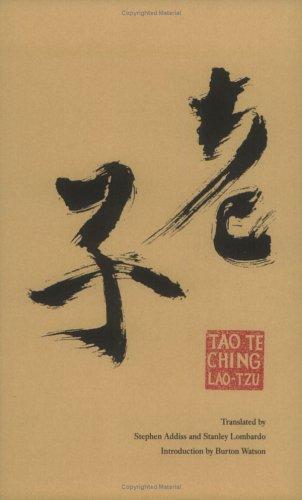
Tao Te Ching by Laozi is a 1972 philosophy book about the tao, wu wei, simplicity. The Tao cannot be fully named or conceptualized; the moment you fix it in language it ceases to be the eternal Tao.
Summary
The Tao Te Ching is one of the most translated texts in world literature and the foundational scripture of Taoism. Attributed to the sage Laozi, it consists of 81 short chapters of verse and prose, composed in classical Chinese sometime between the 6th and 4th centuries BCE. Its apparent simplicity is deceptive: the text proceeds through paradox, negation, and deliberate ambiguity, refusing the kind of systematic argument that Western philosophical texts typically pursue. The Tao that can be named, the opening line announces, is not the eternal Tao.
The central concept is the Tao — the Way — which underlies and pervades all things but cannot be fully conceptualized or described. It is not a god, not a substance, not a principle in the Western sense. It is the ground of being, expressed in the spontaneous workings of nature: water that flows downward without effort, valleys that receive without grasping, the uncarved block that contains all possibilities before any particular shape is imposed. The sage ruler, like water, accomplishes without forcing, leads without commanding, acts through wu wei — effortless, non-coercive action in alignment with the natural order.
Much of the text is concerned with governance and political wisdom. The ideal ruler is almost invisible, achieving order through minimal intervention rather than laws, punishments, or displays of power. Chapters on warfare counsel restraint and the recognition that military victory is always a form of loss. Chapters on knowledge argue that the accumulation of learning and the multiplication of desire corrupt the natural simplicity that is the Tao's expression in human life.
The Tao Te Ching is best approached not as a doctrine to be decoded but as a set of orientations to be inhabited. Its paradoxes — the useful emptiness of a bowl, the strength of yielding, the power of doing nothing — are not riddles with answers but practices for reorienting attention. It has influenced Chinese culture, governance, and aesthetics for over two millennia and continues to resonate in contexts — from leadership theory to mindfulness — that would have surprised its original audience.
Talk to Tao Te Ching like its author wrote you back.
Get the ideas that fit your life — not generic summaries.
- Chat with the book
- Audiobook-style main ideas
- Adapts to your life and goals
- Helps you take action
Key takeaways
- 1.
The Tao cannot be fully named or conceptualized; the moment you fix it in language it ceases to be the eternal Tao.
- 2.
Wu wei — effortless action or non-forcing — is the practical expression of alignment with the Tao; it accomplishes without striving and leads without commanding.
- 3.
Paradox is not a rhetorical device but a feature of reality: what seems weak (water, yielding, emptiness) is often most powerful over time.
- 4.
The useful part of a wheel is the empty hub; the useful part of a room is the empty space inside. Emptiness and absence have their own indispensable function.
- 5.
The sage ruler is almost invisible — the people accomplish their goals and say 'we did it ourselves.' Heavy governance creates heavy resistance.
- 6.
Desire and the multiplication of wants corrupt natural simplicity; the sage reduces desires rather than multiplying them.
- 7.
Knowing others is wisdom; knowing yourself is enlightenment. Conquering others requires force; conquering yourself requires real strength.
- 8.
Return — to simplicity, to the uncarved block, to the root — is the movement of the Tao, not progress or accumulation.
Discussion questions
Use these on your own, with a book club, or as chat starters in Superbook. Book club version, ready to copy or print →
- 1.
The Tao Te Ching insists that the Tao cannot be named or fully described. Does that feel like intellectual honesty or a convenient evasion?
- 2.
Wu wei — accomplishing through non-forcing — is the text's central practical teaching. Can you think of a situation in your own life where doing less would have achieved more?
- 3.
The book argues that visible strength is often a sign of weakness and that yielding is often more powerful than resistance. Does your experience in relationships or work confirm or challenge that?
- 4.
Chapters on governance argue that the best rulers are almost invisible. Is that a useful principle for leadership today, or does it romanticize passivity?
- 5.
The text repeatedly counsels reducing desire rather than satisfying it. Is that renunciation or wisdom? Does it depend on what kind of desire?
- 6.
What is the difference between wu wei and laziness? The text seems to distinguish them, but the line is not always obvious.
- 7.
The Tao Te Ching values simplicity and the 'uncarved block.' What in your own life has become overly complicated, and what would simplifying it look like?
- 8.
The text was written in an era of constant warfare and political chaos. How does that context shape the political advice in chapters like 30, 31, and 68?
- 9.
Many chapters are deliberately paradoxical: the Tao that can be named is not the eternal Tao. Is productive ambiguity possible in written language, or does language always pin things down?
- 10.
The Tao Te Ching has been used to justify everything from radical quietism to active governance. How do you interpret the responsibility it places on those who understand the Tao?
- 11.
Which chapter or image in the text resonates most with how you already think about the world? Which one most challenges your assumptions?
Themes
Frequently asked questions
-
What is the Tao Te Ching about?
It is about the Tao — the Way — the underlying principle of the universe, and how human beings (especially rulers and sages) can align themselves with it through simplicity, non-forcing action, and the reduction of desire. It is also a manual for governance, a meditation on paradox, and a philosophy of natural order.
-
Which translation of the Tao Te Ching should I read?
Stephen Mitchell's version (Harper Perennial) is lyrical and widely loved. D.C. Lau's (Penguin) is more scholarly. Ursula K. Le Guin's (Shambhala) brings literary sensibility to the paradoxes. All involve significant interpretive choices; reading two side by side is instructive.
-
Is the Tao Te Ching religious or philosophical?
Both. As Taoist scripture it has religious significance and is central to Taoist ritual and practice. As philosophy it raises fundamental questions about the nature of reality, knowledge, and governance without requiring theological belief. Many readers engage with it purely philosophically.
-
What is wu wei?
Often translated as non-action or effortless action. It does not mean doing nothing but acting in alignment with natural patterns rather than forcing outcomes through will and effort. Water is the classic example: it does not try to flow downhill, it simply does.
-
How long does it take to read?
About an hour to read once. But the text is designed for slow rereading, contemplation, and return. Many readers spend years or decades with it. A single linear read misses most of what it offers.