Biography · Book club
Team of Rivals: The Political Genius of Abraham Lincoln book club questions
Here are 11 book club questions for Team of Rivals: The Political Genius of Abraham Lincoln by Doris Kearns Goodwin, ordered to open easily and end somewhere worth arguing about. Copy them, print them, or bring them up one at a time.
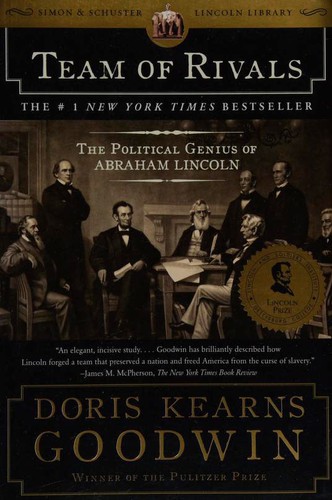
Doris Kearns Goodwin's account of Abraham Lincoln's formation of his cabinet — which included his three main rivals for the 1860 Republican nomination: William Seward, Salmon Chase, and Edward Bates — is one of the most widely discussed leadership books of the twenty-first century and one of the most readable biographies of the Lincoln era.
Doris Kearns Goodwin · 2005 · 20h 0m
Full summary and key takeaways →The 11 questions
- 1.
Lincoln deliberately chose rivals for his cabinet. Under what conditions is this a wise strategy, and when might it fail?
- 2.
Goodwin describes Lincoln's emotional intelligence as his most unusual quality. What specific behaviors does the book cite as evidence?
- 3.
The book has been used as a leadership manual by politicians across the political spectrum. Does that broad appropriation suggest the lessons are genuinely universal, or that the book is too vague to be challenged?
- 4.
Salmon Chase spent much of the war trying to replace Lincoln. How does Lincoln's decision to keep him in the cabinet, and then to appoint him Chief Justice, reflect his political philosophy?
- 5.
The Emancipation Proclamation is described as both morally necessary and politically calculated. Does the calculation diminish the moral significance?
- 6.
Goodwin's research required synthesizing an enormous number of primary sources — diaries, letters, official records. What does that research depth add to the reading experience?
- 7.
The book was criticized after publication for some overlapping language with other historians' works. Does that controversy affect how you read it?
- 8.
Lincoln is described as genuinely funny — a teller of bawdy jokes who used humor strategically. How does that quality fit with the Lincoln of the second inaugural address?
- 9.
The book ends with the assassination compressed into a few pages. Does that abruptness work as a formal choice?
- 10.
What does Team of Rivals suggest about the qualities that distinguish effective from merely capable political leadership?
- 11.
The book influenced Obama's cabinet choices. What parallels between Obama's situation and Lincoln's does the comparison illuminate, and where does it mislead?
How to run the discussion
- Pick six to eight, not all of them. An hour of real discussion covers fewer questions than anyone expects, and racing the list is what makes a book club feel like homework.
- Open with what people noticed, not what they concluded. Asking for a verdict first hardens opinions before anyone has heard each other.
- Let the disagreement run. The questions below that split a room are the ones worth the time; the ones everyone answers the same way can be skipped.
- Ask the quiet person a specific question. A direct, narrow question is far easier to answer than an open invitation to contribute.
Themes worth steering toward
If the conversation stalls, these are the threads that usually restart it.
Common questions
What are good book club questions for Team of Rivals: The Political Genius of Abraham Lincoln?
Here are 11 book club questions for Team of Rivals: The Political Genius of Abraham Lincoln by Doris Kearns Goodwin, ordered to open easily and end somewhere worth arguing about. The strongest openers ask what each reader noticed rather than what they concluded, and the discussion usually turns on leadership, politics, civil war.
How long should a book club discussion of Team of Rivals: The Political Genius of Abraham Lincoln last?
Most groups run 60 to 90 minutes of actual discussion. That is roughly six to eight questions, not all of them, so pick the ones that suit your group rather than working down the list in order.
What are the main themes in Team of Rivals: The Political Genius of Abraham Lincoln?
Leadership, Politics, Civil War, Ambition, Empathy. Those are the threads most likely to divide a room, which makes them the useful places to steer a discussion that has gone quiet.
Picking the next one? See books like Team of Rivals: The Political Genius of Abraham Lincoln or questions for other book club picks.
