Business · Book club
Team of Teams book club questions
Here are 12 book club questions for Team of Teams by Stanley McChrystal, ordered to open easily and end somewhere worth arguing about. Copy them, print them, or bring them up one at a time.
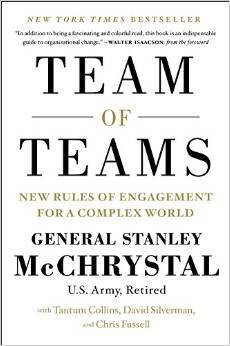
Team of Teams is General Stanley McChrystal's account of how he restructured the Joint Special Operations Task Force in Iraq to fight an enemy — Al-Qaeda in Iraq — that was organized in ways the conventional military hierarchy was too slow to counter.
Stanley McChrystal · 2015 · 5h 45m
Full summary and key takeaways →The 12 questions
- 1.
McChrystal's environment required extreme speed and adaptability. How fast does your environment change? Does your organization's decision-making speed match the rate of change?
- 2.
The Task Force was efficient at planned operations and slow at responding to surprises. Which of those descriptions better characterizes your organization?
- 3.
What would 'shared consciousness' look like in your organization? What information would everyone need to have, and how would you create the conditions for them to have it?
- 4.
McChrystal moved from commander to gardener — creating conditions rather than directing action. How much of your management time is spent directing versus enabling?
- 5.
The key mechanism was radical transparency — vastly more people in the operations briefing. What information in your organization is restricted to a level above where the decisions are being made?
- 6.
What does trust between teams — not just within teams — look like in practice? What's the cost of the trust gaps between teams in your organization?
- 7.
The book argues that efficiency and resilience are in tension and that complexity requires the resilience trade. What have you had to sacrifice for resilience in your own organization?
- 8.
McChrystal describes embedding people across units to build cross-team trust. Is this practiced in your organization? What prevents it from happening more?
- 9.
The 'eyes on, hands off' posture requires leaders to resist the urge to intervene. Where do you find that resistance hardest?
- 10.
The book uses military examples heavily. Which ideas transfer most cleanly to civilian organizational contexts, and which require adaptation?
- 11.
What would have to change about your organization's information architecture for the team-of-teams model to work?
- 12.
If your organization had to reorganize tomorrow to be significantly faster and more adaptive, what would you cut first — and what would that cost?
How to run the discussion
- Pick six to eight, not all of them. An hour of real discussion covers fewer questions than anyone expects, and racing the list is what makes a book club feel like homework.
- Open with what people noticed, not what they concluded. Asking for a verdict first hardens opinions before anyone has heard each other.
- Let the disagreement run. The questions below that split a room are the ones worth the time; the ones everyone answers the same way can be skipped.
- Ask the quiet person a specific question. A direct, narrow question is far easier to answer than an open invitation to contribute.
Themes worth steering toward
If the conversation stalls, these are the threads that usually restart it.
Common questions
What are good book club questions for Team of Teams?
Here are 12 book club questions for Team of Teams by Stanley McChrystal, ordered to open easily and end somewhere worth arguing about. The strongest openers ask what each reader noticed rather than what they concluded, and the discussion usually turns on organizational design, leadership, adaptability.
How long should a book club discussion of Team of Teams last?
Most groups run 60 to 90 minutes of actual discussion. That is roughly six to eight questions, not all of them, so pick the ones that suit your group rather than working down the list in order.
What are the main themes in Team of Teams?
Organizational design, Leadership, Adaptability, Decentralized authority, Complexity. Those are the threads most likely to divide a room, which makes them the useful places to steer a discussion that has gone quiet.
Picking the next one? See books like Team of Teams or questions for other book club picks.
