Business · Book club
That Will Never Work book club questions
Here are 12 book club questions for That Will Never Work by Marc Randolph, ordered to open easily and end somewhere worth arguing about. Copy them, print them, or bring them up one at a time.
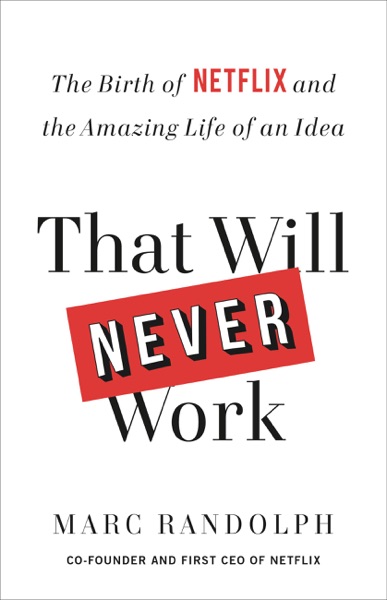
That Will Never Work is Marc Randolph's memoir of co-founding Netflix with Reed Hastings, covering the period from the original idea in 1997 through the company's IPO in 2002.
Marc Randolph · 2019 · 5h 45m
Full summary and key takeaways →The 12 questions
- 1.
Randolph's test-first philosophy is captured in his CD-mailing experiment. What's the equivalent cheap test for an idea you're working on or thinking about?
- 2.
He stepped aside as CEO when Hastings became clearly better suited for the operational role Netflix needed. How do you recognize when you're in the wrong role, and what makes it possible to act on that recognition?
- 3.
Randolph describes the Blockbuster meeting as a kind of hubris on Blockbuster's part. What organizational and psychological factors make established companies so bad at seeing disruptive threats?
- 4.
Netflix went through several failed business models before finding the subscription model. At what point should a founder give up on an idea versus continuing to iterate? What signals would you use?
- 5.
Randolph and Hastings had very different personalities and skill sets. Why do complementary co-founder pairs often outperform solo founders or pairs with similar strengths?
- 6.
The phrase 'that will never work' appears throughout the book as the default response to new ideas. How do you distinguish useful skepticism from resistance that should be overridden?
- 7.
What does the Netflix founding story reveal about the relationship between luck and skill in startup success? How much of what happened was replicable by deliberate choices?
- 8.
Randolph talks extensively about the carpool conversations where he and Hastings developed ideas during their daily commute. What physical or temporal conditions in your own life create the space for that kind of creative thinking?
- 9.
How does Randolph's account compare to the Netflix mythology — the story of a company that was inevitably going to change the world? Does the ground-level view make the success feel more or less impressive?
- 10.
The book ends with the IPO. What do you think happened to Randolph's relationship to Netflix after he left? How do founders typically handle the transition to observer?
- 11.
Randolph is honest that Reed Hastings was a better CEO than he was. How often does that level of self-awareness show up in founder memoirs, and why is it usually absent?
- 12.
If Blockbuster had acquired Netflix in 2000 for $50 million, what would the streaming landscape look like today?
How to run the discussion
- Pick six to eight, not all of them. An hour of real discussion covers fewer questions than anyone expects, and racing the list is what makes a book club feel like homework.
- Open with what people noticed, not what they concluded. Asking for a verdict first hardens opinions before anyone has heard each other.
- Let the disagreement run. The questions below that split a room are the ones worth the time; the ones everyone answers the same way can be skipped.
- Ask the quiet person a specific question. A direct, narrow question is far easier to answer than an open invitation to contribute.
Themes worth steering toward
If the conversation stalls, these are the threads that usually restart it.
Common questions
What are good book club questions for That Will Never Work?
Here are 12 book club questions for That Will Never Work by Marc Randolph, ordered to open easily and end somewhere worth arguing about. The strongest openers ask what each reader noticed rather than what they concluded, and the discussion usually turns on entrepreneurship, startups, leadership.
How long should a book club discussion of That Will Never Work last?
Most groups run 60 to 90 minutes of actual discussion. That is roughly six to eight questions, not all of them, so pick the ones that suit your group rather than working down the list in order.
What are the main themes in That Will Never Work?
Entrepreneurship, Startups, Leadership, Failure and iteration, Company building. Those are the threads most likely to divide a room, which makes them the useful places to steer a discussion that has gone quiet.
Picking the next one? See books like That Will Never Work or questions for other book club picks.
