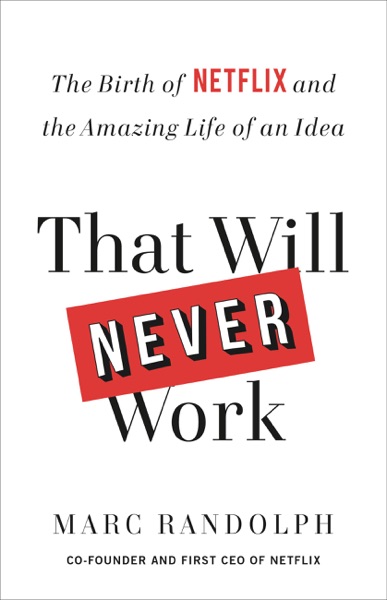
That Will Never Work by Marc Randolph is a 2019 business book about entrepreneurship, startups, leadership. Small, cheap tests beat elaborate analysis. Randolph mailed a used CD to himself to test whether DVDs would survive postal delivery. That one experiment justified building the company.
Summary
That Will Never Work is Marc Randolph's memoir of co-founding Netflix with Reed Hastings, covering the period from the original idea in 1997 through the company's IPO in 2002. Randolph served as Netflix's first CEO before stepping aside for Hastings, and his account is a founder's story told from the inside — which means it's specific, honest, and less polished than the triumphant retrospectives that most tech memoirs become.
The book's title comes from Reed Hastings's reaction to Randolph's early DVD-by-mail pitch. Hastings thought the economics wouldn't work; most people around Randolph agreed. The phrase becomes a refrain throughout the book — the obstacle that every iteration of the idea had to overcome. Randolph describes testing the concept by mailing a used CD to himself to see if it would arrive unbroken. It did. That single experiment justified moving forward, and his preference for small, cheap tests over elaborate analysis is one of the book's recurring themes.
Randolph is candid about his relationship with Hastings, which was productive, complementary, and ultimately required Randolph to accept that Hastings was the better CEO for what Netflix was becoming. This dynamic — a creative founding CEO handing off to a more operationally rigorous partner — is a common startup pattern, and Randolph describes it without the usual resentment or revisionism. He also describes the near-death experiences that most successful company histories skip: the moment in 2000 when Hastings flew to Dallas to offer Netflix to Blockbuster's CEO for $50 million (Blockbuster passed), the fundraising crises, and the repeated pivots before the subscription model clicked.
Compared to Reed Hastings's own book No Rules Rules, which covers Netflix's culture as a mature company, That Will Never Work is a founding story — scrappier, more personal, and more useful for anyone building something from zero. Randolph is not writing a management manual; he's writing a memoir that happens to be full of lessons about how ideas get tested, companies get started, and founders learn what they're actually good at.
Talk to That Will Never Work like its author wrote you back.
Get the ideas that fit your life — not generic summaries.
- Chat with the book
- Audiobook-style main ideas
- Adapts to your life and goals
- Helps you take action
Key takeaways
- 1.
Small, cheap tests beat elaborate analysis. Randolph mailed a used CD to himself to test whether DVDs would survive postal delivery. That one experiment justified building the company.
- 2.
The idea matters less than the willingness to test, adjust, and iterate. Netflix went through multiple business models before the subscription model worked; the original idea was almost irrelevant.
- 3.
Knowing what you're not good at is as important as knowing what you are. Randolph recognized that Reed Hastings was better suited to run Netflix at scale and stepped aside rather than staying in the wrong role.
- 4.
Blockbuster's refusal to acquire Netflix for $50 million in 2000 is one of startup history's most consequential errors. Randolph's account of that meeting is a study in incumbent complacency.
- 5.
Early Netflix was shaped by constraints that forced good decisions: limited capital required cheap tests, small team required generalists, fragile economics required honest data about what was working.
- 6.
Founding a company with someone you already have a relationship with — Randolph and Hastings had worked together before — has advantages but also requires explicit conversations about roles and authority that most co-founders avoid.
- 7.
The subscription model was not the original Netflix idea. Randolph describes the evolution from per-DVD rental to subscription as a pivot driven by data about customer behavior, not vision.
- 8.
The IPO is not the end of the story. Randolph describes leaving Netflix after the IPO and the complicated feelings of watching what you built become something much larger without you.
Discussion questions
Use these on your own, with a book club, or as chat starters in Superbook. Book club version, ready to copy or print →
- 1.
Randolph's test-first philosophy is captured in his CD-mailing experiment. What's the equivalent cheap test for an idea you're working on or thinking about?
- 2.
He stepped aside as CEO when Hastings became clearly better suited for the operational role Netflix needed. How do you recognize when you're in the wrong role, and what makes it possible to act on that recognition?
- 3.
Randolph describes the Blockbuster meeting as a kind of hubris on Blockbuster's part. What organizational and psychological factors make established companies so bad at seeing disruptive threats?
- 4.
Netflix went through several failed business models before finding the subscription model. At what point should a founder give up on an idea versus continuing to iterate? What signals would you use?
- 5.
Randolph and Hastings had very different personalities and skill sets. Why do complementary co-founder pairs often outperform solo founders or pairs with similar strengths?
- 6.
The phrase 'that will never work' appears throughout the book as the default response to new ideas. How do you distinguish useful skepticism from resistance that should be overridden?
- 7.
What does the Netflix founding story reveal about the relationship between luck and skill in startup success? How much of what happened was replicable by deliberate choices?
- 8.
Randolph talks extensively about the carpool conversations where he and Hastings developed ideas during their daily commute. What physical or temporal conditions in your own life create the space for that kind of creative thinking?
- 9.
How does Randolph's account compare to the Netflix mythology — the story of a company that was inevitably going to change the world? Does the ground-level view make the success feel more or less impressive?
- 10.
The book ends with the IPO. What do you think happened to Randolph's relationship to Netflix after he left? How do founders typically handle the transition to observer?
- 11.
Randolph is honest that Reed Hastings was a better CEO than he was. How often does that level of self-awareness show up in founder memoirs, and why is it usually absent?
- 12.
If Blockbuster had acquired Netflix in 2000 for $50 million, what would the streaming landscape look like today?
Themes
Frequently asked questions
-
What is That Will Never Work about?
It's Marc Randolph's memoir of co-founding Netflix, covering the period from the original idea in 1997 through the IPO in 2002. Randolph focuses on the early years — the idea testing, the business model pivots, the near-death experiences — rather than the company's later global dominance.
-
How does That Will Never Work compare to No Rules Rules?
They cover different eras. Randolph's book is a founding story about the scrappy early years when Netflix was a small startup. Hastings's No Rules Rules is about Netflix's culture as a mature company. Both are worth reading, but they're almost different genres — one is memoir, the other is a management philosophy.
-
Is the book honest about failures and mistakes?
Yes, more than most business memoirs. Randolph describes failed business models, near-bankruptcy, the humbling experience of being replaced as CEO by his own co-founder, and the Blockbuster meeting where Netflix almost sold itself for $50 million.
-
What's the most useful business lesson in the book?
The test-first philosophy: make the smallest possible cheap test before committing resources to an unproven assumption. Randolph mailed himself a CD before building a company. Most founders spend months building before testing. He flips that order.
-
Do I need to be interested in Netflix to find this book valuable?
Not particularly. The Netflix story is the vehicle, but the book is really about how ideas get tested and companies get started. The specific questions Randolph wrestles with — co-founder dynamics, when to pivot, how to recognize the right business model — apply broadly.
Similar books
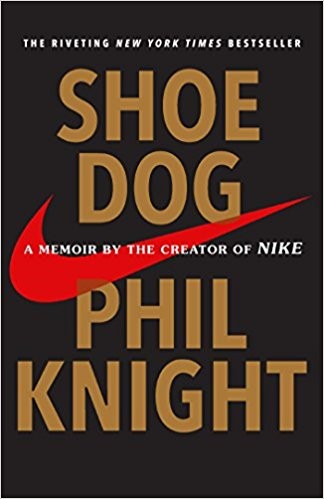
Shoe Dog: A Memoir by the Creator of Nike
Phil Knight
Bad Blood: Secrets and Lies in a Silicon Valley Startup
John Carreyrou
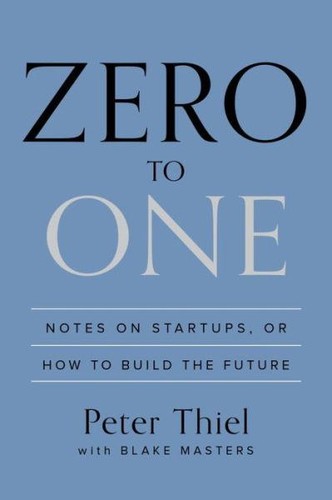
Zero to One: Notes on Startups, or How to Build the Future
Peter Thiel
The Hard Thing About Hard Things
Ben Horowitz
