Self-help · Book club
The 4-Hour Workweek book club questions
Here are 12 book club questions for The 4-Hour Workweek by Timothy Ferriss, ordered to open easily and end somewhere worth arguing about. Copy them, print them, or bring them up one at a time.
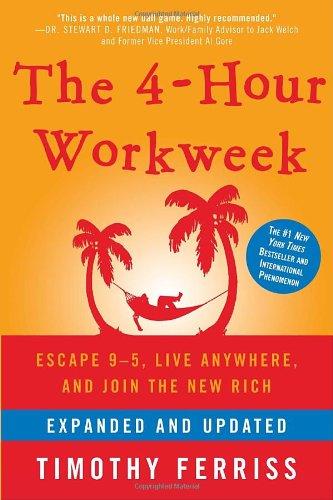
The 4-Hour Workweek is Timothy Ferriss's argument that the standard model of working forty-plus hours a week until retirement is a bad deal, and that a better one is available right now for anyone willing to rethink how they work, earn, and live.
Timothy Ferriss · 2007 · 4h 20m
Full summary and key takeaways →The 12 questions
- 1.
Ferriss frames the forty-hour workweek as an unexamined assumption rather than a requirement. How much of your own work structure have you inherited without questioning?
- 2.
What would you do with your time if you were working four hours a week? How specific can you get? Does that answer tell you anything about your current priorities?
- 3.
Apply the 80/20 rule to your current work: which 20 percent of your tasks generate most of your results? What would happen if you eliminated or delegated the rest?
- 4.
Ferriss recommends checking email twice a day. What's the real cost you'd pay for doing that in your job, versus the cost you'd avoid?
- 5.
The book distinguishes between being effective and being busy. Which are you optimizing for right now, and how would you know the difference?
- 6.
How much of what fills your workday would be eliminated if you had to compress your output into two focused hours instead of eight unfocused ones?
- 7.
Ferriss argues that lifestyle goals should drive work decisions, not the reverse. When did you last design your work around how you want to live?
- 8.
What would a 'muse' — a small automated income source — look like for someone with your skills and knowledge? What's the cheapest way to test whether anyone would pay for it?
- 9.
The book criticizes deferred living: saving experiences and freedom for retirement. Where in your own life are you deferring something you could have now?
- 10.
What would you need to believe about your employer, your skills, or your finances to actually try negotiating remote or flexible work? Are those beliefs accurate?
- 11.
Ferriss's advice assumes a certain amount of professional autonomy and financial cushion. If you don't have those, what's the smallest version of his argument that still applies to your situation?
- 12.
Which part of this book did you find most energizing? Which part struck you as out of touch with your actual circumstances?
How to run the discussion
- Pick six to eight, not all of them. An hour of real discussion covers fewer questions than anyone expects, and racing the list is what makes a book club feel like homework.
- Open with what people noticed, not what they concluded. Asking for a verdict first hardens opinions before anyone has heard each other.
- Let the disagreement run. The questions below that split a room are the ones worth the time; the ones everyone answers the same way can be skipped.
- Ask the quiet person a specific question. A direct, narrow question is far easier to answer than an open invitation to contribute.
Themes worth steering toward
If the conversation stalls, these are the threads that usually restart it.
Common questions
What are good book club questions for The 4-Hour Workweek?
Here are 12 book club questions for The 4-Hour Workweek by Timothy Ferriss, ordered to open easily and end somewhere worth arguing about. The strongest openers ask what each reader noticed rather than what they concluded, and the discussion usually turns on lifestyle design, entrepreneurship, productivity.
How long should a book club discussion of The 4-Hour Workweek last?
Most groups run 60 to 90 minutes of actual discussion. That is roughly six to eight questions, not all of them, so pick the ones that suit your group rather than working down the list in order.
What are the main themes in The 4-Hour Workweek?
Lifestyle design, Entrepreneurship, Productivity, Automation, Freedom. Those are the threads most likely to divide a room, which makes them the useful places to steer a discussion that has gone quiet.
Picking the next one? See books like The 4-Hour Workweek or questions for other book club picks.
