Self-help · Book club
The 7 Habits of Highly Effective People book club questions
Here are 12 book club questions for The 7 Habits of Highly Effective People by Stephen R. Covey, ordered to open easily and end somewhere worth arguing about. Copy them, print them, or bring them up one at a time.
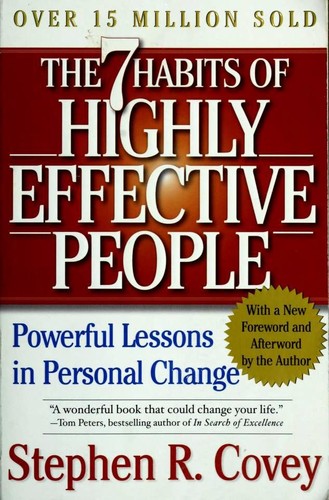
The 12 questions
- 1.
Covey distinguishes the character ethic from the personality ethic. Which ethic has shaped most of the career or self-improvement advice you've received? Does that match your experience of what actually works?
- 2.
Which of the seven habits do you find most natural, and which creates the most resistance for you? What does that gap reveal?
- 3.
Map your last week against Covey's time-management matrix. Which quadrant got most of your time? Which quadrant got least?
- 4.
What would it mean to 'begin with the end in mind' for the area of your life that currently feels most adrift? What is the end you actually want?
- 5.
Covey argues that most people listen with the intent to reply rather than to understand. Think of a recent conversation where you did this. What might you have missed?
- 6.
The think win/win habit requires believing that mutual gain is possible. In which relationships in your life do you default to a zero-sum assumption, and is that assumption accurate?
- 7.
Covey says a personal mission statement is the foundation of the second habit. Have you ever written one? If you drafted one right now, what would it say?
- 8.
The concept of the circle of influence versus the circle of concern — spending energy on what you can control rather than what you can't — is central to being proactive. Where are you currently spending energy on things outside your circle of influence?
- 9.
Sharpen the saw covers physical, mental, social, and spiritual renewal. Which of these four dimensions is most depleted in your life right now, and what would genuine renewal look like?
- 10.
Covey writes that trust is the highest form of motivation. Where in your professional or personal life have you seen high trust produce results that management or incentives alone couldn't?
- 11.
The synergy habit requires valuing differences. Think of a person whose approach to a shared problem frustrates you. Is there something in their perspective that you've been dismissing as merely wrong rather than differently valid?
- 12.
Covey was writing primarily for managers and professionals in 1989. Which parts of the book translate well to your life today, and which feel like relics of a specific era of work?
How to run the discussion
- Pick six to eight, not all of them. An hour of real discussion covers fewer questions than anyone expects, and racing the list is what makes a book club feel like homework.
- Open with what people noticed, not what they concluded. Asking for a verdict first hardens opinions before anyone has heard each other.
- Let the disagreement run. The questions below that split a room are the ones worth the time; the ones everyone answers the same way can be skipped.
- Ask the quiet person a specific question. A direct, narrow question is far easier to answer than an open invitation to contribute.
Themes worth steering toward
If the conversation stalls, these are the threads that usually restart it.
Common questions
What are good book club questions for The 7 Habits of Highly Effective People?
Here are 12 book club questions for The 7 Habits of Highly Effective People by Stephen R. Covey, ordered to open easily and end somewhere worth arguing about. The strongest openers ask what each reader noticed rather than what they concluded, and the discussion usually turns on effectiveness, character ethics, personal leadership.
How long should a book club discussion of The 7 Habits of Highly Effective People last?
Most groups run 60 to 90 minutes of actual discussion. That is roughly six to eight questions, not all of them, so pick the ones that suit your group rather than working down the list in order.
What are the main themes in The 7 Habits of Highly Effective People?
Effectiveness, Character ethics, Personal leadership, Interdependence, Habit formation. Those are the threads most likely to divide a room, which makes them the useful places to steer a discussion that has gone quiet.
Picking the next one? See books like The 7 Habits of Highly Effective People or questions for other book club picks.
