Short stories · Book club
The Adventures of Sherlock Holmes book club questions
Here are 12 book club questions for The Adventures of Sherlock Holmes by Arthur Conan Doyle, ordered to open easily and end somewhere worth arguing about. Copy them, print them, or bring them up one at a time.
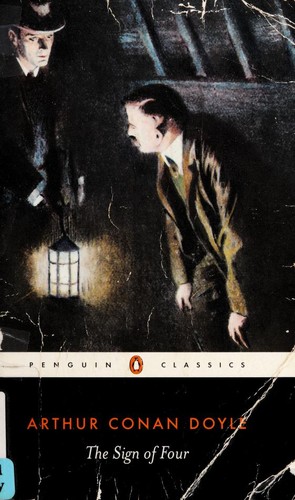
Twelve stories, first published in The Strand Magazine between 1891 and 1892, collected here in their original order: A Scandal in Bohemia, The Red-Headed League, A Case of Identity, The Boscombe Valley Mystery, The Five Orange Pips, The Man with the Twisted Lip, The Adventure of the Blue Carbuncle, The Adventure of the Speckled Band, The Adventure of the Engineer's Thumb, The Adventure of the Noble Bachelor, The Adventure of the Beryl Coronet, and The Adventure of the Copper Beeches.
Arthur Conan Doyle · 1892 · 6h 15m
Full summary and key takeaways →The 12 questions
- 1.
Holmes frequently lets criminals escape official justice when he judges them morally in the right. Is that admirable vigilantism, dangerous precedent, or simply Victorian common sense?
- 2.
Watson is often read as the dim straight man to Holmes's genius. Does reading these stories closely support that reading, or is Watson more capable than he's given credit for?
- 3.
A Scandal in Bohemia is the first Holmes story and one of the few he loses. What does it tell us that the character who defeats him is a woman, and that he admires her for it?
- 4.
Conan Doyle's London is full of people trying to escape their pasts — assumed identities, forged backgrounds, hidden marriages. How does that mirror Victorian anxieties about class mobility and respectability?
- 5.
The Speckled Band is often voted the best Holmes story. What makes a satisfying locked-room mystery — and does Speckled Band satisfy that definition for you?
- 6.
Holmes is a consulting detective who works outside the police. The official police in these stories are either incompetent or limited by bureaucracy. What assumptions about institutions does Conan Doyle make, and do they still resonate?
- 7.
The Red-Headed League is an absurd premise that somehow works. What does it tell us about Conan Doyle's craft that he can make a ridiculous setup genuinely tense?
- 8.
These stories were published in a mass-market magazine and read on the train. Does reading them now — knowing they're literary history — change the experience, or can you still read them as pure entertainment?
- 9.
Compared to Christie's Poirot, who uses the same Watson-figure structure, how does the Holmes-Watson dynamic differ? Which is more interesting as a pair?
- 10.
Holmes has been adapted constantly — from Basil Rathbone to Jeremy Brett to Benedict Cumberbatch. What does each generation's Holmes reveal about that era's anxieties and ideals?
- 11.
Several of the stories end with Holmes and Watson choosing not to report the crime to the police. What moral principle is Conan Doyle articulating, and do you agree with it?
- 12.
The short story is a compressed form. Which story in this collection is the one where you felt Conan Doyle most fully used the compression, and which felt like it needed more space?
How to run the discussion
- Pick six to eight, not all of them. An hour of real discussion covers fewer questions than anyone expects, and racing the list is what makes a book club feel like homework.
- Open with what people noticed, not what they concluded. Asking for a verdict first hardens opinions before anyone has heard each other.
- Let the disagreement run. The questions below that split a room are the ones worth the time; the ones everyone answers the same way can be skipped.
- Ask the quiet person a specific question. A direct, narrow question is far easier to answer than an open invitation to contribute.
Themes worth steering toward
If the conversation stalls, these are the threads that usually restart it.
Common questions
What are good book club questions for The Adventures of Sherlock Holmes?
Here are 12 book club questions for The Adventures of Sherlock Holmes by Arthur Conan Doyle, ordered to open easily and end somewhere worth arguing about. The strongest openers ask what each reader noticed rather than what they concluded, and the discussion usually turns on deductive reasoning, class and victorian society, observation and blindness.
How long should a book club discussion of The Adventures of Sherlock Holmes last?
Most groups run 60 to 90 minutes of actual discussion. That is roughly six to eight questions, not all of them, so pick the ones that suit your group rather than working down the list in order.
What are the main themes in The Adventures of Sherlock Holmes?
Deductive reasoning, Class and Victorian society, Observation and blindness, Hidden lives, Justice outside the law. Those are the threads most likely to divide a room, which makes them the useful places to steer a discussion that has gone quiet.
Picking the next one? See books like The Adventures of Sherlock Holmes or questions for other book club picks.
