The Adventures of Sherlock Holmes by Arthur Conan Doyle is a 1892 short stories book about deductive reasoning, class and victorian society, observation and blindness. Holmes works by abduction, not deduction — he hypothesizes the most probable explanation from observed evidence, then tests it. Conan Doyle called it deduction, but logicians classify it differently.
Summary
Twelve stories, first published in The Strand Magazine between 1891 and 1892, collected here in their original order: A Scandal in Bohemia, The Red-Headed League, A Case of Identity, The Boscombe Valley Mystery, The Five Orange Pips, The Man with the Twisted Lip, The Adventure of the Blue Carbuncle, The Adventure of the Speckled Band, The Adventure of the Engineer's Thumb, The Adventure of the Noble Bachelor, The Adventure of the Beryl Coronet, and The Adventure of the Copper Beeches. Holmes and Watson are at their most archetypal here, and many of the stories in this collection are among the best Holmes ever wrote.
What Conan Doyle achieved with these stories was less a genre than a method. Holmes's deductive performances — reasoning from a scuff on a shoe to a man's profession, from a woman's cuffs to the state of her marriage — are not realistic but they are satisfying in the same way that a good stage magic trick is satisfying: you sense the mechanism even if you cannot name it. Watson is not the fool he is often caricatured as; he is the reader, and his function is to register amazement at conclusions the reader could not have reached alone. The partnership is perfectly calibrated.
The stories also work as social documents. Victorian London seethes beneath Holmes's rooms at Baker Street — the criminal cases are almost always about money, inheritance, hidden identities, marriages gone wrong, or secrets that respectable people need to bury. Holmes operates partly outside the law, sometimes letting criminals go when the law seems inadequate, and Conan Doyle is untroubled by this. The best stories (Speckled Band, Red-Headed League, Scandal in Bohemia) are tight enough that the formula doesn't feel formulaic.
These are pleasure reading first. The historical significance — Holmes invented the procedural detective, influenced Christie, Chandler, every crime writer who followed — is real but not the reason to read them. The reason is that they are consistently entertaining and occasionally brilliant, and that the Watson-Holmes dynamic is one of the great odd-couple friendships in fiction.
Talk to The Adventures of Sherlock Holmes like its author wrote you back.
Get the ideas that fit your life — not generic summaries.
- Chat with the book
- Audiobook-style main ideas
- Adapts to your life and goals
- Helps you take action
Key takeaways
- 1.
Holmes works by abduction, not deduction — he hypothesizes the most probable explanation from observed evidence, then tests it. Conan Doyle called it deduction, but logicians classify it differently.
- 2.
Watson is not a fool. He is a skilled observer who lacks Holmes's indexical knowledge of London's criminal underworld, chemistry, and disguise. The gap between them is expertise, not intelligence.
- 3.
Victorian criminal cases, in Conan Doyle's telling, are almost always about money and secrets — hidden identities, disputed inheritances, bigamy, blackmail. The crimes map directly onto Victorian social anxieties.
- 4.
Holmes's willingness to let some criminals go — most famously Irene Adler, most explicitly in Blue Carbuncle — establishes that his justice is personal and moral, not legal.
- 5.
A Scandal in Bohemia is the story that established Holmes's one vulnerability. Irene Adler defeats him by being better at performance than he is — she out-Holmeses Holmes.
- 6.
The locked-room and misdirection techniques in these stories became the template for Golden Age crime fiction. Christie, Sayers, and Chandler all learned from Conan Doyle.
- 7.
The short story form suits Holmes perfectly. Each case is a closed problem with a demonstrable solution; the satisfaction is precisely proportional because the scale is contained.
- 8.
Baker Street's 221B functions as a kind of sanctuary where Holmes controls the variables. The city outside is chaos; the rooms are order. This contrast structures the entire series.
Discussion questions
Use these on your own, with a book club, or as chat starters in Superbook. Book club version, ready to copy or print →
- 1.
Holmes frequently lets criminals escape official justice when he judges them morally in the right. Is that admirable vigilantism, dangerous precedent, or simply Victorian common sense?
- 2.
Watson is often read as the dim straight man to Holmes's genius. Does reading these stories closely support that reading, or is Watson more capable than he's given credit for?
- 3.
A Scandal in Bohemia is the first Holmes story and one of the few he loses. What does it tell us that the character who defeats him is a woman, and that he admires her for it?
- 4.
Conan Doyle's London is full of people trying to escape their pasts — assumed identities, forged backgrounds, hidden marriages. How does that mirror Victorian anxieties about class mobility and respectability?
- 5.
The Speckled Band is often voted the best Holmes story. What makes a satisfying locked-room mystery — and does Speckled Band satisfy that definition for you?
- 6.
Holmes is a consulting detective who works outside the police. The official police in these stories are either incompetent or limited by bureaucracy. What assumptions about institutions does Conan Doyle make, and do they still resonate?
- 7.
The Red-Headed League is an absurd premise that somehow works. What does it tell us about Conan Doyle's craft that he can make a ridiculous setup genuinely tense?
- 8.
These stories were published in a mass-market magazine and read on the train. Does reading them now — knowing they're literary history — change the experience, or can you still read them as pure entertainment?
- 9.
Compared to Christie's Poirot, who uses the same Watson-figure structure, how does the Holmes-Watson dynamic differ? Which is more interesting as a pair?
- 10.
Holmes has been adapted constantly — from Basil Rathbone to Jeremy Brett to Benedict Cumberbatch. What does each generation's Holmes reveal about that era's anxieties and ideals?
- 11.
Several of the stories end with Holmes and Watson choosing not to report the crime to the police. What moral principle is Conan Doyle articulating, and do you agree with it?
- 12.
The short story is a compressed form. Which story in this collection is the one where you felt Conan Doyle most fully used the compression, and which felt like it needed more space?
Themes
Frequently asked questions
-
Is this the right place to start with Sherlock Holmes?
Yes. These twelve stories are Holmes at his most archetypal, and several — A Scandal in Bohemia, The Speckled Band, The Red-Headed League — are among the best ever written. The earlier novel A Study in Scarlet introduces Holmes and Watson, but the short stories in this collection are the canonical heart of the series.
-
Are these stories hard to read?
Not at all. Conan Doyle wrote for a mass-market magazine audience, and the prose is clear, fast, and pleasurable. The Victorian slang and social context are mostly transparent from context. You can read these on a train, which is exactly where millions of original readers did.
-
Do I need to read them in order?
Each story is entirely self-contained, so you can read in any order. Within this collection, the original ordering is fine — A Scandal in Bohemia sets up useful expectations about the series, and Blue Carbuncle is a good palate cleanser after heavier stories.
-
Are the BBC Sherlock adaptations faithful to these stories?
Loosely. The BBC series (with Cumberbatch) takes the characters and premises into the contemporary world and significantly expands them. Jeremy Brett's 1984–1994 Granada series is the most faithful adaptation and is worth watching alongside the originals.
-
Who shouldn't read these?
Readers looking for psychological depth in character, long-form narrative complexity, or moral ambiguity. These are elegant puzzles with charming characters, not novels of ideas. If you need interiority or sustained emotional engagement, the short story format will feel slight.
Similar books
Death on the Nile
Agatha Christie
The Murder of Roger Ackroyd
Agatha Christie
In Cold Blood
Truman Capote
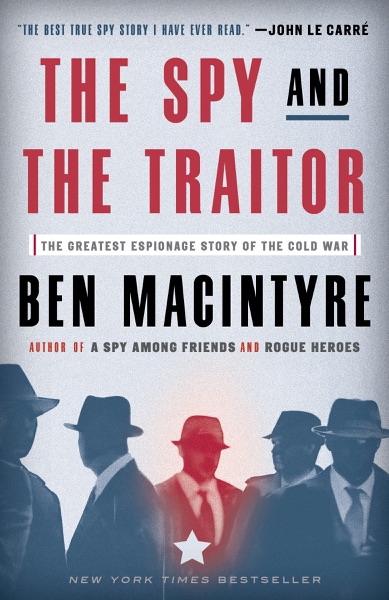
The Spy and the Traitor: The Greatest Espionage Story of the Cold War
Ben Macintyre
