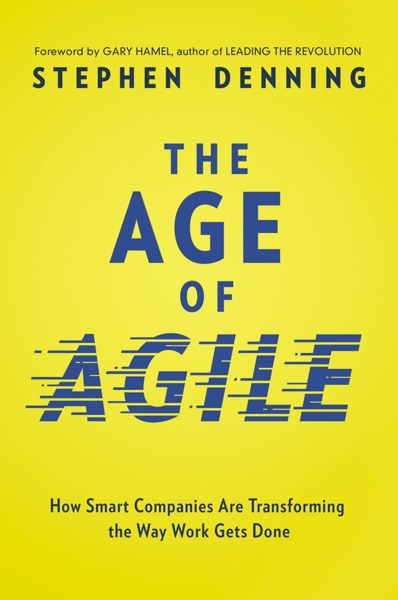
The Age of Agile by Stephen Denning is a 2018 business book about agile, organizational transformation, customer-centricity. Agile is not a software process — it is a management philosophy that applies to any work where complexity, speed, and customer responsiveness are competitive requirements.
Summary
The Age of Agile is Stephen Denning's case that Agile — the software development movement formalized in the 2001 Manifesto — has become a general management framework applicable to any organization facing complexity, speed, and the need for continuous customer value. Denning, a former director at the World Bank and a leadership and management consultant, argues that organizations running on twentieth-century bureaucratic principles are structurally incapable of competing in a world where customer expectations change faster than annual planning cycles can accommodate.
Denning organizes the book around three laws: the Law of the Small Team (small cross-functional teams are the basic unit of work), the Law of the Customer (the customer is the purpose and the ongoing judge of value), and the Law of the Network (the organization is a network of small teams, not a hierarchy of functions). These three ideas, he argues, are what distinguish organizations that have genuinely adopted Agile thinking from those that have installed Agile processes without changing management assumptions.
The book draws heavily on case studies: Spotify's tribe model, Microsoft's transformation under Satya Nadella, Barclays' agile banking practices, and a number of manufacturing and service companies that have extended Agile beyond software. Denning's argument is that the companies winning in the 2020s are not doing so because of technology alone but because of how they organize people to learn and respond. The contrast cases — companies that attempted agile transformations and failed because senior leadership didn't change — are as instructive as the successes.
The book is optimistic in a way that sometimes feels uncritical. Denning is clearly an advocate, and the case studies are largely chosen to support his argument rather than test it. Readers who have worked inside agile transformations will recognize the gap between the case study version and the lived experience of reorganization, role confusion, and middle-management resistance. Nevertheless, for executives who want to understand why their agile initiatives have stalled at the team level without changing the organization, Denning's three laws provide a precise diagnosis.
Talk to The Age of Agile like its author wrote you back.
Get the ideas that fit your life — not generic summaries.
- Chat with the book
- Audiobook-style main ideas
- Adapts to your life and goals
- Helps you take action
Key takeaways
- 1.
Agile is not a software process — it is a management philosophy that applies to any work where complexity, speed, and customer responsiveness are competitive requirements.
- 2.
The Law of the Small Team: small, autonomous, cross-functional teams outperform functional silos when adaptability and customer focus are the goals.
- 3.
The Law of the Customer: decisions at every level should be filtered through whether they create value for the customer, not whether they serve the organization's internal processes.
- 4.
The Law of the Network: an agile organization is a network of small teams coordinating horizontally, not a hierarchy of functions reporting vertically.
- 5.
Middle management is where most agile transformations fail. Processes change at the team level while management assumptions remain bureaucratic, creating a structural contradiction.
- 6.
Leadership in agile organizations shifts from controlling and directing to enabling and removing obstacles. Leaders become servants of the teams, not directors of them.
- 7.
Continuous delivery of small increments creates faster feedback loops than large releases, enabling organizations to learn from customers and adjust before they've committed to a wrong direction.
- 8.
The shift to Agile thinking requires changing what managers measure. Measuring outputs (features shipped, hours worked) produces different organizations than measuring customer outcomes.
Discussion questions
Use these on your own, with a book club, or as chat starters in Superbook. Book club version, ready to copy or print →
- 1.
Denning argues the three laws apply beyond software. Which parts of your organization are already operating this way, and which are most resistant?
- 2.
Have you experienced or witnessed an agile transformation that stalled? At what level did it break down, and what does Denning's framework say about why?
- 3.
The Law of the Customer says every decision should be filtered through customer value. What decision in your current work would look different if you applied that filter seriously?
- 4.
Small teams are the basic unit of agile work. What is the smallest team you could form to tackle your most important current problem, and what functions would it need to include?
- 5.
Denning says middle management is often the main obstacle to agile transformation. If you are or manage middle managers, how accurate is that diagnosis?
- 6.
What does leadership look like in a network-of-teams organization compared to a functional hierarchy? How would your job change?
- 7.
The book profiles Spotify's tribe model. That model has since been questioned by people who worked inside it. Does that complicate Denning's argument, or is it a separate issue?
- 8.
Measuring customer outcomes rather than internal outputs requires different data and different accountability structures. What would have to change in your organization for that shift to happen?
- 9.
Denning treats agile and bureaucracy as fundamentally incompatible. Do you think a hybrid is possible, or does the bureaucratic logic always win eventually?
- 10.
The book's case studies are largely positive. What factors might explain why some agile transformations succeed and others don't that Denning underweights?
- 11.
How does the pressure to demonstrate quarterly results interact with the agile principle of continuous, incremental value delivery?
- 12.
If you had to identify the single biggest structural change your organization would need to make to become genuinely agile, what would it be?
Themes
Frequently asked questions
-
What is The Age of Agile about?
It argues that agile thinking — small teams, customer focus, iterative delivery — has become a general management framework, not just a software development method. Denning profiles companies that have extended agile beyond IT with measurable competitive advantages and explains why bureaucratic organizations structurally resist it.
-
Is The Age of Agile only relevant for tech companies?
No. Denning explicitly argues the opposite, with case studies from banking, manufacturing, and government. Whether the principles translate as cleanly in non-software contexts is debated, but the core ideas about small teams and customer focus apply broadly.
-
Who should read this book?
Senior executives trying to understand why their agile initiatives have delivered team-level results but not organization-level transformation. Also useful for strategists and change managers who need a clear articulation of what genuinely agile management requires, not just agile processes.
-
Is Denning's argument that Agile always wins convincing?
Partially. The case studies are well chosen and the three laws are a useful diagnostic. The book underweights implementation complexity and organizational resistance, and the case studies are sometimes presented more neatly than the underlying reality. It makes a strong argument without being a complete one.
-
What is the most important idea in The Age of Agile?
The Law of the Customer — that every decision and every organizational structure should be evaluated on whether it creates value for the customer, not whether it is internally efficient or politically comfortable. Most organizations say this but measure something different, and Denning's book makes that gap visible.
Similar books

An Elegant Puzzle
Will Larson
Good to Great
Jim Collins

Blitzscaling: The Lightning-Fast Path to Building Massively Valuable Companies
Reid Hoffman and Chris Yeh
The Hard Thing About Hard Things
Ben Horowitz
