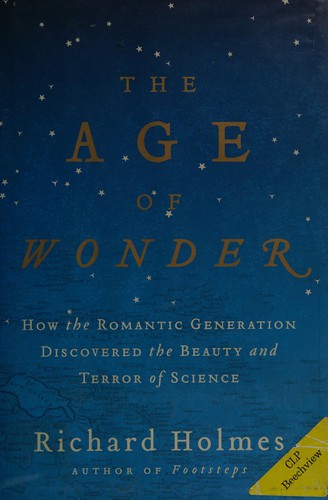
The Age of Wonder: The Romantic Generation and the Discovery of the Beauty and Terror of Science by Richard Holmes is a 2008 history book about scientific discovery, romanticism, history of science. The Romantic period in British culture was also a period of explosive scientific discovery, and the two movements were not separate — scientists read poets and poets attended scientific lectures.
Summary
Richard Holmes is a British literary biographer best known for his two-volume life of Shelley, and The Age of Wonder brings that literary sensibility to the history of science during the Romantic period — roughly 1769 to 1832. The book is organized around the lives and discoveries of several scientists, most prominently the astronomer William Herschel and the chemist Humphry Davy, and uses their stories to argue that the Romantic era represents a specific, largely unrecognized moment in the history of science: the first time scientists and artists inhabited the same emotional and intellectual territory.
Holmes opens with Joseph Banks's voyage to Tahiti on the Endeavour in 1769, tracing how that encounter with radical otherness shaped Banks's later role as the president of the Royal Society and a patron of the next generation of British science. From there, the book follows William Herschel's construction of ever-larger telescopes and his discovery of Uranus — the first new planet in recorded history — and his sister Caroline Herschel's parallel career as an astronomer in her own right, discovering eight comets. Humphry Davy's work on nitrous oxide and later on electrochemistry occupies the middle sections, with Holmes paying close attention to the way Davy understood his experiments as experiences, as encounters with a world that science was revealing to be far stranger than anyone had anticipated.
The literary threads are woven throughout. Coleridge attended Davy's lectures and drew on them for his own thinking about imagination and nature. Shelley's enthusiasm for science, and Mary Shelley's Frankenstein, are read as responses to the specific discoveries and anxieties of the period. Holmes argues that the Romantic poets and the Romantic scientists were responding to the same fundamental experience: the sudden expansion of what was known, and the simultaneous expansion of what could be imagined.
The book is long and unhurried. Holmes writes biographically, which means he follows his subjects through personal as well as professional life, and the result is a portrait of a period rather than a thesis-driven argument. The Age of Wonder has been criticized for being too celebratory and for eliding some of the institutional exclusions of the period, particularly around women and class. Those criticisms have merit. But the core claim — that Romantic science and Romantic poetry drew from the same cultural well — is persuasively made, and Holmes's ability to place discoveries in human context is rarely equaled in the history of science.
Talk to The Age of Wonder: The Romantic Generation and the Discovery of the Beauty and Terror of Science like its author wrote you back.
Get the ideas that fit your life — not generic summaries.
- Chat with the book
- Audiobook-style main ideas
- Adapts to your life and goals
- Helps you take action
Key takeaways
- 1.
The Romantic period in British culture was also a period of explosive scientific discovery, and the two movements were not separate — scientists read poets and poets attended scientific lectures.
- 2.
William Herschel's discovery of Uranus in 1781 was the first identification of a new planet in recorded history, and it expanded the known solar system overnight, demonstrating that the sky was not fixed.
- 3.
Caroline Herschel, William's sister, was a serious astronomer who discovered eight comets and received a gold medal from the Royal Astronomical Society, one of the first women to do so.
- 4.
Humphry Davy's early experiments with nitrous oxide were simultaneously scientific investigations and what he described as experiences of altered consciousness — he published accounts of what the gas felt like as well as what it did chemically.
- 5.
Coleridge, Wordsworth, Keats, and Shelley engaged seriously with the science of their time. Holmes argues that Romantic poetry cannot be fully understood without understanding the science it was responding to.
- 6.
Mary Shelley's Frankenstein draws directly on the galvanism experiments and natural philosophy debates of the period, making it a scientific as well as a literary document.
- 7.
The balloon flights of the period — Holmes devotes considerable attention to them — were experienced by the public as revelatory, opening a new perspective on the Earth that previously only birds had.
- 8.
The Romantic generation was the first for whom science became a professional vocation rather than a gentleman's hobby, marking a shift in how scientific knowledge was produced and who produced it.
Discussion questions
Use these on your own, with a book club, or as chat starters in Superbook. Book club version, ready to copy or print →
- 1.
Holmes argues that Romantic poetry and Romantic science were drawing from the same cultural sources. Do you find that argument convincing? What evidence in the book was most persuasive?
- 2.
Caroline Herschel's career is embedded in her brother's story rather than told on its own terms. How does Holmes handle the institutional constraints on her work, and how would you tell that story differently?
- 3.
Humphry Davy treated his own consciousness as data in his nitrous oxide experiments. What does that approach to self-experimentation suggest about the relationship between scientific and subjective knowledge?
- 4.
The discovery of Uranus in 1781 demonstrated that the solar system was larger than anyone had assumed. What discovery in your lifetime has had a similarly disorienting effect on what seemed settled?
- 5.
Holmes writes biographical history rather than analytical history. What does that choice allow him to do that a more argument-driven approach would not?
- 6.
The book has been criticized for being too celebratory and for not adequately addressing who was excluded from Romantic science. How much does that criticism change your reading of it?
- 7.
Coleridge and Keats both engaged with science as readers and observers, not practitioners. What does their engagement suggest about how scientific ideas move into culture?
- 8.
Frankenstein is read here as a response to specific scientific experiments of the period. Does knowing that context change how you read the novel, or how you think it should be taught?
- 9.
Holmes describes the Romantic scientists as experiencing wonder alongside their discoveries. Is that an emotion you associate with modern science as it's publicly presented? What changed?
- 10.
The book covers roughly sixty years. Which of the individual figures Holmes profiles did you find most compelling, and what does their story illuminate about the period?
- 11.
What would it look like today for scientists and artists to inhabit the same intellectual territory as Holmes claims they did in the Romantic period? Where do you see that happening?
- 12.
Holmes is primarily a literary biographer. How does that background shape the strengths and limitations of The Age of Wonder as a history of science?
Themes
Frequently asked questions
-
Is The Age of Wonder worth reading?
Yes, for readers who enjoy literary biography and history of science together. It's long and unhurried, so it rewards readers who don't need a tight thesis. If you want rigorous analytical history of science, it may feel too anecdotal, but the writing is excellent and the period is genuinely fascinating.
-
How long does it take to read The Age of Wonder?
Around twelve hours at a comfortable pace — it's a substantial book at over 500 pages. The chapters are organized around individual figures and can be read somewhat independently, which makes it manageable in a long reading project.
-
What is the book's central argument?
That Romantic science and Romantic poetry were parts of the same cultural moment — both responding to the sudden expansion of what was known about the physical world, and both grappling with what that expansion meant for human meaning and imagination.
-
Who should read this book?
Readers interested in Romantic literature, history of science, or British intellectual history of the early 19th century. It's particularly rewarding for readers who've already encountered Frankenstein, Coleridge, or Keats and want a richer context for their work.
-
What's the most memorable section of the book?
Many readers single out the chapters on William and Caroline Herschel — the scale of their telescope construction project, the years of systematic sky surveys, and the specific moment of discovering a new planet. The balloon chapter, which follows early aeronauts, is also vivid and unexpected.