Economics · Book club
The Aggressive Conservative Investor book club questions
Here are 11 book club questions for The Aggressive Conservative Investor by Martin J. Whitman, Martin Shubik & Gene Isenberg, ordered to open easily and end somewhere worth arguing about. Copy them, print them, or bring them up one at a time.
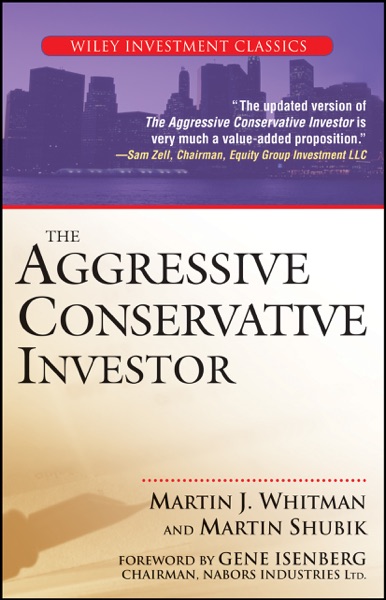
The Aggressive Conservative Investor lays out Martin Whitman's distinctive approach to securities analysis, which he developed over decades as a distressed-debt investor and fund manager before founding Third Avenue Management.
Martin J. Whitman, Martin Shubik & Gene Isenberg · 1979 · 6h 0m
Full summary and key takeaways →The 11 questions
- 1.
Whitman argues asset-based analysis is more reliable than earnings-based analysis. In what kinds of businesses does this hold most strongly, and where does it break down?
- 2.
The 'aggressive conservative' label resolves a false dichotomy. Where else in investing or business do you think people create false tradeoffs between risk and return?
- 3.
Whitman was deeply skeptical of Modern Portfolio Theory and the Efficient Market Hypothesis. How have the decades since 1979 shaped or complicated his critique?
- 4.
The book assumes serious accounting literacy. Do you think that requirement is a feature or a limitation — does good investing require being a good accountant?
- 5.
Whitman's framework is built around net asset value. What are the hardest parts of balance-sheet analysis — the places where book value most diverges from economic reality?
- 6.
Distressed investing requires holding unpopular positions for long periods. What temperamental or institutional factors make this hardest, and how do successful practitioners manage them?
- 7.
Whitman distinguishes between good businesses bought at any price and businesses with sound financial condition bought cheaply. How do you weigh business quality versus price in your own framework?
- 8.
The book was written in 1979. How have changes in accounting standards, financial instruments, and market structure changed the applicability of Whitman's framework?
- 9.
Whitman is skeptical of EPS as a metric. What alternative metrics does he prefer, and do you find those more or less useful in the businesses you analyze?
- 10.
Asset-based investing tends to work better in asset-heavy industries. How do you apply the underlying principles to knowledge businesses or software companies with few tangible assets?
- 11.
The book argues that complex situations create opportunity. Do you think information is more or less the edge in today's markets versus Whitman's era?
How to run the discussion
- Pick six to eight, not all of them. An hour of real discussion covers fewer questions than anyone expects, and racing the list is what makes a book club feel like homework.
- Open with what people noticed, not what they concluded. Asking for a verdict first hardens opinions before anyone has heard each other.
- Let the disagreement run. The questions below that split a room are the ones worth the time; the ones everyone answers the same way can be skipped.
- Ask the quiet person a specific question. A direct, narrow question is far easier to answer than an open invitation to contribute.
Themes worth steering toward
If the conversation stalls, these are the threads that usually restart it.
Common questions
What are good book club questions for The Aggressive Conservative Investor?
Here are 11 book club questions for The Aggressive Conservative Investor by Martin J. Whitman, Martin Shubik & Gene Isenberg, ordered to open easily and end somewhere worth arguing about. The strongest openers ask what each reader noticed rather than what they concluded, and the discussion usually turns on value investing, financial analysis, asset-based investing.
How long should a book club discussion of The Aggressive Conservative Investor last?
Most groups run 60 to 90 minutes of actual discussion. That is roughly six to eight questions, not all of them, so pick the ones that suit your group rather than working down the list in order.
What are the main themes in The Aggressive Conservative Investor?
Value investing, Financial analysis, Asset-based investing, Risk management, Contrarian investing. Those are the threads most likely to divide a room, which makes them the useful places to steer a discussion that has gone quiet.
Picking the next one? See books like The Aggressive Conservative Investor or questions for other book club picks.
