Historical fiction · Book club
The Alienist book club questions
Here are 12 book club questions for The Alienist by Caleb Carr, ordered to open easily and end somewhere worth arguing about. Copy them, print them, or bring them up one at a time.
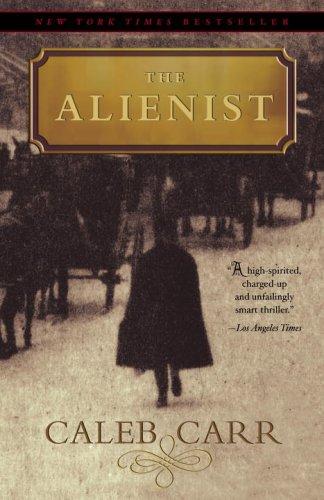
The Alienist is set in 1896 New York City, where Dr.
Caleb Carr · 1994 · 10h 0m
Full summary and key takeaways →The 12 questions
- 1.
Kreizler believes the killer was shaped by childhood trauma and social circumstance. Does the novel ask you to agree with him, or does it leave room to push back?
- 2.
Sara Howard has to do expert work while being denied expert status. How does Carr handle her frustration? Does he give her enough agency?
- 3.
The victims are boys from the city's most marginal communities. How does the book handle the question of who gets to be a victim worth investigating?
- 4.
Roosevelt is portrayed sympathetically as a reformer. Does that portrait feel earned, or does it soften a complicated historical figure?
- 5.
Kreizler's methods are unconventional and his team operates outside official sanction. Is that a strength or a problem in terms of the investigation's legitimacy?
- 6.
The killer's backstory, when revealed, involves a pattern of institutional failure. Does knowing the why make the crimes more or less disturbing to you?
- 7.
The novel is narrated by Moore, who is a participant but not the investigative genius. What does Carr gain — or lose — by not making Kreizler the first-person narrator?
- 8.
How does this compare to other historical detective fiction you've read — Umberto Eco's The Name of the Rose, say, or the Sherlock Holmes stories? What does the historical setting add?
- 9.
Institutional corruption blocks the investigation repeatedly. Does the novel suggest that justice is ultimately achievable, or does it have a more pessimistic view of systems?
- 10.
The criminal psychology in the novel is slightly anachronistic — they're using 1896 methods to generate insights that belong more to the 1960s FBI. Does that bother you, or does it feel like acceptable creative license?
- 11.
Who in the novel changes most by the end? Is the change earned?
- 12.
The Gilded Age parallels to contemporary inequality are hard to miss. Does Carr press that parallel too hard, or does he let it speak for itself?
How to run the discussion
- Pick six to eight, not all of them. An hour of real discussion covers fewer questions than anyone expects, and racing the list is what makes a book club feel like homework.
- Open with what people noticed, not what they concluded. Asking for a verdict first hardens opinions before anyone has heard each other.
- Let the disagreement run. The questions below that split a room are the ones worth the time; the ones everyone answers the same way can be skipped.
- Ask the quiet person a specific question. A direct, narrow question is far easier to answer than an open invitation to contribute.
Themes worth steering toward
If the conversation stalls, these are the threads that usually restart it.
Common questions
What are good book club questions for The Alienist?
Here are 12 book club questions for The Alienist by Caleb Carr, ordered to open easily and end somewhere worth arguing about. The strongest openers ask what each reader noticed rather than what they concluded, and the discussion usually turns on psychology and criminal profiling, gilded age inequality, gender and power.
How long should a book club discussion of The Alienist last?
Most groups run 60 to 90 minutes of actual discussion. That is roughly six to eight questions, not all of them, so pick the ones that suit your group rather than working down the list in order.
What are the main themes in The Alienist?
Psychology and criminal profiling, Gilded Age inequality, Gender and power, Institutional corruption, The birth of modern forensics. Those are the threads most likely to divide a room, which makes them the useful places to steer a discussion that has gone quiet.
Picking the next one? See books like The Alienist or questions for other book club picks.
