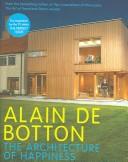
The Architecture of Happiness by Alain de Botton is a 2006 philosophy book about architecture, aesthetics, identity. Architecture is a form of communication: buildings embody values, and we respond to whether those values harmonize with our own sense of who we want to be.
Summary
The Architecture of Happiness is Alain de Botton's investigation into why certain buildings make us feel more alive and others leave us deflated. Published in 2006, it approaches architecture not as a technical discipline or a history of styles but as a psychological one: the spaces we inhabit reflect back to us something about who we want to be, and the quality of that reflection shapes our wellbeing more than we ordinarily admit.
De Botton's central argument is that architecture is a form of communication. Buildings embody values — whether order, grandeur, humility, or domesticity — and those values either complement or conflict with the person inhabiting them. He traces how different civilizations built to project their ideals: the Greek temple communicating the rationality of civic life, the Gothic cathedral projecting the terror and comfort of faith, the modernist glass tower expressing a faith in transparency and efficiency. What shifts over time are the underlying psychological needs driving the forms, not just the fashions.
The book is frank about the difficulty of articulating why one building feels right and another doesn't. De Botton draws on Stendhal, Ruskin, and Le Corbusier as he works through proportions, materials, ornament, and the tension between tradition and novelty. He argues that the insistence on purely functional criteria — efficiency, cost, structural soundness — ignores how much of our daily experience of a space is emotional. We are not indifferent to whether a ceiling is high or low, whether light enters obliquely or directly, whether materials feel warm or cold.
The tone is characteristically de Botton: literary, associative, willing to make large claims and defend them with specific examples rather than academic apparatus. Architects sometimes find the book too subjective, and the prose can linger when directness would serve better. But for readers without formal training who want to think more carefully about the built environment — what's been built around them, what they'd choose to live in, and why — it opens genuinely useful ways of looking.
Talk to The Architecture of Happiness like its author wrote you back.
Get the ideas that fit your life — not generic summaries.
- Chat with the book
- Audiobook-style main ideas
- Adapts to your life and goals
- Helps you take action
Key takeaways
- 1.
Architecture is a form of communication: buildings embody values, and we respond to whether those values harmonize with our own sense of who we want to be.
- 2.
The psychological dimension of space — how it makes us feel — is not decoration added on top of function. It is part of what a building is for.
- 3.
Different eras built to express different collective needs: order, transcendence, efficiency, intimacy. Understanding the need behind the form helps explain why buildings resonate across cultures.
- 4.
Beauty is not purely subjective. De Botton argues that we can reason about why certain proportions, materials, and arrangements feel right, even if the arguments are harder to settle than purely technical ones.
- 5.
The longing for beauty in our buildings reflects a longing for a better self — we want to live among reminders of what we aspire to, not just what we are.
- 6.
Modernism promised liberation from ornament, but stripped buildings can feel cold because ornament was carrying psychological work that pure form cannot.
- 7.
The tension between tradition and innovation in architecture mirrors a broader human ambivalence about belonging and change.
- 8.
Awareness of why spaces affect you is itself useful: it helps you design your own environment more intentionally, even if you have no formal authority over what gets built.
Discussion questions
Use these on your own, with a book club, or as chat starters in Superbook. Book club version, ready to copy or print →
- 1.
Think of a building or room that genuinely improved your mood. What specifically about it do you think produced that effect?
- 2.
De Botton argues that what we find beautiful reflects what we value. What does your ideal living space say about what you're looking for in life?
- 3.
He claims that buildings embody the psychological needs of the era that built them. What do contemporary glass-and-steel office towers communicate about our current values, and do you agree with that message?
- 4.
The book suggests that we surround ourselves with beauty because we need reminders of who we want to be. Is that a meaningful claim to you, or does it feel like over-reading?
- 5.
De Botton is critical of purely functionalist architecture that ignores emotional effect. Have you ever worked or lived in a space so uninspiring that it affected your work? What would you have changed?
- 6.
He draws on Ruskin's argument that ornament carries meaning. What do you think is lost when we strip buildings of decoration in the name of modernity or economy?
- 7.
The book distinguishes between buildings that communicate order, those that communicate grandeur, and those that communicate intimacy. Which of these do you most want in a home, and which do you most want in a public building?
- 8.
Architecture shapes behavior subtly — where you linger, where you rush, what feels private. Can you think of a space that changed how you behaved in ways you didn't consciously choose?
- 9.
De Botton is a generalist philosopher writing about architecture. Architects sometimes find his approach too literary. Is there a risk that non-specialists writing about craft fields simplify more than they illuminate?
- 10.
The book ends with a case for taking aesthetics seriously in urban planning. What would be the cost of doing that in a city you know well?
- 11.
If you had the budget and authority to redesign one room in your life right now, which room and what would you change? What does that tell you about what you're missing?
Themes
Frequently asked questions
-
Is The Architecture of Happiness worth reading if I have no background in architecture?
Yes — it's written for exactly that reader. De Botton doesn't assume technical knowledge. The value of the book is less information about buildings than a new way of looking at the spaces around you and asking why they feel the way they do.
-
What is the main argument of The Architecture of Happiness?
That buildings are not neutral containers for life. They communicate values, generate moods, and shape identity in ways that matter — and that we have both the right and the responsibility to take aesthetic criteria seriously, not just functional ones.
-
How long does it take to read?
Around four to five hours. The chapters are short and well-structured, though the prose is dense enough that quick skimming loses texture. Many readers find it worth reading slowly with time to look at the buildings around them between sessions.
-
Who shouldn't read this book?
Readers who want systematic architectural theory or historical survey will find it frustratingly selective. De Botton is essayistic and impressionistic; he's not trying to produce a comprehensive account but to change how you look.
-
Does the book offer any practical advice?
Not directly. It's more diagnostic than prescriptive. But becoming more articulate about what you want from a space — and why certain qualities resonate with you — is itself a form of practical knowledge when choosing where to live or work.
Similar books
The Death and Life of Great American Cities
Jane Jacobs

Status Anxiety
Alain de Botton
The Art of Travel
Alain de Botton
Seeing Is Forgetting the Name of the Thing One Sees
Lawrence Weschler
