The Art of the Good Life by Rolf Dobelli is a 2017 philosophy book about decision-making, cognitive biases, stoicism. Negative visualization — regularly imagining losing what you value — increases gratitude, reduces hedonic adaptation, and prepares you emotionally for real loss.
Summary
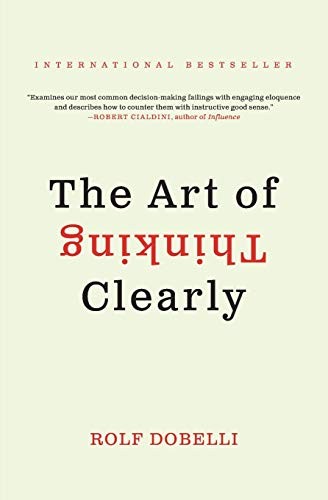
The Art of the Good Life is Rolf Dobelli's sequel to The Art of Thinking Clearly, applying the same format — short, self-contained chapters on discrete mental tools — to the question of how to construct a life that goes well. Where the earlier book catalogued cognitive biases that cause poor thinking, this one focuses on tools and habits of mind that improve judgment and reduce unnecessary suffering. The two books share a format but the emphasis here is constructive rather than cautionary.
Dobelli draws heavily on Stoic philosophy, particularly Seneca and Marcus Aurelius, while translating their insights into modern, practical terms. He covers negative visualization (imagining losing what you have, to appreciate it and to prepare for loss), the circle of competence (knowing precisely where your edge ends and avoiding decisions outside it), and the concept of focusing exclusively on what is within your control while accepting what is not. These ideas are not new, but Dobelli presents them with unusual clarity and in contexts a contemporary reader will recognize.
The book's format keeps each chapter short — usually three to five pages — which makes it easy to read and easy to apply one idea at a time. This is also its main limitation. The brevity that makes the book approachable can make individual chapters feel superficial to readers who want more depth. Some chapters lean on anecdotes that serve more as illustration than evidence. Dobelli is not presenting original research; he is curating and synthesizing ideas from philosophy, psychology, and economics and making them accessible.
The underlying argument is that a good life is less about maximizing outcomes and more about eliminating the thought patterns and behaviors that cause predictable misery. The focus on subtraction rather than addition sets Dobelli apart from most self-help literature, which tends to push addition: more goals, more habits, more routines. Dobelli's prescription is closer to the Stoic one: identify what genuinely matters, invest attention there, and stop wasting energy on the rest.
Talk to The Art of the Good Life like its author wrote you back.
Get the ideas that fit your life — not generic summaries.
- Chat with the book
- Audiobook-style main ideas
- Adapts to your life and goals
- Helps you take action
Key takeaways
- 1.
Negative visualization — regularly imagining losing what you value — increases gratitude, reduces hedonic adaptation, and prepares you emotionally for real loss.
- 2.
The circle of competence defines the boundaries of your genuine understanding. Operating inside it produces good decisions; straying outside it produces confident mistakes.
- 3.
Focusing on what is within your control and accepting what is not is the core Stoic operating system. Most anxiety arises from trying to control outcomes that are fundamentally outside your influence.
- 4.
The news cycle produces anxiety and false urgency without improving decision-making. Dobelli argues it should be eliminated rather than moderated.
- 5.
Comparison with peers is a near-universal source of unhappiness that provides almost no useful information. Measuring against your own standards is more reliable and more stable.
- 6.
Regret minimization — asking which choice you'll regret less at eighty — is a useful heuristic for major life decisions where analysis alone doesn't resolve the question.
- 7.
The good life requires declining good opportunities to protect space for great ones. Saying no is a skill that most people underuse relative to its importance.
- 8.
Rational thinking and emotional well-being are both served by reducing the volume of decisions, information, and commitments that consume attention without producing value.
Discussion questions
Use these on your own, with a book club, or as chat starters in Superbook. Book club version, ready to copy or print →
- 1.
Dobelli argues for subtracting bad thinking patterns rather than adding good habits. Does that framing feel more actionable than the typical self-help approach?
- 2.
Which chapter or mental tool in the book felt most immediately applicable to a decision or habit you're currently dealing with?
- 3.
The Stoic practice of negative visualization asks you to imagine losing what you value most. Have you ever done this deliberately? What happened?
- 4.
Dobelli recommends quitting news consumption entirely. What would you lose if you stopped, and is that loss worth the clarity he claims you'd gain?
- 5.
The circle of competence depends on honest self-assessment. How do you distinguish genuine expertise from confident familiarity in your own areas of knowledge?
- 6.
Where in your life are you currently expending energy on something outside your control? What would actually accepting that feel like?
- 7.
Dobelli argues that most peer comparison produces only misery and no useful information. Do you agree? Are there cases where comparison is genuinely useful?
- 8.
The book uses the regret minimization heuristic for major decisions. Can you think of a past decision where applying that framework would have changed your choice?
- 9.
Dobelli writes from a position of material comfort. How much of the philosophy transfers to people dealing with genuine economic insecurity or constrained choices?
- 10.
The book is structured as 52 tools — one per week. Have you read it that way, or did you read it straight through? Which approach do you think produces more lasting change?
- 11.
Which idea in the book do you most resist accepting, and why?
- 12.
If you could only keep three mental tools from the book and apply them rigorously for a year, which three would you choose?
Themes
Frequently asked questions
-
Do I need to read The Art of Thinking Clearly first?
No. The books share a format and sensibility but each chapter stands alone. The Art of the Good Life is more philosophical and constructive in orientation, while The Art of Thinking Clearly is primarily about avoiding bad reasoning. Either can be read first without losing anything.
-
Is The Art of the Good Life worth reading?
Yes, if you want a concise, readable introduction to applied Stoicism and related mental models. If you've already read Marcus Aurelius, Seneca, and a few books on decision-making, the content will feel familiar. Its main value is synthesis and accessibility.
-
How long is it?
About 300 pages divided into 52 short chapters. Most readers finish it in a few hours of total reading time. The chapter structure makes it easy to read in short sessions.
-
Who should read this book?
Readers who want a practical philosophy for daily life but find ancient Stoic texts difficult to apply directly. Also useful for readers who enjoyed The Art of Thinking Clearly and want a more constructive companion to it.
-
What's the most important idea in the book?
Probably the circle of competence applied not just to investing but to life decisions broadly — identifying where your genuine judgment is reliable and systematically avoiding overconfidence outside those boundaries. It's simple but most people don't apply it consistently.