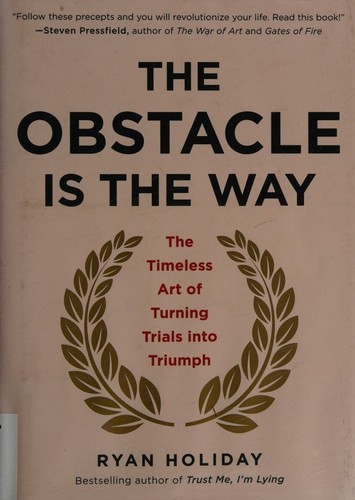
The Obstacle Is the Way by Ryan Holiday is a 2014 philosophy book about stoicism, resilience, adversity. The obstacle itself is often the path forward. Marcus Aurelius's insight was that what blocks the action is where the action must go.
Summary
The Obstacle Is the Way is Ryan Holiday's translation of Stoic philosophy into a practical guide for dealing with hardship. The central idea comes from Marcus Aurelius: the impediment to action advances action — what stands in the way becomes the way. Holiday argues that obstacles are not interruptions to the work; they are the work. Every setback contains an angle of attack if you're willing to look for it rather than react to it.
The book is organized around three disciplines drawn from Stoicism. Perception is first: how you see the obstacle determines whether it defeats you before you've even started. Holiday walks through figures like Thomas Edison, Theodore Roosevelt, and Amelia Earhart to show that what made them effective was less raw talent than the ability to remain calm and clear-eyed under pressure, to see things as they are rather than catastrophize or deny. Second is action: once perception is steady, you move — with persistence, with creativity, and with the willingness to try a different approach when the direct route is blocked. Third is will: the inner discipline to accept what cannot be changed and keep going anyway, drawing on what the Stoics called amor fati, love of fate.
Holiday is not writing a philosophy textbook. The prose is punchy and the examples are drawn almost entirely from soldiers, athletes, entrepreneurs, and historical figures who faced real, material difficulty. The risk is a certain flatness — each story illustrates a point rather than complicates it. The historical vignettes are motivating but sometimes thin on context, and readers who want nuance about when Stoic acceptance tips into denial will find the book resolute rather than reflective.
What Holiday does well is take ideas that live in Marcus Aurelius and Epictetus and make them feel immediate. The three-part framework is simple enough to remember under pressure, which is ultimately when it needs to work. For anyone whose default response to a hard situation is either paralysis or panic, the book offers a reliable mental reset: see clearly, move with purpose, accept what you cannot control. That is not a complete philosophy of life, but as a field manual for adversity it is genuinely useful.
Talk to The Obstacle Is the Way like its author wrote you back.
Get the ideas that fit your life — not generic summaries.
- Chat with the book
- Audiobook-style main ideas
- Adapts to your life and goals
- Helps you take action
Key takeaways
- 1.
The obstacle itself is often the path forward. Marcus Aurelius's insight was that what blocks the action is where the action must go.
- 2.
Perception comes first. Seeing a situation clearly and without panic is not a soft skill — it is the prerequisite for any effective response.
- 3.
Action must be persistent and flexible. When the direct route fails, the answer is not to stop but to find a different angle.
- 4.
Will is what carries you through obstacles that cannot be overcome. Amor fati — love of fate — means turning what you must endure into fuel.
- 5.
Most people catastrophize before the problem is even defined. Controlling what you tell yourself about an obstacle changes what options you can see.
- 6.
Discipline in one area compounds. Every obstacle you convert into progress builds the habit of conversion; every one you avoid makes the next harder.
- 7.
The Stoics drew a sharp line between what is up to you and what isn't. Directing energy only at the first category is the core of the framework.
- 8.
Holiday's historical examples — Roosevelt, Lincoln, Edison, Rockefeller — show that great careers are built on a consistent ability to absorb setbacks, not on an absence of them.
Discussion questions
Use these on your own, with a book club, or as chat starters in Superbook. Book club version, ready to copy or print →
- 1.
Think of an obstacle you're facing right now. What would it look like to treat it as the path forward rather than a detour around the path?
- 2.
Holiday argues that perception is the first discipline. Where in your life are you letting an emotional reaction to a situation substitute for a clear reading of it?
- 3.
The book draws a line between things within your control and things outside it. What's a current problem where you're spending energy on the wrong side of that line?
- 4.
Which historical figure in the book resonated most with you, and what specifically about their response to adversity do you want to carry forward?
- 5.
Amor fati means not just accepting what happens but embracing it. Is there a past setback in your life that, in retrospect, pushed you somewhere better?
- 6.
Holiday's action discipline includes creativity — when the direct path is blocked, find another. What's an obstacle in your life where you haven't yet looked for the indirect route?
- 7.
The will discipline is about endurance rather than solution. What's something in your life right now that may have no good solution but still needs to be carried?
- 8.
The book treats equanimity as a learnable skill rather than a personality trait. What practices help you stay clear-headed when something goes badly wrong?
- 9.
Holiday's writing is almost entirely through the lens of high achievers under extreme pressure. Does that framing make the ideas more compelling or harder to apply to ordinary life?
- 10.
The Stoics used negative visualization — imagining the worst — to reduce fear and increase gratitude. Have you ever used something like this deliberately? Did it work?
- 11.
Where in your life do you tend toward paralysis when facing a setback, and where do you tend toward immediate action? What drives the difference?
- 12.
Marcus Aurelius was writing his Meditations as private notes to himself, not as advice to others. Does knowing that change how you read Holiday's use of him as a model?
Themes
Frequently asked questions
-
Is The Obstacle Is the Way worth reading?
Yes, particularly if you're drawn to Stoic philosophy but haven't read the primary texts. Holiday makes Marcus Aurelius and Epictetus immediately practical. The book is short, direct, and memorable. Readers who already know the Stoics well will find it a useful refresher but may want more depth.
-
How long does it take to read The Obstacle Is the Way?
About three and a half to four hours at a normal reading pace. At under 230 pages it's one of Holiday's shortest books. The chapters are brief and self-contained, which makes it easy to read in short sessions and return to specific sections when you need them.
-
What is The Obstacle Is the Way about?
It applies three Stoic disciplines — perception, action, and will — to the problem of how to respond to setbacks and adversity. The argument is that obstacles are not in the way of the work; they are the work. Holiday illustrates the framework through historical figures who faced significant hardship and converted it into progress.
-
Who should read The Obstacle Is the Way?
Anyone who finds themselves paralyzed or panicked by setbacks and wants a practical mental framework for responding more clearly. It's also useful for leaders, athletes, and founders who face high-stakes situations regularly and need a reliable way to reset under pressure.
-
What's the most useful idea in The Obstacle Is the Way?
The distinction between what is and isn't in your control, combined with the idea that your interpretation of an obstacle — not the obstacle itself — determines what options are available to you. Correcting your perception before acting is the discipline most people skip, and it's the one the whole framework depends on.