Psychology · Book club
The Art of Thinking Clearly book club questions
Here are 11 book club questions for The Art of Thinking Clearly by Rolf Dobelli, ordered to open easily and end somewhere worth arguing about. Copy them, print them, or bring them up one at a time.
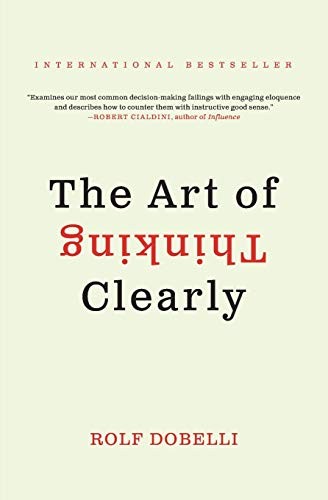
Rolf Dobelli is a Swiss entrepreneur and novelist who wrote a series of short newspaper columns on cognitive biases, later collected and expanded into this book.
Rolf Dobelli · 2013 · 4h 40m
Full summary and key takeaways →The 11 questions
- 1.
Which of the ninety-nine biases do you think has the most practical impact on your own decision-making?
- 2.
Survivorship bias suggests that most success stories we hear are not representative. Which domains in your life or work do you think are most distorted by survivorship?
- 3.
The sunk cost fallacy says past investment should not influence current decisions. Can you think of something you are continuing primarily because of what you have already put into it?
- 4.
Dobelli argues that authority bias extends beyond expertise. When have you deferred to someone's judgment in a domain where their credentials did not actually apply?
- 5.
The format is ninety-nine short chapters. Does a catalog format teach you to think differently, or does it just add to your vocabulary without changing behavior?
- 6.
Action bias is the preference for doing something over nothing. Can you identify a domain in your professional or personal life where you tend to act when inaction would serve better?
- 7.
Confirmation bias is one of the most cited biases in the book. What is a belief you hold strongly? How would you design a genuine test of that belief?
- 8.
The halo effect means good impressions in one area transfer to unrelated areas. Who in your life do you judge primarily through a halo — and is that assessment fair?
- 9.
Dobelli wrote these as newspaper columns. Does the short format make cognitive biases more or less actionable than a sustained argument would?
- 10.
Several chapters cover social biases — social proof, bandwagon effects, conformity. Which of these is most visible in the contexts you work or live in?
- 11.
He ends without a strong prescription for how to improve reasoning. What would a serious program for reducing cognitive bias in your own decisions actually require?
How to run the discussion
- Pick six to eight, not all of them. An hour of real discussion covers fewer questions than anyone expects, and racing the list is what makes a book club feel like homework.
- Open with what people noticed, not what they concluded. Asking for a verdict first hardens opinions before anyone has heard each other.
- Let the disagreement run. The questions below that split a room are the ones worth the time; the ones everyone answers the same way can be skipped.
- Ask the quiet person a specific question. A direct, narrow question is far easier to answer than an open invitation to contribute.
Themes worth steering toward
If the conversation stalls, these are the threads that usually restart it.
Common questions
What are good book club questions for The Art of Thinking Clearly?
Here are 11 book club questions for The Art of Thinking Clearly by Rolf Dobelli, ordered to open easily and end somewhere worth arguing about. The strongest openers ask what each reader noticed rather than what they concluded, and the discussion usually turns on cognitive bias, decision-making, logical fallacies.
How long should a book club discussion of The Art of Thinking Clearly last?
Most groups run 60 to 90 minutes of actual discussion. That is roughly six to eight questions, not all of them, so pick the ones that suit your group rather than working down the list in order.
What are the main themes in The Art of Thinking Clearly?
Cognitive bias, Decision-making, Logical fallacies, Reasoning, Behavioral economics. Those are the threads most likely to divide a room, which makes them the useful places to steer a discussion that has gone quiet.
Picking the next one? See books like The Art of Thinking Clearly or questions for other book club picks.
