Religion & Spirituality · Book club
The Battle for God book club questions
Here are 12 book club questions for The Battle for God by Karen Armstrong, ordered to open easily and end somewhere worth arguing about. Copy them, print them, or bring them up one at a time.
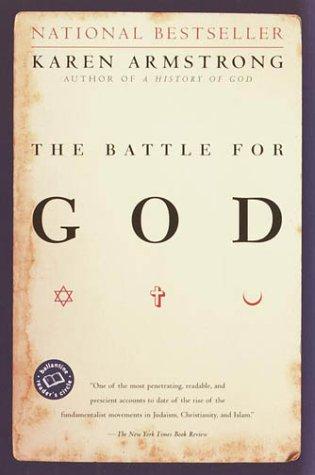
The Battle for God is Karen Armstrong's history of religious fundamentalism across Judaism, Christianity, and Islam from the early modern period to the late twentieth century.
Karen Armstrong · 2000 · 8h 45m
Full summary and key takeaways →The 12 questions
- 1.
Armstrong argues fundamentalism is a product of modernity, not a continuity with tradition. Does this frame change how you think about fundamentalist movements you've observed?
- 2.
The logos/mythos distinction is central to the book. Do you think most religious practitioners today operate primarily in logos mode, mythos mode, or some mix of both?
- 3.
Armstrong identifies fear as the core emotion driving fundamentalism. Does that diagnosis seem accurate to you, and does it change your ethical response to these movements?
- 4.
What distinguishes a legitimate religious traditionalism from the kind of defensive fundamentalism Armstrong describes? Is there a clear line?
- 5.
Armstrong treats Jewish ultraorthodoxy, American evangelical fundamentalism, and political Islam as versions of the same phenomenon. Does that comparison illuminate or flatten important differences?
- 6.
She argues that secular liberals misunderstand fundamentalism by treating it as purely irrational. What would it mean to take fundamentalism seriously without endorsing it?
- 7.
How do you think secularization theory — the idea that modernization causes religion to decline — holds up after reading this book?
- 8.
Many fundamentalist movements also provide social services, community, and meaning that the secular state doesn't. How does that function factor into your assessment?
- 9.
Armstrong gives significant weight to colonialism in the development of Islamic fundamentalism. Do you think Western policy bears any responsibility for the movements it helped produce?
- 10.
The book ends shortly before September 2001. Looking back from the present, do Armstrong's diagnoses seem to have predicted what followed?
- 11.
Do you see any contemporary secular movements that exhibit the same defensive, identity-protecting structure Armstrong identifies in religious fundamentalism?
- 12.
What would conditions look like in which fundamentalist movements lost their appeal? What would have to change?
How to run the discussion
- Pick six to eight, not all of them. An hour of real discussion covers fewer questions than anyone expects, and racing the list is what makes a book club feel like homework.
- Open with what people noticed, not what they concluded. Asking for a verdict first hardens opinions before anyone has heard each other.
- Let the disagreement run. The questions below that split a room are the ones worth the time; the ones everyone answers the same way can be skipped.
- Ask the quiet person a specific question. A direct, narrow question is far easier to answer than an open invitation to contribute.
Themes worth steering toward
If the conversation stalls, these are the threads that usually restart it.
Common questions
What are good book club questions for The Battle for God?
Here are 12 book club questions for The Battle for God by Karen Armstrong, ordered to open easily and end somewhere worth arguing about. The strongest openers ask what each reader noticed rather than what they concluded, and the discussion usually turns on fundamentalism, modernity, religion.
How long should a book club discussion of The Battle for God last?
Most groups run 60 to 90 minutes of actual discussion. That is roughly six to eight questions, not all of them, so pick the ones that suit your group rather than working down the list in order.
What are the main themes in The Battle for God?
Fundamentalism, Modernity, Religion, Judaism, Christianity, Islam, Political religion. Those are the threads most likely to divide a room, which makes them the useful places to steer a discussion that has gone quiet.
Picking the next one? See books like The Battle for God or questions for other book club picks.
