Philosophy · Book club
The Bed of Procrustes book club questions
Here are 11 book club questions for The Bed of Procrustes by Nassim Nicholas Taleb, ordered to open easily and end somewhere worth arguing about. Copy them, print them, or bring them up one at a time.
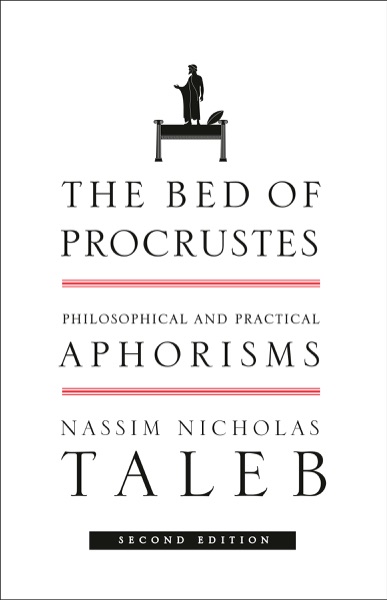
The Bed of Procrustes is Nassim Nicholas Taleb's collection of philosophical aphorisms, the third volume in his Incerto series following Fooled by Randomness and The Black Swan.
Nassim Nicholas Taleb · 2010 · 1h 30m
Full summary and key takeaways →The 11 questions
- 1.
Pick any three aphorisms from the book. What's the strongest objection you can make to each? Does the objection defeat the aphorism or just qualify it?
- 2.
Taleb's targets are consistent across his books: naive experts, fragile systems, people without skin in the game. Is that consistency a philosophical strength or a sign of a fixed worldview?
- 3.
The aphorism form compresses arguments that could be made at length. Does that compression help or hurt the quality of thinking? What is gained and what is lost?
- 4.
What's the difference between an aphorism that is genuinely illuminating and one that is merely clever? Can you find examples of each in the book?
- 5.
Taleb frequently attacks 'intellectuals' and credentialed experts. Is that attack most fair when directed at economists, policy analysts, public health officials, or some other group you know well?
- 6.
The Procrustean metaphor—cutting reality to fit the model—is the central image of the book. Where do you see Procrustean thinking in your own field or daily reasoning?
- 7.
Taleb argues that true wisdom is visible in what you refuse to do. What have you refused to do recently that reflects your actual values rather than external pressure?
- 8.
The book draws on Stoic philosophy without labeling it explicitly. How does the Stoic inheritance shape what Taleb praises and what he condemns?
- 9.
Some readers find Taleb's style arrogant and his targets too obvious. Others find his confidence appropriate given the substance of the arguments. Where do you land, and why?
- 10.
Which aphorism in the book do you most disagree with? What would the full counterargument look like?
- 11.
Taleb's aphorism books are shorter and require less effort than his full-length works. Is that a feature or does the compression sacrifice too much?
How to run the discussion
- Pick six to eight, not all of them. An hour of real discussion covers fewer questions than anyone expects, and racing the list is what makes a book club feel like homework.
- Open with what people noticed, not what they concluded. Asking for a verdict first hardens opinions before anyone has heard each other.
- Let the disagreement run. The questions below that split a room are the ones worth the time; the ones everyone answers the same way can be skipped.
- Ask the quiet person a specific question. A direct, narrow question is far easier to answer than an open invitation to contribute.
Themes worth steering toward
If the conversation stalls, these are the threads that usually restart it.
Common questions
What are good book club questions for The Bed of Procrustes?
Here are 11 book club questions for The Bed of Procrustes by Nassim Nicholas Taleb, ordered to open easily and end somewhere worth arguing about. The strongest openers ask what each reader noticed rather than what they concluded, and the discussion usually turns on aphorisms, epistemology, uncertainty.
How long should a book club discussion of The Bed of Procrustes last?
Most groups run 60 to 90 minutes of actual discussion. That is roughly six to eight questions, not all of them, so pick the ones that suit your group rather than working down the list in order.
What are the main themes in The Bed of Procrustes?
Aphorisms, Epistemology, Uncertainty, Fragility, Human nature. Those are the threads most likely to divide a room, which makes them the useful places to steer a discussion that has gone quiet.
Picking the next one? See books like The Bed of Procrustes or questions for other book club picks.
