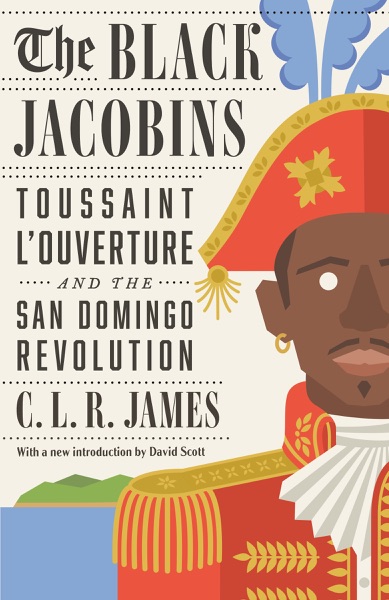
Talk to The Black Jacobins like its author wrote you back.
Get the ideas that fit your life — not generic summaries.
- Chat with the book
- Audiobook-style main ideas
- Adapts to your life and goals
- Helps you take action
What it argues
The Black Jacobins is C.L.R. James's account of the Haitian Revolution, the only successful slave revolt in history, which between 1791 and 1804 transformed Saint-Domingue — France's wealthiest Caribbean colony — into the independent republic of Haiti. First published in 1938, the book centers on Toussaint L'Ouverture, the former slave who became the revolution's greatest general and strategist, and traces his rise, his complex relationships with France and with rival Haitian factions, and his eventual capture and death in a French prison.
James wrote the book as both history and political argument. He was a Trinidadian Marxist writing in the late 1930s, and his subject was not merely the past. He wanted to show that enslaved Africans were not passive victims of history but active agents who made decisions, built alliances, and shaped the modern world. The Haitian revolutionaries, James argued, drew on the same Enlightenment ideals as the French Jacobins — liberty, equality, the rights of man — and carried those ideals further than their French contemporaries were willing to.
What it gets right
- 1.
The Haitian Revolution was the only successful slave revolt in history, and it produced the first Black republic in the Western Hemisphere, declared independent in 1804.
- 2.
Toussaint L'Ouverture was a self-educated former slave who became one of the great military strategists of his era, holding off French, Spanish, and British forces simultaneously.
- 3.
James argues that enslaved people were not passive: they were active historical agents who interpreted Enlightenment ideas and deployed them against the system that had enslaved them.
What it covers
Who wrote it
C.L.R. James (1901–1989) was a Trinidadian historian, novelist, and political theorist whose work shaped twentieth-century thinking about colonialism, Caribbean culture, and Marxist politics. Born in Trinidad, he worked as a journalist and cricket writer before moving to Britain and later the United States. Beyond The Black Jacobins, he is known for Beyond a Boundary, a landmark examination of cricket and colonialism, and for The Case for West-Indian Self-Government. He was active in pan-African and Trotskyist movements and his writing influenced the generation of Caribbean and African independence leaders who came after him.
