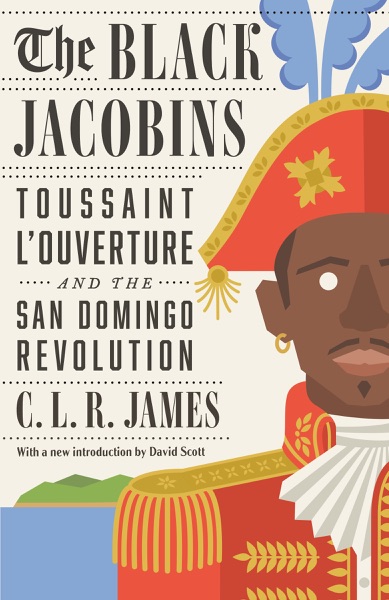
The Black Jacobins by C.L.R. James is a 1938 history book about revolution, colonialism, race and class. The Haitian Revolution was the only successful slave revolt in history, and it produced the first Black republic in the Western Hemisphere, declared independent in 1804.
Summary
The Black Jacobins is C.L.R. James's account of the Haitian Revolution, the only successful slave revolt in history, which between 1791 and 1804 transformed Saint-Domingue — France's wealthiest Caribbean colony — into the independent republic of Haiti. First published in 1938, the book centers on Toussaint L'Ouverture, the former slave who became the revolution's greatest general and strategist, and traces his rise, his complex relationships with France and with rival Haitian factions, and his eventual capture and death in a French prison.
James wrote the book as both history and political argument. He was a Trinidadian Marxist writing in the late 1930s, and his subject was not merely the past. He wanted to show that enslaved Africans were not passive victims of history but active agents who made decisions, built alliances, and shaped the modern world. The Haitian revolutionaries, James argued, drew on the same Enlightenment ideals as the French Jacobins — liberty, equality, the rights of man — and carried those ideals further than their French contemporaries were willing to.
The book's most arresting passages describe the scale of the plantation system's violence and the calculated economic logic that sustained it. Saint-Domingue's sugar production made France rich, and the colony's white planters, free colored class, and enslaved population lived in a structure of organized terror. When the revolution came, it came from below and with extraordinary brutality on both sides, which James refuses to sanitize.
Toussaint's tragedy, in James's telling, is that he tried to hold contradictions together that couldn't be held. He wanted independence and order, racial equality and the plantation economy, alliance with France and sovereignty for Haiti. His maneuvering was brilliant but ultimately left him vulnerable to Napoleon's double-dealing. James's admiration for Toussaint is clear, but so is his analysis of the structural limits that undid him. The book holds up as both a compelling narrative and a serious work of political thought about colonialism, race, and the conditions under which revolutionary movements succeed or fail.
Talk to The Black Jacobins like its author wrote you back.
Get the ideas that fit your life — not generic summaries.
- Chat with the book
- Audiobook-style main ideas
- Adapts to your life and goals
- Helps you take action
Key takeaways
- 1.
The Haitian Revolution was the only successful slave revolt in history, and it produced the first Black republic in the Western Hemisphere, declared independent in 1804.
- 2.
Toussaint L'Ouverture was a self-educated former slave who became one of the great military strategists of his era, holding off French, Spanish, and British forces simultaneously.
- 3.
James argues that enslaved people were not passive: they were active historical agents who interpreted Enlightenment ideas and deployed them against the system that had enslaved them.
- 4.
Saint-Domingue's plantation economy was among the most productive and most brutal in the world. The colony's wealth was the direct product of that violence.
- 5.
The revolution's complexity reflected the deep divisions within colonial society — white planters, free colored landowners, and enslaved Africans all had conflicting interests that shifted through the revolution.
- 6.
Napoleon's decision to reimpose slavery in the French colonies ultimately drove Haitian leaders to declare full independence and defeated his attempt to reassert French power in the Americas.
- 7.
Toussaint's downfall was his attempt to maintain plantation productivity while achieving freedom — a structural contradiction that his opponents exploited.
- 8.
James wrote the book partly as a warning and call to action for Africa's future independence movements, which he believed were analogous to Haiti's eighteenth-century struggle.
Discussion questions
Use these on your own, with a book club, or as chat starters in Superbook. Book club version, ready to copy or print →
- 1.
James argues that Toussaint's greatest weakness was his attempt to reconcile independence with maintaining the plantation economy. Do you think that contradiction was avoidable?
- 2.
The Haitian Revolution drew explicitly on French Revolutionary rhetoric about liberty and equality. What does it mean for those ideals that France still denied them to Haiti's people?
- 3.
James was writing in 1938, with European colonialism still intact and World War II approaching. How does knowing that context change how you read the book's final chapters?
- 4.
How does James handle the violence of the revolution? Does his treatment feel honest, or does it minimize or exaggerate either side's actions?
- 5.
The free colored class occupied an ambiguous position — not enslaved but not equal to whites. How did their choices shape the revolution's course?
- 6.
Napoleon's decision to reimpose slavery is one of the book's pivotal moments. What does it reveal about how French republican ideals were actually applied in the colonies?
- 7.
James was a Marxist, and class analysis runs through the whole book. How much does that lens illuminate the revolution, and where does it feel insufficient?
- 8.
Toussaint is clearly James's hero, but James is honest about his strategic failures. What do you think James most admired about him, and what did he see as his fundamental error?
- 9.
The book ends with Haiti declared independent but the costs were immense. How does that outcome compare to what the revolutionaries were fighting for?
- 10.
James updates the book's appendix in 1963 to address the ongoing struggle for Black freedom. Does the original 1938 text feel dated, or does it still speak to something current?
- 11.
What does The Black Jacobins suggest about the conditions under which revolutionary movements succeed, and what brings them down?
Themes
Frequently asked questions
-
What is The Black Jacobins about?
It is a history of the Haitian Revolution, centered on the leader Toussaint L'Ouverture. James tells the story of how enslaved people in the French colony of Saint-Domingue overthrew slavery, fought off European powers, and established the independent republic of Haiti in 1804.
-
Is The Black Jacobins a hard read?
It is demanding but not inaccessible. James writes with both scholarly precision and rhetorical force. Readers unfamiliar with Caribbean colonial history may need to adjust to the large cast of characters and the complex political alliances, but the narrative pulls you forward.
-
Why is The Black Jacobins still considered important?
It was one of the first serious historical accounts to treat enslaved people as historical agents rather than objects. Written in 1938, it preceded the academic turn toward subaltern and postcolonial history by decades. It also remains the most readable account of the Haitian Revolution in English.
-
Who should read The Black Jacobins?
Anyone interested in the history of revolution, colonialism, or the African diaspora. Also valuable for readers of political philosophy who want to see how Enlightenment ideals played out in practice for the people they were designed to exclude.
-
How does James view Toussaint L'Ouverture?
With deep admiration and clear-eyed criticism. James sees Toussaint as a military and political genius trapped by structural contradictions — he wanted both liberation and economic continuity, and Napoleon used that tension to destroy him. James's account is sympathetic but not hagiographic.