Economics · Book club
The Bogleheads' Guide to Investing book club questions
Here are 12 book club questions for The Bogleheads' Guide to Investing by Taylor Larimore, ordered to open easily and end somewhere worth arguing about. Copy them, print them, or bring them up one at a time.
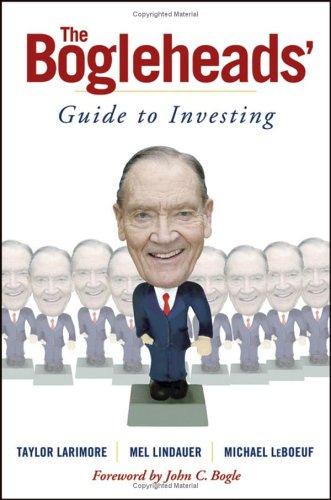
The Bogleheads' Guide to Investing is Taylor Larimore, Mel Lindauer, and Michael LeBoeuf's practical manual for implementing John Bogle's investment philosophy in a complete financial plan.
Taylor Larimore · 2006 · 4h 15m
Full summary and key takeaways →The 12 questions
- 1.
The book recommends a three-fund portfolio for nearly everyone. Does that recommendation feel too simple, or does its simplicity suggest you should actually do it?
- 2.
The authors say asset allocation is the most important decision and everything else is secondary. What is your current stock-bond allocation, and how did you arrive at it?
- 3.
The book addresses the situation where your 401(k) has only expensive options. How do you balance the tax advantage of a 401(k) against paying for high-cost funds inside it?
- 4.
The Bogleheads are a community of amateur investors who collectively have significant financial expertise. What is the value and the risk of taking financial guidance from a community rather than a professional?
- 5.
The behavioral chapter argues that staying the course through downturns is the key skill. What specific cognitive or emotional strategies help you maintain that discipline?
- 6.
The book covers insurance in unusual depth for a personal finance book. Do you have the right amount of the right kinds of insurance, and how do you evaluate that?
- 7.
The three-fund portfolio recommendation is the same for almost everyone regardless of income or wealth. Does that universality make you trust it more or less?
- 8.
The book was published in 2006. What aspects of the investment landscape have changed enough since then to require updating its specific recommendations?
- 9.
The Bogleheads forum is a community where participants share investment questions and advice. Have you ever sought financial guidance from an online community? How did you evaluate the quality of the advice?
- 10.
The estate planning chapter covers wills, beneficiary designations, and powers of attorney. Do you have these basic documents in place, and if not, what's stopped you from getting them?
- 11.
The book's philosophy is deliberately simple and low-effort once the initial setup is done. How much time do you currently spend on your investments each year, and is that the right amount?
- 12.
The authors emphasize that complexity in financial products usually benefits the seller. Have you ever bought or been sold a financial product where, in retrospect, the complexity primarily benefited the seller?
How to run the discussion
- Pick six to eight, not all of them. An hour of real discussion covers fewer questions than anyone expects, and racing the list is what makes a book club feel like homework.
- Open with what people noticed, not what they concluded. Asking for a verdict first hardens opinions before anyone has heard each other.
- Let the disagreement run. The questions below that split a room are the ones worth the time; the ones everyone answers the same way can be skipped.
- Ask the quiet person a specific question. A direct, narrow question is far easier to answer than an open invitation to contribute.
Themes worth steering toward
If the conversation stalls, these are the threads that usually restart it.
Common questions
What are good book club questions for The Bogleheads' Guide to Investing?
Here are 12 book club questions for The Bogleheads' Guide to Investing by Taylor Larimore, ordered to open easily and end somewhere worth arguing about. The strongest openers ask what each reader noticed rather than what they concluded, and the discussion usually turns on index investing, asset allocation, tax efficiency.
How long should a book club discussion of The Bogleheads' Guide to Investing last?
Most groups run 60 to 90 minutes of actual discussion. That is roughly six to eight questions, not all of them, so pick the ones that suit your group rather than working down the list in order.
What are the main themes in The Bogleheads' Guide to Investing?
Index investing, Asset allocation, Tax efficiency, Retirement planning, Investment simplicity. Those are the threads most likely to divide a room, which makes them the useful places to steer a discussion that has gone quiet.
Picking the next one? See books like The Bogleheads' Guide to Investing or questions for other book club picks.
