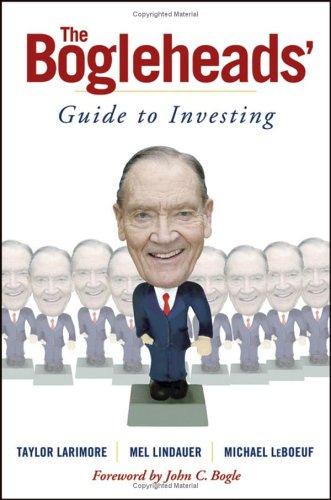
The Bogleheads' Guide to Investing by Taylor Larimore is a 2006 economics book about index investing, asset allocation, tax efficiency. The three-fund portfolio — total US stock market, total international stock market, total bond market — handles the investment need for most people with minimal complexity.
Summary
The Bogleheads' Guide to Investing is Taylor Larimore, Mel Lindauer, and Michael LeBoeuf's practical manual for implementing John Bogle's investment philosophy in a complete financial plan. The Bogleheads are the community of investors who follow Bogle's principles — low costs, broad diversification, long-term holding — and who gather on an online forum that began at Morningstar and moved to its own site. The book distills the forum's collective wisdom into a comprehensive guide covering everything from first principles to specific account types to withdrawal strategies in retirement.
The book's approach is explicitly simple and deliberately unpretentious. The authors do not claim to help readers beat the market; they claim to help readers earn the market return with minimal cost and maximum reliability. The core portfolio recommendation is a three-fund portfolio: a total US stock market index fund, a total international stock market index fund, and a total bond market index fund. The proportions depend on age, time horizon, and risk tolerance, but the structure is the same for almost everyone.
The coverage extends well beyond portfolio construction. The book addresses account types and their tax implications in detail: the difference between traditional and Roth IRAs, how to think about 401(k) allocations when the available funds are expensive, how to prioritize different account types when you have limited dollars to invest. There are chapters on insurance (both necessary and unnecessary kinds), estate planning basics, and the selection and evaluation of financial advisors for situations where one is genuinely needed.
The behavioral section is clear-eyed: the authors know their readers will face market downturns and market euphoria, and they spend considerable effort making the case for staying the course. The book ends with a chapter that assembles the key recommendations into a simple financial plan that most readers could implement over a few weekends. For investors who want a comprehensive, evidence-based, practical guide to everything they need to do rather than just the investment philosophy, this book is the most complete single reference available.
Talk to The Bogleheads' Guide to Investing like its author wrote you back.
Get the ideas that fit your life — not generic summaries.
- Chat with the book
- Audiobook-style main ideas
- Adapts to your life and goals
- Helps you take action
Key takeaways
- 1.
The three-fund portfolio — total US stock market, total international stock market, total bond market — handles the investment need for most people with minimal complexity.
- 2.
Asset allocation between stocks and bonds is the most important portfolio decision. Everything else (which funds, which brokerage) is secondary.
- 3.
Tax efficiency requires using the right account for each type of holding. Tax-inefficient assets belong in tax-advantaged accounts; tax-efficient assets can go in taxable accounts.
- 4.
Keep costs as low as possible. The expense ratio is a certain drag on returns; outperformance to cover it is uncertain. Minimize what's certain.
- 5.
Rebalancing once a year keeps the portfolio aligned with your target allocation without excessive transaction costs or taxes.
- 6.
Behavioral discipline through downturns is worth more than small portfolio improvements. Don't change your strategy when the market falls; that is when it matters most to hold.
- 7.
Employer 401(k) matching is a guaranteed 50-100% return on contributions. Always capture the full match before directing money elsewhere.
- 8.
Financial complexity often exists to generate fees. When someone shows you a complicated financial product, ask who benefits from the complexity.
Discussion questions
Use these on your own, with a book club, or as chat starters in Superbook. Book club version, ready to copy or print →
- 1.
The book recommends a three-fund portfolio for nearly everyone. Does that recommendation feel too simple, or does its simplicity suggest you should actually do it?
- 2.
The authors say asset allocation is the most important decision and everything else is secondary. What is your current stock-bond allocation, and how did you arrive at it?
- 3.
The book addresses the situation where your 401(k) has only expensive options. How do you balance the tax advantage of a 401(k) against paying for high-cost funds inside it?
- 4.
The Bogleheads are a community of amateur investors who collectively have significant financial expertise. What is the value and the risk of taking financial guidance from a community rather than a professional?
- 5.
The behavioral chapter argues that staying the course through downturns is the key skill. What specific cognitive or emotional strategies help you maintain that discipline?
- 6.
The book covers insurance in unusual depth for a personal finance book. Do you have the right amount of the right kinds of insurance, and how do you evaluate that?
- 7.
The three-fund portfolio recommendation is the same for almost everyone regardless of income or wealth. Does that universality make you trust it more or less?
- 8.
The book was published in 2006. What aspects of the investment landscape have changed enough since then to require updating its specific recommendations?
- 9.
The Bogleheads forum is a community where participants share investment questions and advice. Have you ever sought financial guidance from an online community? How did you evaluate the quality of the advice?
- 10.
The estate planning chapter covers wills, beneficiary designations, and powers of attorney. Do you have these basic documents in place, and if not, what's stopped you from getting them?
- 11.
The book's philosophy is deliberately simple and low-effort once the initial setup is done. How much time do you currently spend on your investments each year, and is that the right amount?
- 12.
The authors emphasize that complexity in financial products usually benefits the seller. Have you ever bought or been sold a financial product where, in retrospect, the complexity primarily benefited the seller?
Themes
Frequently asked questions
-
Is The Bogleheads' Guide to Investing the same as The Little Book of Common Sense Investing?
Different books, complementary. Bogle's book makes the philosophical and empirical case for index investing. The Bogleheads' Guide is a practical implementation manual — it tells you specifically how to set up accounts, which fund types to use where, how to handle your 401(k), and how to build a complete financial plan. Read Bogle for the argument; read Bogleheads for the implementation.
-
What is the three-fund portfolio?
A portfolio consisting of three low-cost index funds: a total US stock market fund, a total international stock market fund, and a total US bond market fund. The proportions between stocks and bonds depend on time horizon and risk tolerance; within stocks, a common allocation is 60-80% US and 20-40% international. The simplicity makes it easy to understand, manage, and rebalance.
-
Is the Bogleheads approach appropriate for high-income earners?
Yes. The principles — low costs, broad diversification, tax efficiency, long holding periods — apply regardless of income level. High earners have additional opportunities for tax optimization and may have access to more account types, but the core approach is the same.
-
Does the book address self-employment and small business retirement accounts?
Yes, though the coverage is less detailed than for W-2 employees with 401(k) plans. The book discusses SEP-IRAs and solo 401(k) plans as options for self-employed individuals. For complex small-business situations, the book appropriately recommends consulting a tax professional.
-
How often should I rebalance using the Bogleheads approach?
The book recommends annual rebalancing as a reasonable default, or rebalancing when the portfolio drifts significantly from target allocation (more than 5-10 percentage points). Rebalancing more frequently creates unnecessary transaction costs and taxes; less frequently can let the portfolio drift into a risk profile different from what you intended.
Similar books
The Little Book of Common Sense Investing
John C. Bogle
A Random Walk Down Wall Street
Burton G. Malkiel
The Four Pillars of Investing
William J. Bernstein
The Simple Path to Wealth
JL Collins
