Psychology · Book club
The Brain That Changes Itself book club questions
Here are 12 book club questions for The Brain That Changes Itself by Norman Doidge, ordered to open easily and end somewhere worth arguing about. Copy them, print them, or bring them up one at a time.
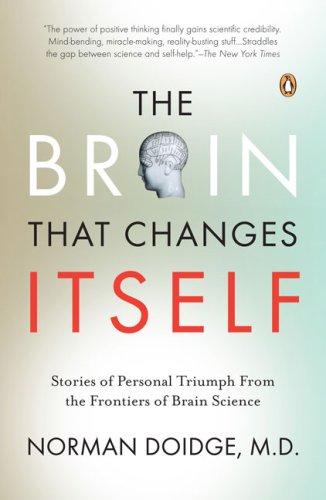
Norman Doidge is a Canadian psychiatrist who traveled to interview the scientists and patients at the frontier of neuroplasticity research in the mid-2000s.
Norman Doidge · 2007 · 5h 40m
Full summary and key takeaways →The 12 questions
- 1.
Doidge's central message is that the brain can change throughout life. Has that idea changed how you think about anything — a habit, a skill, a limitation you have accepted?
- 2.
The book describes patients who recovered function after damage that was considered permanent. What does that say about how medicine should communicate prognosis to patients?
- 3.
He discusses the dark side of plasticity — addiction, obsessive sexual behavior, PTSD. How does the same mechanism produce both recovery and entrenchment?
- 4.
Doidge writes about competitive plasticity: when the brain is deprived of input from one system, it repurposes that cortex. What does that suggest about the use-it-or-lose-it principle in cognitive development?
- 5.
Several of the patients in the book recovered by finding workarounds — using a different neural pathway than the damaged one. How does that principle apply to learning in non-medical contexts?
- 6.
The book was criticized for overstating some plasticity claims. How do you weigh that against the value of accessible science writing? Where is the line between simplification and distortion?
- 7.
Merzenich's work on cognitive training programs has been commercially applied in products like Lumosity. How skeptical are you about the translation from laboratory research to commercial applications?
- 8.
Doidge describes patients who changed their brains through mental practice alone — without physical activity. Does that surprise you? What does it suggest about the relationship between mind and body?
- 9.
What cognitive or physical capacity would you most want to develop, and what would a genuinely neuroplasticity-informed training program for that capacity look like?
- 10.
The book was published in 2007 and was enormously popular. How has the public understanding of neuroplasticity changed since then — and where do you think it has overcorrected?
- 11.
He argues that plasticity declines but does not disappear with age. How does that intersect with your own assumptions about what you can still learn or change in yourself?
- 12.
What is the most practically useful idea you took from the cases in this book?
How to run the discussion
- Pick six to eight, not all of them. An hour of real discussion covers fewer questions than anyone expects, and racing the list is what makes a book club feel like homework.
- Open with what people noticed, not what they concluded. Asking for a verdict first hardens opinions before anyone has heard each other.
- Let the disagreement run. The questions below that split a room are the ones worth the time; the ones everyone answers the same way can be skipped.
- Ask the quiet person a specific question. A direct, narrow question is far easier to answer than an open invitation to contribute.
Themes worth steering toward
If the conversation stalls, these are the threads that usually restart it.
Common questions
What are good book club questions for The Brain That Changes Itself?
Here are 12 book club questions for The Brain That Changes Itself by Norman Doidge, ordered to open easily and end somewhere worth arguing about. The strongest openers ask what each reader noticed rather than what they concluded, and the discussion usually turns on neuroplasticity, brain science, recovery.
How long should a book club discussion of The Brain That Changes Itself last?
Most groups run 60 to 90 minutes of actual discussion. That is roughly six to eight questions, not all of them, so pick the ones that suit your group rather than working down the list in order.
What are the main themes in The Brain That Changes Itself?
Neuroplasticity, Brain science, Recovery, Learning, Perception. Those are the threads most likely to divide a room, which makes them the useful places to steer a discussion that has gone quiet.
Picking the next one? See books like The Brain That Changes Itself or questions for other book club picks.
