Science · Book club
The Brain's Way of Healing book club questions
Here are 11 book club questions for The Brain's Way of Healing by Norman Doidge, ordered to open easily and end somewhere worth arguing about. Copy them, print them, or bring them up one at a time.
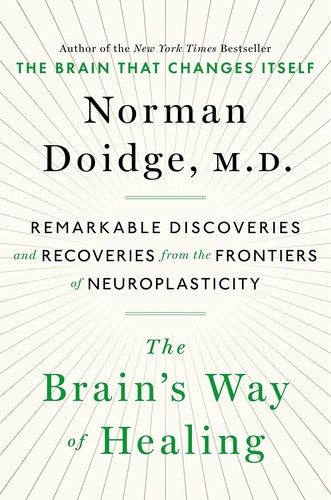
The Brain's Way of Healing is Norman Doidge's follow-up to The Brain That Changes Itself and extends its central argument: the brain retains significant capacity to reorganize itself throughout life, and this plasticity can be deliberately harnessed to treat conditions that conventional medicine has largely written off as permanent.
Norman Doidge · 2015 · 7h 45m
Full summary and key takeaways →The 11 questions
- 1.
Doidge argues that chronic pain is often a learned brain pattern rather than a structural problem. Does that framing change how you think about pain you experience, or pain in someone you care for?
- 2.
The book profiles clinicians who worked outside mainstream medicine for years. How do you decide when an outside-the-mainstream treatment is worth trying versus when it's wishful thinking?
- 3.
Doidge's case studies are all successes. What would you need to know about the failures and null results before changing your view of how broadly applicable these approaches are?
- 4.
Movement that requires novel, complex coordination appears especially effective for brain change. What activities in your own life produce that kind of challenge, and what could you add?
- 5.
The placebo effect is described as a real neurological process. Does that make it more or less acceptable to use it deliberately in clinical settings?
- 6.
The brain's use-it-or-lose-it principle means unused circuits are colonized by neighboring ones. Where in your own cognitive or physical life do you see that process operating?
- 7.
Doidge's enthusiasm for neuroplasticity is consistent across both books. Where do you think he draws the line — if anywhere — between legitimate hope and false promise for patients with serious conditions?
- 8.
The attention requirement — that exercises must be done with focused attention to produce maximum brain change — has practical implications. How do you manage attention during the physical practices in your own life?
- 9.
The book's treatment of Parkinson's disease involves movement therapy that changes symptoms without changing the underlying dopamine deficiency. What does that suggest about the relationship between brain structure and function?
- 10.
Several of the therapists profiled essentially developed their approaches through self-experimentation after personal illness. Is that a feature of the field (motivated investigators) or a warning sign (anecdote-driven research)?
- 11.
If the brain can be trained to reduce chronic pain through mental practice, what does that imply about the responsibility of patients in their own treatment — and the limits of that responsibility?
How to run the discussion
- Pick six to eight, not all of them. An hour of real discussion covers fewer questions than anyone expects, and racing the list is what makes a book club feel like homework.
- Open with what people noticed, not what they concluded. Asking for a verdict first hardens opinions before anyone has heard each other.
- Let the disagreement run. The questions below that split a room are the ones worth the time; the ones everyone answers the same way can be skipped.
- Ask the quiet person a specific question. A direct, narrow question is far easier to answer than an open invitation to contribute.
Themes worth steering toward
If the conversation stalls, these are the threads that usually restart it.
Common questions
What are good book club questions for The Brain's Way of Healing?
Here are 11 book club questions for The Brain's Way of Healing by Norman Doidge, ordered to open easily and end somewhere worth arguing about. The strongest openers ask what each reader noticed rather than what they concluded, and the discussion usually turns on neuroplasticity, healing, chronic pain.
How long should a book club discussion of The Brain's Way of Healing last?
Most groups run 60 to 90 minutes of actual discussion. That is roughly six to eight questions, not all of them, so pick the ones that suit your group rather than working down the list in order.
What are the main themes in The Brain's Way of Healing?
Neuroplasticity, Healing, Chronic pain, Recovery, Movement. Those are the threads most likely to divide a room, which makes them the useful places to steer a discussion that has gone quiet.
Picking the next one? See books like The Brain's Way of Healing or questions for other book club picks.
