Talk to The Bride Test like its author wrote you back.
Get the ideas that fit your life — not generic summaries.
- Chat with the book
- Audiobook-style main ideas
- Adapts to your life and goals
- Helps you take action
What it argues
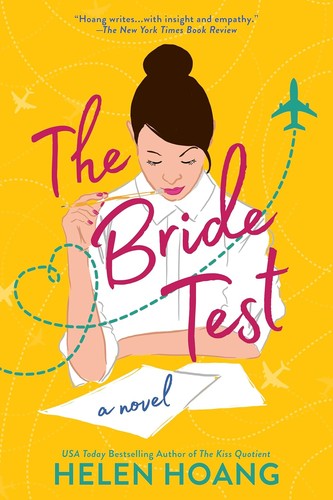
The Bride Test is the second novel in Helen Hoang's Kiss Quotient series. Khai Diep is a Vietnamese-American software engineer in San Jose who is on the autism spectrum and has convinced himself he is incapable of love. His mother, determined to find him a match, travels to Vietnam and brings back Esme Tran — an ambitious young woman from Ho Chi Minh City with an unknown father and a daughter she is desperate to provide for. Esme moves in with Khai's family for a summer to try to win his heart, with a plane ticket home as the alternative.
The book is fundamentally about whether we get to decide the shape of our own hearts. Khai's neurodivergence is not presented as a defect to be overcome but as an authentic mode of being that comes with genuine limitations around emotional recognition. Esme's story is equally substantive: her arc concerns class, immigration, and what it means to want a better life for your child without erasing who you are. The two misreadings — Khai misreading his own emotions, Esme misreading his signals — drive the tension with real pathos rather than manufactured drama.
What it gets right
- 1.
Khai's inability to recognize his own emotions is portrayed as a genuine feature of his neurodivergence, not as emotional unavailability that can simply be overcome by the right person.
- 2.
Esme's ambition is never coded as mercenary — the novel treats her desire for financial security and her capacity for love as fully compatible.
- 3.
The immigration and class dynamics give the book a social texture that most contemporary romance doesn't attempt.
What it covers
Who wrote it
Helen Hoang is an American author who was diagnosed with autism spectrum disorder as an adult, an experience that directly shaped her debut novel The Kiss Quotient (2018). The Bride Test followed in 2019. Her work is known for sensitive, authentic portrayals of autistic characters in romance and for centering Asian-American experiences. She lives in San Diego with her family and has spoken and written extensively about her own diagnosis and its influence on her writing.
