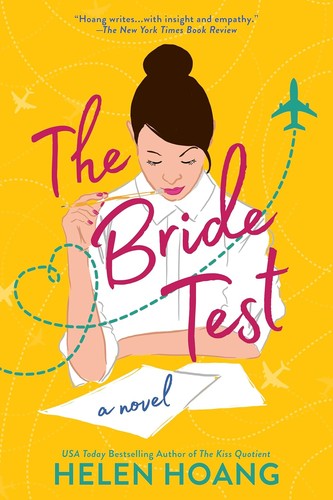
The Bride Test by Helen Hoang is a 2019 romance book about neurodiversity and connection, immigration and belonging, class and aspiration. Khai's inability to recognize his own emotions is portrayed as a genuine feature of his neurodivergence, not as emotional unavailability that can simply be overcome by the right person.
Summary
The Bride Test is the second novel in Helen Hoang's Kiss Quotient series. Khai Diep is a Vietnamese-American software engineer in San Jose who is on the autism spectrum and has convinced himself he is incapable of love. His mother, determined to find him a match, travels to Vietnam and brings back Esme Tran — an ambitious young woman from Ho Chi Minh City with an unknown father and a daughter she is desperate to provide for. Esme moves in with Khai's family for a summer to try to win his heart, with a plane ticket home as the alternative.
The book is fundamentally about whether we get to decide the shape of our own hearts. Khai's neurodivergence is not presented as a defect to be overcome but as an authentic mode of being that comes with genuine limitations around emotional recognition. Esme's story is equally substantive: her arc concerns class, immigration, and what it means to want a better life for your child without erasing who you are. The two misreadings — Khai misreading his own emotions, Esme misreading his signals — drive the tension with real pathos rather than manufactured drama.
Hoang herself is autistic and brings specificity and care to Khai's characterization that distinguishes this from novels that use neurodivergence as quirky shorthand. The representation is meaningful without being didactic. The romance earns its emotional payoffs — when Khai's feelings become legible to him, the moment lands because the book has done the work. Hoang also gives Esme's backstory genuine weight rather than instrumentalizing it as obstacle.
Readers who appreciate romance with real emotional and social stakes will find this rewarding. Those who prefer their love stories without immigration themes, class anxiety, or a protagonist who genuinely struggles to recognize love may find it heavier than expected. The first book in the series, The Kiss Quotient, is slightly lighter; this one commits more fully to its characters' complications.
Talk to The Bride Test like its author wrote you back.
Get the ideas that fit your life — not generic summaries.
- Chat with the book
- Audiobook-style main ideas
- Adapts to your life and goals
- Helps you take action
Key takeaways
- 1.
Khai's inability to recognize his own emotions is portrayed as a genuine feature of his neurodivergence, not as emotional unavailability that can simply be overcome by the right person.
- 2.
Esme's ambition is never coded as mercenary — the novel treats her desire for financial security and her capacity for love as fully compatible.
- 3.
The immigration and class dynamics give the book a social texture that most contemporary romance doesn't attempt.
- 4.
Hoang's own autistic experience lends Khai's characterization a specificity that makes him feel real rather than type-cast.
- 5.
The misreading at the center of the plot — he thinks he can't love, she reads his distance as rejection — is emotionally grounded rather than a contrivance.
- 6.
Family, in Vietnamese-American terms, is shown as both a profound support system and a source of enormous pressure.
- 7.
Love being unrecognized by the person feeling it is one of the oldest literary devices; the book updates it with neurodivergent authenticity.
- 8.
The happy ending feels earned because both characters have genuinely changed in understanding themselves, not just in their feelings toward each other.
Discussion questions
Use these on your own, with a book club, or as chat starters in Superbook. Book club version, ready to copy or print →
- 1.
Khai believes he is incapable of love. The novel eventually proves him wrong — but does it do so in a way that respects the real experience of people who struggle with emotional recognition, or does it veer toward the 'love fixes everything' trope?
- 2.
Esme agrees to an arranged situation for a summer in hopes of securing a better life. Is that pragmatic, desperate, or both? How does the novel frame her choice?
- 3.
Khai's mother arranges this whole scheme without fully consulting him. Is she presented sympathetically? Should she be?
- 4.
How does Esme's class background shape the way she reads Khai and her situation? What assumptions does she make that come directly from her circumstances?
- 5.
The novel suggests that Khai genuinely doesn't recognize his own emotions because of how his brain works. How do you distinguish between emotional unavailability and a neurological difference? Does the book draw that line well?
- 6.
Esme has a daughter she is trying to build a life for. At what point does her story stop being about the romance and become something broader?
- 7.
Compared to The Kiss Quotient — if you've read it — how does this book handle neurodivergent romance differently? Is the emotional register the same?
- 8.
The Vietnamese-American family dynamics are central. Did they feel authentic to you, or did they feel like backdrop?
- 9.
Is the 'mismatch in perceived feelings' plot device used thoughtfully here, or does it still feel like manufactured conflict?
- 10.
What does the title mean by the end? Is it ironic, sincere, or complicated?
- 11.
Who in the novel changes more: Khai or Esme? Is it an equal transformation?
- 12.
Which scene in the book did the most emotional work for you, and why?
Themes
Frequently asked questions
-
Do I need to read The Kiss Quotient first?
No. The Bride Test works as a standalone. Characters from The Kiss Quotient appear but their backstory is not required. That said, reading in order adds emotional context to Khai's family and community.
-
What is The Bride Test about without spoilers?
A Vietnamese-American man who believes he cannot love is surprised by his mother with a woman from Vietnam she has brought over as a potential match. The woman, trying to build a better life for herself and her daughter, spends a summer trying to reach him.
-
Is the autism representation good?
Widely considered yes. The author is autistic and draws on her own experience. Khai is not a stereotype or a quirky-genius shorthand — his experience is treated with specificity, including the genuine difficulty of emotional recognition.
-
Why was this book a bestseller?
It offered something unusual: a romance where the barrier isn't drama or misunderstanding but a genuine, compassionate portrayal of how a neurodivergent person navigates emotion. Readers who had never seen that in romance found it resonant.
-
Who shouldn't read this book?
Readers who prefer romance with lighter emotional stakes or fast-moving plots may find the first half slow. The immigration and class dynamics add weight that not all romance readers are looking for.