Talk to The Bride Test like its author wrote you back.
Get the ideas that fit your life — not generic summaries.
- Chat with the book
- Audiobook-style main ideas
- Adapts to your life and goals
- Helps you take action
The Bride Test, in detail
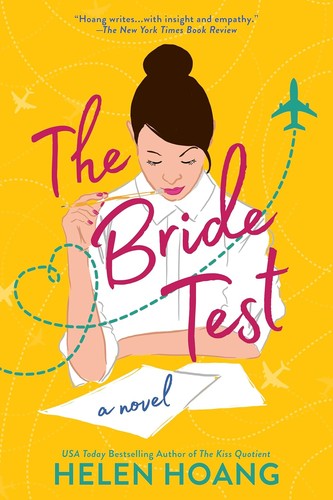
The Bride Test is the second novel in Helen Hoang's Kiss Quotient series. Khai Diep is a Vietnamese-American software engineer in San Jose who is on the autism spectrum and has convinced himself he is incapable of love. His mother, determined to find him a match, travels to Vietnam and brings back Esme Tran — an ambitious young woman from Ho Chi Minh City with an unknown father and a daughter she is desperate to provide for. Esme moves in with Khai's family for a summer to try to win his heart, with a plane ticket home as the alternative.
The book is fundamentally about whether we get to decide the shape of our own hearts. Khai's neurodivergence is not presented as a defect to be overcome but as an authentic mode of being that comes with genuine limitations around emotional recognition. Esme's story is equally substantive: her arc concerns class, immigration, and what it means to want a better life for your child without erasing who you are. The two misreadings — Khai misreading his own emotions, Esme misreading his signals — drive the tension with real pathos rather than manufactured drama.
Hoang herself is autistic and brings specificity and care to Khai's characterization that distinguishes this from novels that use neurodivergence as quirky shorthand. The representation is meaningful without being didactic. The romance earns its emotional payoffs — when Khai's feelings become legible to him, the moment lands because the book has done the work. Hoang also gives Esme's backstory genuine weight rather than instrumentalizing it as obstacle.
Readers who appreciate romance with real emotional and social stakes will find this rewarding. Those who prefer their love stories without immigration themes, class anxiety, or a protagonist who genuinely struggles to recognize love may find it heavier than expected. The first book in the series, The Kiss Quotient, is slightly lighter; this one commits more fully to its characters' complications.
The big ideas
- 1.
Khai's inability to recognize his own emotions is portrayed as a genuine feature of his neurodivergence, not as emotional unavailability that can simply be overcome by the right person.
- 2.
Esme's ambition is never coded as mercenary — the novel treats her desire for financial security and her capacity for love as fully compatible.
- 3.
The immigration and class dynamics give the book a social texture that most contemporary romance doesn't attempt.
