Health · Book club
The Cancer Code book club questions
Here are 12 book club questions for The Cancer Code by Jason Fung, ordered to open easily and end somewhere worth arguing about. Copy them, print them, or bring them up one at a time.
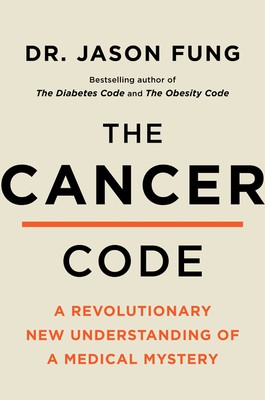
The Cancer Code is Jason Fung's case that oncology's dominant paradigm — cancer as a genetic disease driven by somatic mutations — is incomplete and has contributed to fifty years of largely stagnant survival rates for most cancers.
Jason Fung · 2020 · 5h 20m
Full summary and key takeaways →The 12 questions
- 1.
Fung argues that oncology has been working within an incomplete paradigm for fifty years. Does the history of how paradigms shape medical research concern you, or do you find it reassuring that the field eventually corrects itself?
- 2.
The Warburg effect — cancer cells preferring glycolysis even with oxygen available — was discovered in the 1920s. Why do you think it was largely set aside for decades before the metabolic view revived it?
- 3.
Fung makes a strong case that high insulin levels create conditions favorable for cancer growth. How does that change how you think about the long-term consequences of the standard Western diet?
- 4.
The book argues that fasting may both protect healthy cells during chemotherapy and sensitize cancer cells. If you or someone you knew were receiving chemotherapy, would you try therapeutic fasting alongside it?
- 5.
Fung is a nephrologist, not an oncologist. Does that strengthen or weaken your trust in his analysis of cancer biology and treatment?
- 6.
The book distinguishes between prevention, where the metabolic case is strongest, and treatment, where the evidence is earlier-stage. How does that distinction affect how you act on the book's recommendations?
- 7.
Drug resistance in cancer follows evolutionary dynamics: selection pressure from treatment kills susceptible cells and leaves resistant ones. What does this imply about the standard approach of treating to maximum tolerated dose?
- 8.
Fung reviews evidence suggesting that fasting before chemotherapy may improve outcomes. Why do you think clinical oncology has been slow to study this rigorously?
- 9.
The book uses the evolution analogy — cancer as a regression to a more primitive, unicellular mode — to explain its behavior. Does that framing make cancer feel more or less tractable?
- 10.
If cancer prevention is substantially achievable through metabolic health, what are the structural and economic barriers to making that the primary focus of cancer medicine?
- 11.
How does Fung's skepticism about the pharmaceutical industry's influence on oncology research feel to you — well-founded, overstated, or both?
- 12.
What one change in how you eat or live would you make based on the metabolic theory of cancer, regardless of whether you fully accept Fung's argument?
How to run the discussion
- Pick six to eight, not all of them. An hour of real discussion covers fewer questions than anyone expects, and racing the list is what makes a book club feel like homework.
- Open with what people noticed, not what they concluded. Asking for a verdict first hardens opinions before anyone has heard each other.
- Let the disagreement run. The questions below that split a room are the ones worth the time; the ones everyone answers the same way can be skipped.
- Ask the quiet person a specific question. A direct, narrow question is far easier to answer than an open invitation to contribute.
Themes worth steering toward
If the conversation stalls, these are the threads that usually restart it.
Common questions
What are good book club questions for The Cancer Code?
Here are 12 book club questions for The Cancer Code by Jason Fung, ordered to open easily and end somewhere worth arguing about. The strongest openers ask what each reader noticed rather than what they concluded, and the discussion usually turns on cancer biology, metabolic health, insulin resistance.
How long should a book club discussion of The Cancer Code last?
Most groups run 60 to 90 minutes of actual discussion. That is roughly six to eight questions, not all of them, so pick the ones that suit your group rather than working down the list in order.
What are the main themes in The Cancer Code?
Cancer biology, Metabolic health, Insulin resistance, Fasting, Oncology. Those are the threads most likely to divide a room, which makes them the useful places to steer a discussion that has gone quiet.
Picking the next one? See books like The Cancer Code or questions for other book club picks.
