Health · Book club
The Checklist Manifesto book club questions
Here are 12 book club questions for The Checklist Manifesto by Atul Gawande, ordered to open easily and end somewhere worth arguing about. Copy them, print them, or bring them up one at a time.
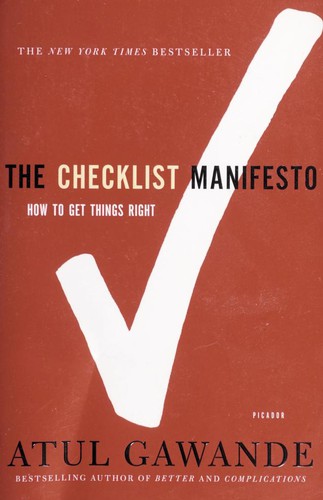
The Checklist Manifesto is Atul Gawande's argument that the single most underused tool for preventing catastrophic failure in complex fields is also the simplest: a well-designed checklist.
Atul Gawande · 2009 · 4h 0m
Full summary and key takeaways →The 12 questions
- 1.
Gawande distinguishes between errors of ignorance and errors of ineptitude. Which type do you encounter more often in your own work, and what conditions tend to trigger them?
- 2.
He argues that professional pride is one of the main barriers to adopting checklists. Where in your field do you see that resistance, and what does it look like in practice?
- 3.
Think of a task in your life — professional or personal — that has become complex enough to benefit from a checklist. What would be on it?
- 4.
The book stresses that checklists should be short. What's the hardest part of deciding what to leave off?
- 5.
Gawande describes checklists that force team members to speak to each other rather than just check boxes individually. What problems in your work could be addressed by requiring that kind of forced communication?
- 6.
The aviation industry's safety improvements came from treating pilot error as a systems problem rather than an individual failing. Does your field do the same, or does it default to blaming individuals?
- 7.
The WHO checklist improved outcomes even in hospitals where staff were initially skeptical or resistant. What does that suggest about how to implement new protocols in organizations where buy-in is low?
- 8.
Gawande draws a distinction between simple, complicated, and complex problems. How does that framework apply to the biggest challenges in your work?
- 9.
The venture capitalists in the book kept quiet checklists to override their own enthusiasm. What biases in your own decision-making might a personal checklist help guard against?
- 10.
The book was published in 2009. In what ways has the argument aged well, and where do you think the limits of the checklist idea have become clearer since then?
- 11.
Gawande is a surgeon writing partly about his own profession's failures. Does it change how you receive the argument that the critique comes from inside the field rather than outside it?
- 12.
What would it take for checklists to be genuinely adopted in a domain you know — not just mandated on paper but actually followed under pressure?
How to run the discussion
- Pick six to eight, not all of them. An hour of real discussion covers fewer questions than anyone expects, and racing the list is what makes a book club feel like homework.
- Open with what people noticed, not what they concluded. Asking for a verdict first hardens opinions before anyone has heard each other.
- Let the disagreement run. The questions below that split a room are the ones worth the time; the ones everyone answers the same way can be skipped.
- Ask the quiet person a specific question. A direct, narrow question is far easier to answer than an open invitation to contribute.
Themes worth steering toward
If the conversation stalls, these are the threads that usually restart it.
Common questions
What are good book club questions for The Checklist Manifesto?
Here are 12 book club questions for The Checklist Manifesto by Atul Gawande, ordered to open easily and end somewhere worth arguing about. The strongest openers ask what each reader noticed rather than what they concluded, and the discussion usually turns on checklists, complexity, decision-making.
How long should a book club discussion of The Checklist Manifesto last?
Most groups run 60 to 90 minutes of actual discussion. That is roughly six to eight questions, not all of them, so pick the ones that suit your group rather than working down the list in order.
What are the main themes in The Checklist Manifesto?
Checklists, Complexity, Decision-making, Medicine, Human error, Systems. Those are the threads most likely to divide a room, which makes them the useful places to steer a discussion that has gone quiet.
Picking the next one? See books like The Checklist Manifesto or questions for other book club picks.
