Memoir · Book club
The Choice book club questions
Here are 12 book club questions for The Choice by Edith Eva Eger, ordered to open easily and end somewhere worth arguing about. Copy them, print them, or bring them up one at a time.
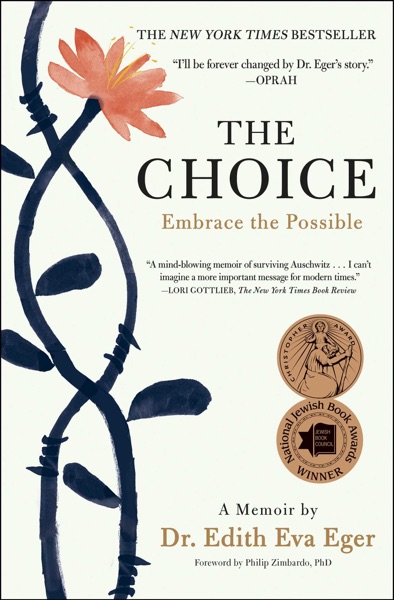
Edith Eva Eger was sixteen years old when she arrived at Auschwitz-Birkenau in May 1944.
Edith Eva Eger · 2017 · 6h 45m
Full summary and key takeaways →The 12 questions
- 1.
Eger describes maintaining an inner life — dancing mentally for Mengele — as her primary survival strategy. What does that suggest about the relationship between imagination and resilience?
- 2.
Eger spent decades after the war not talking about her experience. What does that silence cost, and under what conditions does it become protective rather than harmful?
- 3.
The title refers to a choice that Eger argues everyone faces: to live as a victim or as a survivor. Is that framing fair to people whose circumstances prevent easy recovery?
- 4.
Eger distinguishes between self-blame and responsibility — between punishing yourself for what happened and taking ownership of your response to it. Where is that line, and how does she help patients find it?
- 5.
Victor Frankl is a major presence in the book. How does Eger's account of finding meaning in suffering compare to Frankl's account? Do they diverge in any important ways?
- 6.
Eger returned to Auschwitz thirty-six years after liberation. What made that return possible when it hadn't been before? What does her account suggest about the timing of confronting difficult history?
- 7.
The book argues that resentment imprisons the person who holds it more than the person it is directed at. Can you think of an example from your own life where that was true?
- 8.
Eger's clinical work uses her own survival story as part of therapy. What are the benefits and risks of a therapist's self-disclosure in a clinical relationship?
- 9.
Eger describes the ordinary imprisonments of ordinary life — perfectionism, people-pleasing, the need for approval — as variations on the same psychological prison. Does that comparison feel illuminating or does it risk trivializing extreme suffering?
- 10.
The third section of the book, covering her clinical work, shifts from memoir to applied psychology. Did that transition work for you as a reader? What did it add to the memoir?
- 11.
Eger says she didn't fully heal until her return to Auschwitz. But she had been a practicing psychotherapist for years before that visit. What does that suggest about the relationship between helping others and healing oneself?
- 12.
The last thing Mengele said to her on arrival at Auschwitz was that she would be free by the end of the day — a reference to the chimney. How does Eger's later philosophy of inner freedom engage with, and transform, that moment?
How to run the discussion
- Pick six to eight, not all of them. An hour of real discussion covers fewer questions than anyone expects, and racing the list is what makes a book club feel like homework.
- Open with what people noticed, not what they concluded. Asking for a verdict first hardens opinions before anyone has heard each other.
- Let the disagreement run. The questions below that split a room are the ones worth the time; the ones everyone answers the same way can be skipped.
- Ask the quiet person a specific question. A direct, narrow question is far easier to answer than an open invitation to contribute.
Themes worth steering toward
If the conversation stalls, these are the threads that usually restart it.
Common questions
What are good book club questions for The Choice?
Here are 12 book club questions for The Choice by Edith Eva Eger, ordered to open easily and end somewhere worth arguing about. The strongest openers ask what each reader noticed rather than what they concluded, and the discussion usually turns on holocaust survival, trauma and healing, freedom.
How long should a book club discussion of The Choice last?
Most groups run 60 to 90 minutes of actual discussion. That is roughly six to eight questions, not all of them, so pick the ones that suit your group rather than working down the list in order.
What are the main themes in The Choice?
Holocaust survival, Trauma and healing, Freedom, Choice, Psychology. Those are the threads most likely to divide a room, which makes them the useful places to steer a discussion that has gone quiet.
Picking the next one? See books like The Choice or questions for other book club picks.
